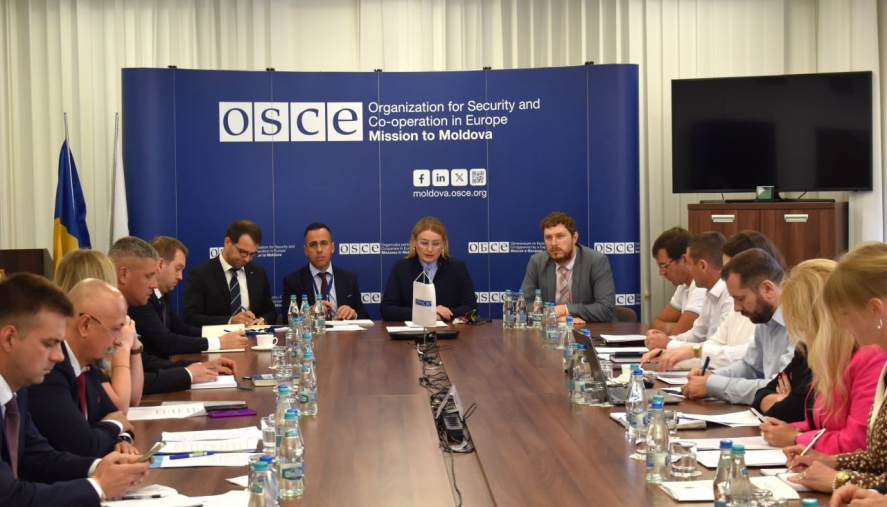
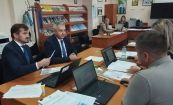
The second meeting of the Economic Working Groups this year, with the participation of sector-specific experts from both banks of the Dniester, was held yesterday at the OSCE Mission’s office in Chișinău, TRIBUNA reports.
During the meeting, experts from the Ministry of Economic Development and Digitalization, Ministry of Finance, Ministry of Environment, State Tax Service, Customs Service, Environment Agency, Environmental Protection Inspectorate, and National Food Safety Agency discussed the uniform application throughout the country of customs, tax, environmental, and food safety legislation aligned with European standards. The discussions took place in the context of efforts aimed at gradually integrating the Transnistrian region into the national economic, customs, fiscal, and legal space.
Chișinău representatives also briefed their Tiraspol counterparts on developments in the dialogue between the Republic of Moldova and the European Union regarding the application of EU import quotas to steel products originating from the Republic of Moldova. The participants also discussed practical aspects of applying value-added tax (VAT) and excise duties, continuing discussions held at the sectoral economic working group meeting on May 5 of this year.
A separate topic concerned the implementation of provisions contained in the draft government decision on applying VAT and excise duties to goods brought into the territory of the Republic of Moldova by economic operators based in the Transnistrian region. The draft is intended to ensure implementation of Law No. 1417/1997 on the application of Title III of the Tax Code, Law No. 1054/2000 on the application of Title IV of the Tax Code, and Law No. 67/2026 establishing the Convergence Fund and amending certain legislative acts concerning VAT and excise duties.
In this context, representatives of the Ministry of Finance explained the provisions of the draft legislation and their impact on citizens and businesses in the region. They stressed that the proposed measures are intended to strengthen tax equity, eliminate competitive distortions, and increase budget revenues. At the same time, it was emphasized that the financial resources collected would be used through the Convergence Fund to modernize infrastructure and develop projects and programmes supporting businesses and citizens in the Transnistrian region. The fund will be financed from domestic sources, external contributions, and taxes paid by economic operators from the left bank of the Dniester and the municipality of Bender.
During the dialogue, Chișinău experts emphasized that a gradual approach would allow businesses to adapt, mitigate the immediate financial impact on prices, and prevent potential disruptions to trade. For this purpose, priority would be given to categories of goods with a limited social impact on final consumers, allowing the measure to be implemented without causing major fluctuations in prices for everyday consumer goods.
It was also noted that, as part of the process of fiscal harmonization, categories of goods with a greater social impact would subsequently be assessed, including consumer goods and products essential to the population and economic activity. This phased approach is intended to achieve fiscal policy objectives in a balanced manner while simultaneously increasing tax compliance and maintaining economic and social stability.
During the meeting, experts from the Ministry of Environment presented Tiraspol representatives with the legal requirements for obtaining an integrated environmental permit and an environmental permit for economic operators in the Transnistrian region, as provided for by Law No. 227/2022 on industrial emissions. They stressed that all economic operators registered with the Public Services Agency are required to comply with national legislation.
Regarding inspections carried out on economic operators in the region, representatives of the National Food Safety Agency informed their Tiraspol counterparts about the relevant national legislation, emphasizing the need for regional authorities to ensure, without exception, the free movement of the agency’s employees and to remove all artificial and unlawful barriers.
The meeting also addressed issues related to the collection of customs duties associated with commercial activities, the export of strategic goods by enterprises in the region, and the restoration of traffic on the Dniester bridge connecting the localities of Bâcioc and Gura Bâcului.
The discussions took place in a constructive atmosphere, with participants expressing their willingness to continue the dialogue in order to resolve existing economic issues for the benefit of residents on both banks of the Dniester.
 Loading ...