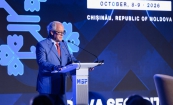
Around 200 mayors from all regions of the Republic of Moldova participated in the extended meeting of the Management Council of the Congress of Local Authorities of Moldova (CALM), together with experts in local public administration, representatives of the academic sector, and the State Chancellery. The event took place in the context of the ongoing reform of local public administration and the numerous concerns expressed by mayors regarding the stages and concept of this reform.
At the end of the meeting, with a majority of votes and only one abstention, CALM adopted a Declaration on the reform of local public administration. The document will be sent to the country’s leadership and calls for:
- stopping the rush and adopting a phased approach to the reform;
- ending political, administrative, financial, or economic pressure on mayors;
- resuming dialogue on a partnership basis, with real and mandatory consultations;
- jointly developing a clear reform concept;
- ensuring fiscal decentralization and adequate resources for local public administration, TRIBUNA reports.
CALM leadership: The reform must be consensual and adapted to local realities
“The process must be clear, phased, and built on consensus, not on dividing society. The reform must respect the identity of administrative-territorial units, be accompanied by mandatory public consultations, and offer flexible solutions adapted to local diversity. We want a reform model that brings benefits to people and strengthens local democracy,” emphasized CALM President Tatiana Badan.
CALM Executive Director Viorel Furdui reiterated the association’s support for a transparent, phased, and participatory reform, with a focus on reforming the districts (raioane) and strengthening towns as economic growth poles, so that local democracy is consolidated and the reform brings direct benefits to citizens. He presented the reform model developed by CALM with the support of the Council of Europe and agreed upon by local elected officials.
Academic perspective: A functional, integrated administrative reform model
During the extended meeting, Sergiu Palihovici, Director of the School of Public Administration at the State University of Moldova, presented the Functional Integrated Administrative Reform Model (RAFI). He stressed that the reform must be transparent, informative, and participatory, involving authorities, experts, and civil society.
“What I am presenting today is not necessarily my personal view, but rather a choice between what we ideally should do and what we can afford to do. We cannot carry out a general territorial-administrative reorganization today, which is why we propose an individualized approach for each case. We must also think about what to do with the districts,” Palihovici said.
Mayors highlight gaps, inconsistencies, and risks
-
- Victor Gori, mayor of Botnărești and CALM vice president, addressed the issue raised by reform initiators regarding the minimum population required for an administrative-territorial unit:
“Should we understand that 1,500 people are considered citizens, but 1,499 are not and no longer have the same rights?” - Marcel Bobeica, mayor of Gangura and CALM vice president, stated that voluntary amalgamation must remain a continuous process, including after 2027.
- Alexandr Petcov, mayor of Bălți and CALM vice president, argued that the Government has not yet managed to build the necessary consensus for such an important reform:
“Consultations presented publicly as extensive dialogue with local authorities have, in reality, become a formality.” - Valeriu Scutelnic, mayor of Bîrnova and president of the Ocnița mayors’ association, pointed out several legislative gaps affecting voluntary amalgamation:
“What do we do if three localities want to amalgamate but have only 2,700 inhabitants, not 3,000 as required by law? Where do we find the extra 300 citizens?”
He also noted that the ‘Restart’ reform and changes concerning deconcentrated services and civil status offices contain many inconsistencies. - Alina Pascaru, mayor of Bănești, Telenești, stressed that reform is necessary, but clarity is needed regarding what will follow.
- Ion Bîzu, mayor of Cîrpești and CALM vice president, suggested that Moldova has too many MPs and too many districts, not too many municipalities.
- Nina Cereteu, mayor of Drochia and CALM vice president, argued that voluntary amalgamation must be part of an integrated concept. She warned that the Government currently supports amalgamation only temporarily through incentives:
“What will happen to these localities in the future? Where will they get their own revenue sources? We do not have real decentralization to help municipalities develop, whether amalgamated or not.” - Arcadie Covaliov, mayor of Sîngerei, emphasized that the Government’s reform concept must emerge from consultations and be based on proposals from local elected officials:
“Sîngerei is open to voluntary amalgamation, and from the Government we must demand financial decentralization, so that we strengthen municipalities with 500 or 2,000 inhabitants alike.” - Daniel Țonu, mayor of Zâmbreni, Ialoveni, explained that during consultations with local elected officials in Ialoveni, 23 out of 25 mayors supported voluntary amalgamation, not normative (mandatory) amalgamation.
- Victor Gori, mayor of Botnărești and CALM vice president, addressed the issue raised by reform initiators regarding the minimum population required for an administrative-territorial unit:
 Loading ...