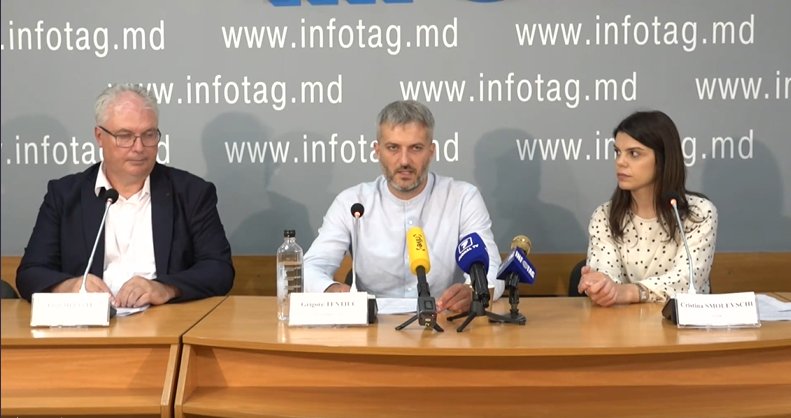
The consortium formed by Turboenergy Power (Republic of Moldova) and MASS (Türkiye) announced, during a press conference, serious concerns regarding the contract award procedure for the design and construction of the wastewater treatment plant and sewerage infrastructure in the municipality of Soroca.
Program Manager and Engineer Grigore Tentiuc stated that the consortium participated in the tender with what it considers a realistic, verifiable offer based on technical parameters that can be achieved in practice.
“After the results were communicated, we noticed a very large gap between the technical score awarded to the winning bidder and the scores given to the other participants. The bidder declared the winner received 98.99 points out of 100 for the technical component, while our consortium, ranked second, received 33.15 points,” Tentiuc said.
Emil Melinte, engineer and wastewater treatment technology consultant, emphasized that the discrepancy raises questions, given that all participants prepared their bids based on the same tender specifications, for the same project and under the same conditions.
“The main issue is not only the difference in scores. According to our technical calculations, some of the energy consumption values declared by the winning bidder and accepted by the Evaluation Commission appear impossible to achieve under real operating conditions. In this tender, the technical score was calculated based on declared energy consumption: the lower the declared consumption, the higher the score.
The winning bidder obtained almost the maximum score, largely due to very low energy consumption figures included in its proposal. According to our calculations, some of these values cannot be achieved in the actual operation of a wastewater treatment plant. We are asking for verification as to whether the score was awarded for real technical performance or for figures that look good on paper but cannot be confirmed in practice,” Melinte stated.
Attorney Cristina Smolevschi noted that the selected winning offer is more than €700,000 — equivalent to approximately 14 million lei — more expensive.
“This difference amounts to approximately 14 million lei. Given that the project is financed through an external loan that will ultimately be repaid by the state, this additional cost must be justified by real advantages, not by parameters that cannot be verified or confirmed in practice,” she said.
The consortium stated that it identified the issues before the contract was awarded.
“On April 30, 2026, we officially notified the Evaluation Commission and ONDRL, requesting verification of the technical feasibility of the declared values. However, in its response of May 21, 2026, ONDRL refused to conduct a genuine technical assessment and relied on the binding nature of the bidder’s declaration.
With all due respect to the institutions involved, we believe that for a project of such importance it is not enough to say: ‘the bidder declared it, therefore we accept it.’ When public funds, external financing, environmental protection and public health are at stake, the decisive data must be verified,” Smolevschi added.
Another issue raised by the consortium concerns the integrity of the procurement procedure.
“Among the materials we examined, there is information indicating that an entity previously operating under names that included ALKE INSAAT was mentioned in the World Bank Group Sanctions System Annual Report 2019 and was sanctioned for fraudulent practices. We are not claiming today that this information automatically proves any violation in the current procedure. Nor are we asserting that there is certainly a legal or economic identity between that entity and the bidder selected as the winner.
However, we do maintain that such information should have been treated as a serious risk indicator and should have prompted the Evaluation Commission to exercise heightened scrutiny, including examining possible links, affiliations, corporate continuities, beneficial ownership structures or other relevant circumstances.
When a project is financed by the World Bank and information regarding a previous sanction within the World Bank system appears in connection with a similar or historically associated name, the contracting authority should be twice as vigilant. Unfortunately, we have not seen such vigilance,” Smolevschi stated.
Based on these concerns, the consortium has submitted notifications to the Parliament of the Republic of Moldova, the relevant parliamentary committees, the Government of the Republic of Moldova, the Court of Accounts, the Supreme Security Council and the Anti-Corruption Prosecutor’s Office.
“According to the information available to us, the only institutional response we have received so far has come from the President of the Republic of Moldova, who chairs the Supreme Security Council. We welcome this reaction and consider it confirmation of the public importance of the matter. We have also received a response from the Ministry of Finance.
At the same time, we are concerned by the lack of a clear and prompt response from other authorities. This project cannot be treated with indifference. Any delay may make it more difficult to prevent financial, technical and reputational consequences,” Smolevschi said.
The consortium is therefore calling for the establishment of an independent panel of experts to examine:
– the feasibility of the declared technical parameters;
– the manner in which energy consumption figures influenced the final scoring;
– the justification for accepting a more expensive bid;
– risks to the public budget;
– risks to the operation of the future treatment plant;
– compliance with standards of integrity, transparency and fair competition.

 Loading ...