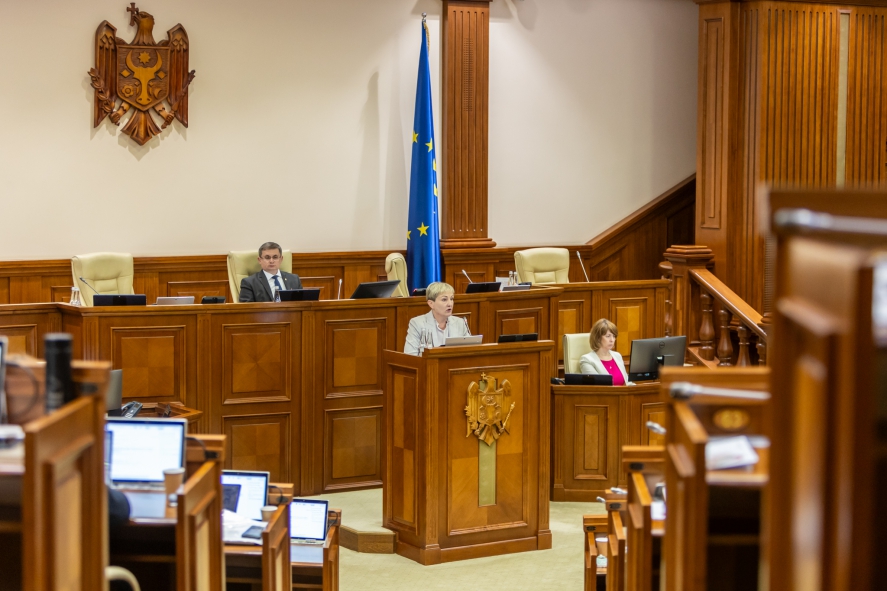
PSRM MP Adela Răileanu spoke in Parliament during the debates on the draft of the new Media Law, emphasizing on the one hand the need to update legislation to reflect current realities in the media sector, and on the other hand warning about the risks of expanding administrative and political pressure on the press.
She noted that the need for a new media law is evident: “The media landscape has changed radically in recent years: digital platforms, online publications, and new methods of distributing information have emerged. Legislation must keep pace with these transformations.”
According to Răileanu, the draft contains important and correct principles — media pluralism, editorial independence, and journalists’ professional rights. However, she stressed that the problem lies not in the declared goals, but in the mechanisms of implementation:
“A media law must guarantee the freedom of journalism, not create premises for expanding administrative control.”
A key concern for her is the provision establishing a Register of Media Service Providers, administered by the Ministry of Culture. She argued that although registration is formally voluntary, in practice access to subsidies and public funding will depend on this mechanism. “In reality, a ministry led by a politically appointed person will decide who is ‘convenient’ and deserves support, and who does not,” she said, stressing the need for maximum caution toward any mechanism that could enable political influence over the media.
She also warned about the risk of creating a double system of administrative oversight for TV and radio broadcasters — from both the Audiovisual Council and the Ministry of Culture — which, in her view, would create additional centers of influence over media institutions.
Răileanu criticized the role assigned in the draft to the Press Council, presented as a self‑regulatory body. She argued that genuine self‑regulation is possible only when the entire journalistic community is broadly represented, not just a narrow group of organizations.
She also drew attention to the draft’s references to “manifestly illegal content” and violations of legally protected rights. The lack of clear definitions, she said, creates a risk of arbitrary interpretation: “Experience from recent years shows that the same notions can be interpreted differently depending on the political context. This leads to self‑censorship — the most dangerous form of restricting freedom of expression.”
Răileanu further highlighted concerns about the regulation of online media and liability for user comments, noting that unclear rules may push newsrooms to remove content pre‑emptively out of fear of sanctions.
In conclusion, she stressed that a strong press is not one that supports those in power, but one that is free to criticize it. She expressed confidence that a freer and more independent press would contribute to more effective public decision‑making: “A free press does not hinder a country’s development. On the contrary, it helps prevent the repetition of past mistakes.”


 Loading ...