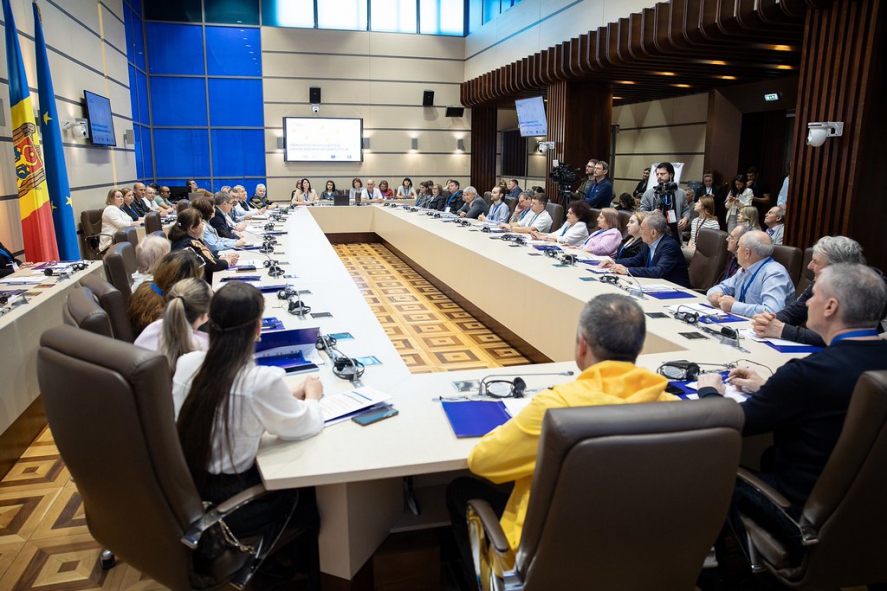
The Citizens’ Assembly on local public administration (LPA) reform concluded on Sunday, 31 May, at the Parliament of the Republic of Moldova. Over two weekends — 16–17 May and 30–31 May — 50 randomly selected citizens from different regions of the country took part in a democratic deliberation exercise dedicated to the LPA reform, TRIBUNA reports.
Participants examined the impact of the reform on communities, held discussions with experts and government representatives, and formulated recommendations to be submitted to the Parliament of the Republic of Moldova.
During the secret voting session, the Assembly approved 15 recommendations, each receiving over 75% support.
The recommendations adopted by the participants are:
- Support for localities unable to amalgamate voluntarily, ensuring they are not financially disadvantaged in the event of a normative amalgamation.
- Introduction of fair mechanisms for distributing resources among amalgamated localities and temporary support so that smaller villages are not left without investments and services.
- Support for small localities wishing to amalgamate but rejected by larger ones, through targeted development programs.
- State‑funded rehabilitation and construction of roads and infrastructure between amalgamated localities to prevent community isolation.
- Harmonization of legislation on Local Action Groups (LAGs) in the context of LPA reform.
- Accessible information campaigns adapted to different age groups and social categories, including online platforms and regional public meetings.
- Informing citizens about the LPA reform in the languages spoken by ethnic minorities in Moldova.
- Ensuring fair representation of small localities in new administrative structures and local councils by creating the role of locality representative and adjusting electoral legislation to guarantee proportional representation.
- Guaranteeing open access to information on local council activities, including live broadcasts of council meetings and outreach sessions in communities.
- Protecting localities with ethnic minorities and safeguarding their rights within the LPA reform, including exceptions to minimum population thresholds.
- Protecting local cultural infrastructure — cultural centers, libraries, museums — in amalgamated localities.
- Reemployment and retraining of municipal staff who risk losing their jobs as a result of the reform.
- Creating a differentiated taxation mechanism for amalgamated localities to prevent sudden tax increases in small villages.
- Redirecting personal income tax to the taxpayer’s locality of residence to support local economic development.
- Expanding services provided through Unified Public Service Centers (CUPS), including mobile services for rural areas.
The recommendations were handed over to Ana Calinici, Vice‑Chair of the Parliamentary Committee on European Integration, as the representative of the Parliament of the Republic of Moldova.
Ana Calinici emphasized that the Assembly was not organized to formally validate pre‑made decisions: “Its purpose was to create an open, safe and pluralistic space. The recommendations presented today belong to the citizens. One of the most valuable aspects of this process is that people with different opinions sat at the same table, listened to each other, and worked to formulate common proposals.”
Natalia Hadei, Senior Advisor at the European Partnership for Democracy (EPD), highlighted the unusually high level of engagement: “In many public consultations, participation drops from one stage to another. Here, we had a 100% participation rate in both weekends. This shows that people want to be involved when they feel their opinions matter and that they are part of a genuine deliberative process.”
Andrei Lutenco, Executive Director of the Center for Policies and Reforms (CPR), underlined the deliberative nature of the Assembly: “Decisions here are taken by secret ballot and with a qualified majority so that the final recommendations reflect as accurately as possible the views and concerns of citizens across the country.”
The Citizens’ Assembly is a democratic participation exercise hosted by the Parliament of the Republic of Moldova and organized by the European Partnership for Democracy (EPD) and the Center for Policies and Reforms (CPR), with financial support from the European Union through the INSPIRĂ Moldova project and from the Government of Sweden through the SPACE Initiative.


 Loading ...