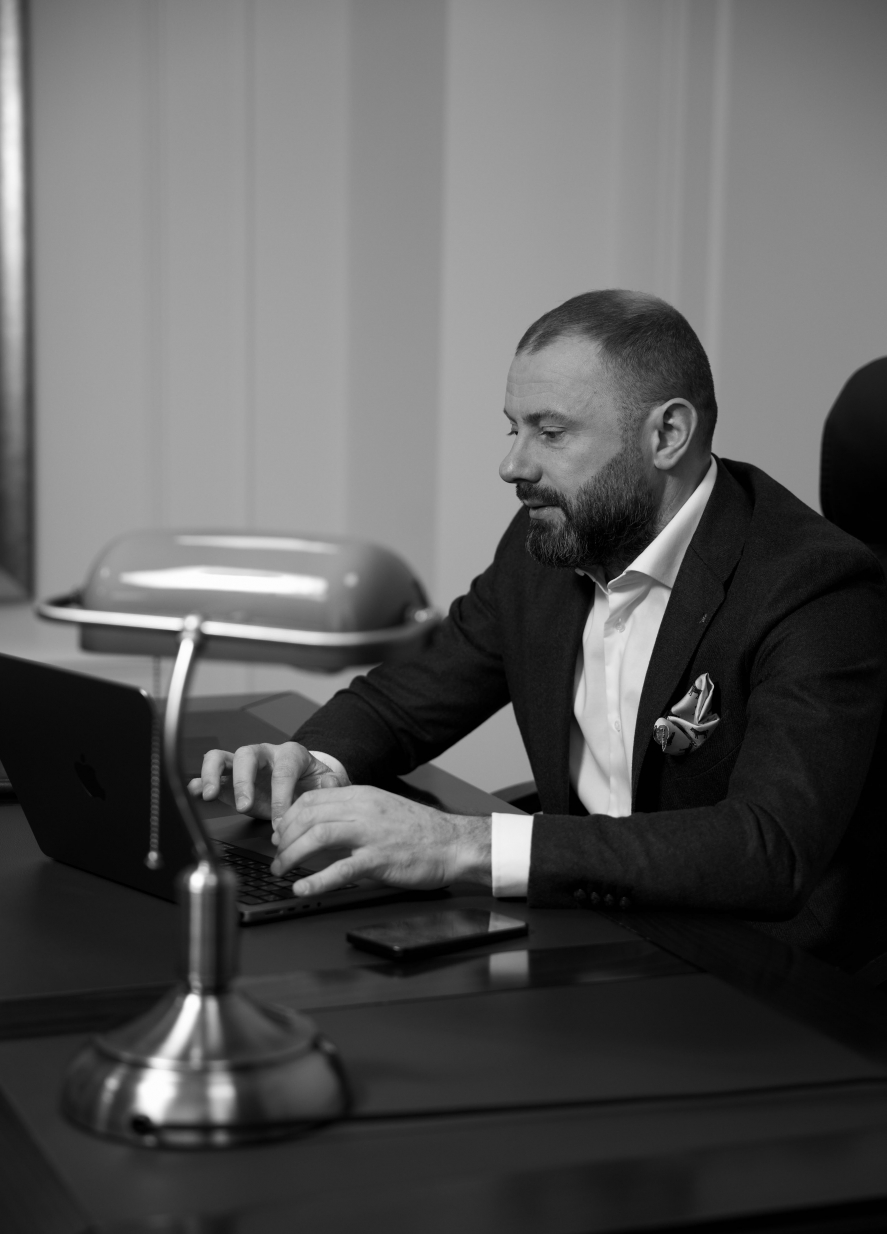
Victor Slivinschi, who has been developing businesses in the Republic of Moldova and Romania for the past 20 years, believes that the Tofan Government has a responsibility to restore the confidence of society, and especially of the business community, which is the true engine of the economy. In an interview with Curentul.md, he spoke about expectations, challenges, interests, and future prospects.
Mr. Slivinschi, as a businessman who has been building businesses for more than 20 years, do you have expectations of the government led by Vasile Tofan?
It is only natural that I have expectations, both as a citizen of this country and as an entrepreneur who contributes tens of millions of lei to the state budget every year and has created hundreds of jobs. These expectations are even greater when it comes to the government led by Vasile Tofan, a person who comes from the business world, where he has achieved remarkable success.
The business community is not asking for favors—we are asking for fairness and transparency. The truth is that, in recent years, local businesses have suffered not only because of multiple crises but also because of the government’s lack of vision and openness. Against this backdrop, the Tofan Government’s mission is to demonstrate a genuine understanding of how businesses operate and to create conditions that enable companies—small, medium-sized, and large—to grow and thrive.
By the way, do you know Mr. Vasile Tofan personally? Have you interacted with him?
I believe many people know Mr. Tofan, and I am one of them. I have had the opportunity to interact with him at several events, and I am confident that he genuinely wants to change things for the better.
Now it depends on the people who will support him and whether he avoids getting drawn into endless discussions without concrete action. The Republic of Moldova needs reforms, but those reforms should not become a stick used against businesses. Instead, they should become the long-awaited support that helps businesses grow and, consequently, generates greater economic prosperity.
Many believe that the Tofan Government’s greatest challenge will be tax reform, which has been widely discussed recently.
Yes, indeed, this reform will be a major challenge for the new government because it will have to strike the right balance between the interests of the state and those of the business community.
I understand that the proposed reform is necessary. However, it must be implemented in a way that not only avoids placing an additional burden on businesses but also provides them with genuine opportunities for future growth.
Business is the state’s partner in addressing socio-economic challenges. The stronger the business environment, the greater the state’s capacity to solve the problems facing its citizens and to ensure a decent standard of living.
The new Prime Minister is a visionary who understands very well what businesses need in order to develop sustainably while also contributing to the country’s overall development. That is why I believe the new tax reform can become the balanced solution that serves both the interests of the state and those of the business community.
What has been one of the biggest challenges you have faced in your relationship with the authorities?
It may sound cliché, but communication has been the weakest point in our relationship with the authorities.
A concrete example is the project for the expansion of the 400 kV Vulcănești Electric Substation (Plant Design, Supply & Installation), which forms part of the Power System Development Project. The project was successfully implemented by the consortium JV CELIN SRL, part of the Turboenergy Power (TEP) Group, together with Energobit SA, within the contractual deadline established under the agreement signed on 24 February 2025.
However, if you have followed this project, you have probably noticed the amount of confusing information released by the authorities themselves, particularly by the responsible ministry.
For us, this was an extremely important project, and at no point did we allow ourselves to exceed the contractual deadline. We completed the project on time, and we are proud of that achievement.
Meeting the deadline was not the result of a single decision or one person’s effort—it was the outcome of the sustained work of everyone involved.
We would have appreciated it if the authorities had assessed the impact of their public statements before making unfounded allegations. As a company that values its reputation, it is extremely important for us to be treated fairly.
It is deeply disappointing when the efforts of an entire team are undermined by irresponsible public statements.
You do business in both the Republic of Moldova and Romania. What are the biggest challenges you face?
To be honest, there is a significant difference between doing business in Romania, a member of the European Union, and in the Republic of Moldova, which aspires to join the EU. In Romania, I can make medium- and long-term business plans. In Moldova, that is still not possible. For entrepreneurs who want to know where their business will be in ten years, this is a real challenge. The same applies to foreign investors, who, when entering a new market, want to understand exactly how their business is likely to develop over the next 10–20 years.
Furthermore, in Moldova we still cannot speak of fairness, impartiality, and transparency. Let me give you a recent example—the latest public procurement tender organized by the National Office for Regional and Local Development (ONDRL). My company, Turboenergy Power Moldova, participating in a consortium with MASS (Turkey), ranked second, even though our bid fully complied with the tender specifications and was 14 million lei lower than the winning offer.
After the results were announced, however, we noticed a striking discrepancy between the technical score awarded to the winning bidder and those awarded to the other participants. The winning bidder received 98.99 out of 100 points for the technical evaluation, while our consortium, which ranked second, received only 33.15 points.
This difference raises legitimate questions, given that all bidders prepared their proposals based on the same tender documentation, for the same project, and under the same conditions. According to our technical calculations, some of the energy consumption figures declared by the winning bidder and accepted by the Evaluation Committee appear impossible to achieve under real operating conditions.
In this tender, the technical score was calculated on the basis of the declared energy consumption: the lower the declared consumption, the higher the score. The winning bidder received almost the maximum technical score, largely because of the exceptionally low energy consumption figures stated in its proposal. According to our engineering analysis, some of these values cannot realistically be achieved in the operation of a wastewater treatment plant.
We therefore requested that the authorities verify whether the technical score was awarded on the basis of genuinely achievable technical performance or merely on figures that look impressive on paper but cannot be substantiated in practice.
What steps have you taken? After all, a difference of 14 million lei is substantial, and the technical discrepancies appear even more significant.
Yes, we have taken action because we believe that, at the very least, the situation is unfair.
On 30 April 2026, we formally notified both the Evaluation Committee and the ONDRL, requesting a technical verification of the feasibility of the declared performance values. However, in its reply of 21 May 2026, the ONDRL declined to conduct an independent technical assessment, arguing that it was obliged to rely on the bidder’s declarations.
We also submitted formal requests to the Court of Accounts, the National Security Council, the Anti-Corruption Prosecutor’s Office, the Presidency, Parliament, and the Government, asking them to verify whether the winning bidder is genuinely capable of delivering the project in accordance with the technical commitments made in its proposal.
With all due respect for these institutions, we believe that in a project of such importance it is not sufficient to say, “The bidder declared it, therefore we accept it.” When public funds, external financing, environmental protection, and public health are involved, the decisive technical data must be independently verified.
Nevertheless, the ONDRL maintains that there is no cause for concern and intends to proceed with signing the contract.
We have therefore formally requested the establishment of an independent panel of experts to examine:
- the technical feasibility of the declared performance parameters;
- how the declared energy consumption figures influenced the final technical score;
- the justification for awarding the contract to the more expensive bidder;
- the risks to public finances;
- the risks to the future operation of the treatment plant; and
- compliance with the principles of integrity, transparency, and fair competition.
We have recently been informed by the National Anti-Corruption Centre (NAC) in Bălți that a criminal investigation has been initiated based on our complaints. Accordingly, the matter will now be investigated.
So, we understand that you are not giving up?
Giving up? Absolutely not!
I was born in Soroca, and I sincerely want this project to be implemented with the utmost responsibility. The municipality of Soroca deserves to see this project completed as soon as possible—and, most importantly, to have a facility that functions properly and delivers the intended results.
Do you believe that public procurement in the Republic of Moldova is still an area where vested interests play a role?
All public procurement procedures must be fair and transparent, both for the companies participating in them and for the taxpayers who ultimately finance these projects. At present, unfortunately, we cannot say that this is always the case.
And this is not only about us or about this particular tender. Speak with businesspeople from different sectors and you will hear what can only be described as horror stories.
I sincerely hope that the Tofan Government will bring order to this area and that attempts to circumvent legal requirements—such as those we believe have occurred in the Soroca wastewater treatment plant project—will no longer happen.
The Republic of Moldova will become a member of the European Union only when corruption and vested interests are eliminated, including in public procurement.
Do you plan to expand your business in the Republic of Moldova?
I do not want to make categorical statements, nor do I want to sound pessimistic, even though recent events in Moldova have disappointed all of us.
As a businessman, I want to contribute to my country’s development. I want to create new jobs, pay decent wages, and continue contributing taxes to the state budget.
Today, we employ around 200 people in Moldova and another 200 in Romania, while the taxes paid by our companies to the budgets of the two countries exceed €20 million.
However, this does not depend solely on me. It depends directly on whether the state creates the conditions that allow businesses to grow and compete on a level playing field.
I have a clear vision and ambitious development plans, and I hope the necessary conditions will be created to make them a reality.
Since you have businesses on both sides of the Prut River, where do you consider home?
Yes, I have businesses on both sides of the Prut and travel frequently between the two countries, to which I am connected not only through business but also through a deep sense of pride.
For me, home is where my family and my children are. Home also means the Soroca district, where I was born, grew up, and where I always return with great affection whenever I have the opportunity. That is precisely why I was so eager to acquire the Soroca Zemstva, a building of exceptional historical, cultural, and national significance for both sides of the Prut, built in 1877. The building served as Soroca’s administrative headquarters and hosted nationally significant historical events, including the vote on 13 March 1918 supporting the Union of Bessarabia with Romania. Over the years, dozens of generations of Soroca residents worked and spent a significant part of their lives there. They deserve our gratitude for their service to the city, the country, and their dedication to the Romanian nation. This is a building that preserves the memory of defining moments in our country’s history. I look forward to restoring it to its former grandeur.
 Loading ...