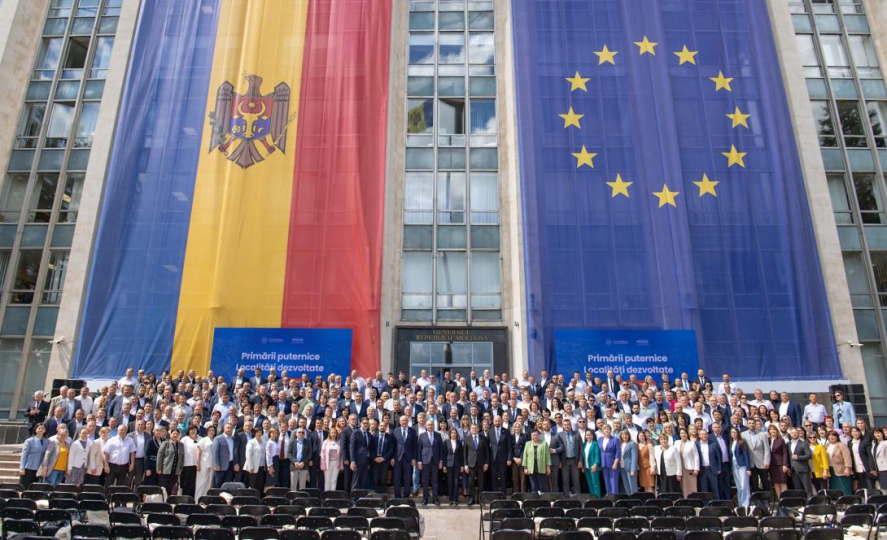
Around 400 local elected officials from more than 680 localities that have decided to merge their town halls participated in the “Strong Municipalities – Developed Communities” event, alongside the President of the Republic of Moldova, Maia Sandu, the Speaker of Parliament, Igor Grosu, Moldova’s Prime Minister Alexandru Munteanu, Romania’s Prime Minister Ilie Bolojan, as well as external partners and representatives of sectoral organizations.
Addressing the mayors, President Maia Sandu highlighted the courage of local leaders to embark on a complex reform — rethinking how localities are administered and pooling resources, capacities, and efforts. She stressed the need for larger administrative structures with the necessary specialists, especially to take advantage of opportunities created by EU accession: pre‑accession funds are allocated for large, regional‑impact projects that require consolidated teams. Modern services — waste management, social services, digitalization — are more efficient and cost‑effective when managed by a strong administrative structure.
The President also emphasized the importance of effective cooperation and clear communication with citizens. She recalled that Moldovan villages have always relied on collective effort: “In Moldova, people in the village have always joined forces to help one another. Big things were done together, through clacă. This reform is, in fact, a clacă between villages — several villages uniting their town halls into one to improve everyone’s life. Water, sewage, roads, services — we can achieve all of this together if we pool our resources and invest wisely.”
Romania continues to support the development of Moldovan localities. Speaking at the event, Prime Minister Ilie Bolojan stated that ensuring citizens’ safety and creating prosperous living conditions are key priorities, and Moldova’s decision to follow the European path strengthens these goals. He noted that prosperity depends on what happens in each local community: investments in water and sewage systems, paved roads, better schools, and improved medical facilities. “The value of an administration is measured by how much of the collected taxes is returned to citizens,” he said.
Bolojan encouraged mayors to support the reform despite initial discomfort: “Even if at first it seems inconvenient, even if two mayoral seats become one, even if the number of councillors decreases, it is important to remain dignified before our citizens and support what is good for them — because that is our mission.”
Mayors Vitalie Vrabie (Ungheni), Vladimir Cucereavîi (Taraclia, Căușeni), and Rodica Rusu (Telița, Anenii Noi) shared their experience, stressing that beyond figures and strategies, the reform is about people choosing to collaborate for the common good. Local leaders argue that the reform is decisive for the future of communities, enabling them to build more capable administrations, attract funding, and implement projects that would be impossible individually. When administrations join forces, service quality improves, infrastructure modernizes faster, projects reach communities, and living standards rise.
During the event hosted by the Government, mayors from across the country took part in discussions on how to build strong municipalities capable of attracting external funds, implementing major projects, and providing quality services. The thematic panels focused on financing mechanisms, legal transition, and strengthening local administrative capacities, with practical examples and technical solutions.
Local public administration reform is one of the most important and complex transformations in Moldova. As part of the reform, the voluntary amalgamation process has been simplified. So far, local councils have adopted more than 680 decisions to initiate voluntary amalgamation.
Localities that choose to merge their administrations will receive financial incentives of 3,000 lei per resident, multiplied by the population of the merging villages. Another benefit is improved access to public services — more than 600 services will be available through Unified Service Centers and one‑stop shops. Each locality will also have a representative of the mayor to maintain direct contact between the administration and the community. More information is available on primariiputernice.gov.md.
Government representatives continue visiting communities to explain the amalgamation process, its advantages, and the benefits for citizens. All town halls that have initiated voluntary amalgamation receive guidance from the Government to successfully complete the process.



 Loading ...