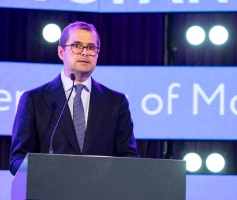
– We see many opportunities that will arise for Moldova in connection with the accession to the European Union from a general economic perspective, not just from a trade perspective. Of course, our market is different and we hope to maintain our uniqueness in this sense in the future as well – said Natalia Bejan, General Director of the Invest Moldova Agency in an interview with the Warsaw Enterprise Institute as part of the “Pentru Moldova – For Moldova” project.
- The situation in Ukraine creates new opportunities for the Moldovan economy.
- The best moment for foreign investments in Moldova, even before the country’s formal accession to the European Union.
- The National Industrialization Plan is an opportunity to support Polish industrial investments in Moldova.
- Poland’s role as Moldova’s leading economic partner is growing.
- Thanks to the actions taken, Moldova will become an even more attractive market for Western investments.
What main challenges do you see for the Moldovan economy?
I think the Moldovan economy is currently at a stage where we are going through a major transformation, becoming a mature economy in a sense. This is visible in several sectors that are strategically important for our economy. In the IT sector, we have been developing in terms of outsourcing services and increasing the number of companies. Now we want to create more products, develop our startups and create more and more complex products. The same is happening in agriculture, for example. Up until now, we have produced and even still produce many raw materials, such as grains, cherries and apples, which we are proud of. However, the economy is now moving to a stage where we want to process this food and create advanced and complex products. We want to raise the economy to a much higher level. Of course, we have some challenges in terms of the war in our region. This is one of the reasons that makes investors more cautious. At the same time, it creates opportunities and opens up other sectors of the economy that we have not focused on much so far.
You mentioned the difficult political situation in the region. How do the internal political processes in the country and external threats affect foreign direct investment in Moldova?
As I mentioned, the war in the region is causing some investors to be more cautious. Some of them have a heightened risk perception. At the same time, however, new investors are entering the market that we did not consider a priority before. For example, in the energy sector, including batteries, renewable energy, or construction materials. We are talking mainly about companies that are preparing not only to export products to other markets, but also those that want to focus on Ukraine and its reconstruction. From this perspective, new opportunities are emerging that some partners will try to fully exploit.
How will the start of negotiations on membership in the European Union affect Moldova’s investment ecosystem? On the one hand, prospects for European funds will open up for Moldova, but on the other hand, there will also be more regulations governing business activities.
We started accession negotiations with the EU some time ago. The adaptation of our legal framework is already in full swing. We are making every effort to complete it as soon as possible. We see many opportunities that will arise for our country in connection with the accession to the European Union from a general economic perspective, not only from a trade perspective. Moldova has signed free trade agreements with 47 countries, including the member states of the Commonwealth of Independent States, the Central European Free Trade Agreement (CEFTA), the European Union (AA/DCFTA) and Turkey. In June 2023, Moldova signed a free trade agreement with the European Free Trade Association (EFTA), covering Iceland, Liechtenstein, Norway and Switzerland, which is to enter into force this year. Now we need to adapt our standards, quality of products and services to those of the European Union. This will finally remove the limits on our products, open the market and create the same conditions for investors as in the European Union. The conditions for investors in Moldova will be aligned with EU standards, covering regulatory issues, market access and investment protection, which will be consistent with those in other EU countries. Investors coming to Moldova today spend time and effort to understand our legal framework, but once we become part of the EU, these questions will disappear because the conditions will be identical. From an overall economic perspective, the same guarantees, security and opportunities will apply as in the European Union. Of course, our market is different and we hope to maintain our uniqueness in this sense also in the future. However, we see many advantages related to integration. For many investors, the fact that we will become a member of the European Union is a signal to invest earlier, when the economy still requires lower investments, instead of waiting for additional years when we become part of the European Union.
Does Invest Moldova already have a plan to adapt the laws and regulations required by the EU and does it know how to prepare its business for this?
We started this work from the first day I became the Director of the Agency. We do not only discuss, but also carry out specific tasks to adjust some procedures and ensure compliance with the European Union law. As an Agency, we are not directly involved in preparing or updating the rules and legal regulations; this is mainly the responsibility and task of the Ministry of Economy of Moldova. They are the ones who do this work. Our role is to understand these changes and inform the foreign business community about them, so that all those affected by them are aware of them.
Which sectors of the Moldovan economy have the greatest development potential?
The IT sector has been developing very actively over the last seven years. We have managed to increase this sector more than sevenfold, in terms of the number of companies, employees and average salaries, which significantly exceed the average salaries in other industries. This sector offers unique tax opportunities, even on a global scale. The Moldovan IT Park, which is a platform created by the government to stimulate investments and development of IT business, offers a consolidated flat tax of 7% (the regular CIT rate for companies is 12%). It has attracted many different international companies and IT investments. For example, last year we had at least two investments from Poland in the IT sector within the Moldova IT Park, these companies currently employ over 200 people and generate exports worth EUR 11 million. In addition to the IT sector, the most developing industry is the outsourcing sector, i.e. audits, consulting, accounting and call centers, which can also benefit from our unique and simplified tax system. The government also places great emphasis on the development of industry in order to create products with high added value for export. Recently, the government approved the National Industrialization Plan, giving priority to six sectors of the economy: electronics, mechanical engineering and automotive, textile, agro-food, pharmaceuticals and chemicals, and construction materials. The government is preparing a state aid mechanism to support strategic investments in these areas with state aid of up to 50% of their operation if the investment is at least half a million euros. Our goal is to develop Moldova’s industrial power and we invite investors to look at these opportunities.
Why should Polish companies invest in Moldova?
Every investment decision is a business decision. We welcome investors who want to do business in Moldova, establish profitable companies, create value for our economy, employ people, offer good wages, produce good products or services and eventually export them. Investors should see this as a business opportunity. Most investors in Moldova make profits, which indicates that our market still has many untapped opportunities. Many industries lack investors and companies that could take them to a higher level of complexity and technological development.
As our National Bank President mentioned, in a few years, when the economic situation in Moldova improves, many investors will regret not having invested here earlier. Now is the right time, when prices are still very competitive, there is less competition in some sectors, and investors can make a significant impact on local industries and achieve good business results.
For example, we have very stable relations with Romania. We export a lot to Romania, but we also import a lot from it. Interestingly, Ukraine is also an important partner, because it is our neighbor and a priority partner both in terms of import and export.
Returning to the question and issues closer to the hearts of the initiators of the project “Pentru Moldova – For Moldova”, in 2023 Poland was the eighth country in terms of exports from Moldova and the seventh in terms of imports to Moldova. This shows strong economic relations, but I believe there is potential to strengthen them further. It is important to note that our relations are mutual. In the case of other countries, we have large imports but almost no exports, which seems less balanced. Healthier relations, such as those we have with Romania, Ukraine and Poland, show a visible balance between exports and imports.
What tools does Invest Moldova have to help investors? What do you do to support foreign companies in Moldova?
Our most important tools are information and networking. We can answer all questions investors have about doing business in Moldova, such as the cost of renting premises, where to buy land, how to hire people, which companies to use as partners and which accounting firms to use. We have materials, information and people ready to provide support and answers.
Many investors need contacts with public administrations, ministries, agencies, associations, opinion leaders in specific areas and even partner companies that can share their experiences. We develop investment projects supporting strategic projects worth at least 3 million euros through negotiations and provision of infrastructure support. The government is also working on a state aid mechanism that offers a 50% refund of investment costs for significant investments, which we hope to implement by September or October. EU competition and state aid rules, partially transposed into national state aid regulatory frameworks, contain provisions on state aid that may be compatible with a competitive market, including regional state aid. The state aid program for the manufacturing industry will be of an incentive nature and may include a 50% income tax exemption or direct subsidies with an intensity of up to 50% for companies in priority manufacturing sectors that make capital investments of at least 500,000 euros. The period of validity of the exemption depends on the beneficiary company reaching the permissible aid intensity threshold after the approval of the National Industrial Development Programme for 2024–2028.
What has Invest Moldova achieved through its activities supporting the Moldovan economy? Could you mention some important projects in this regard?
We can talk about our achievements from two perspectives. First, in terms of the number of companies and exporters we have supported. We focus not only on attracting foreign investments, but also on promoting Moldovan exports. Over the past three years, we have facilitated the implementation of more than 20 investment projects, providing operational support, such as helping the company with the recruitment process. For example, we helped a company that opened a business in Moldova last year by providing it with a hundred CVs from a specific region, proving the availability of the necessary talents on the ground.
We also have export promotion programs. Over the last three years, we have supported various companies, mainly through business associations, generating over 100 million euros in additional exports. This has been achieved by helping companies participate in international fairs and exhibitions, where they present their products, establish new partnerships, sign contracts and secure new exports.
What are your priorities as CEO of Invest Moldova in the coming years?
In the short term, my number one priority is to strengthen my team at Invest Moldova. With government support, we were able to get approval to triple the size of the team because we showed that there are potential results that we can achieve. More than half of Invest Moldova’s employees are new, hired this year since I became CEO. It is crucial to ensure that these people are top professionals, knowledgeable and able to build valuable relationships with investors and partners.
In addition to institutional capacities, we believe that in Moldova there is not only potential and need, but also great opportunities that potential investors can use. We want to attract strategic investors who can change the landscape of our economy, bringing investments worth more than one hundred million euros. Such investments will not only support the economy, but also help to raise Moldova’s position on the economic map of Europe.
The project is funded by the Polish Ministry of Foreign Affairs within the framework of the project “For Moldova – Pentru Moldova. Platform for Polish-Moldovan dialogue”.
 Loading ...