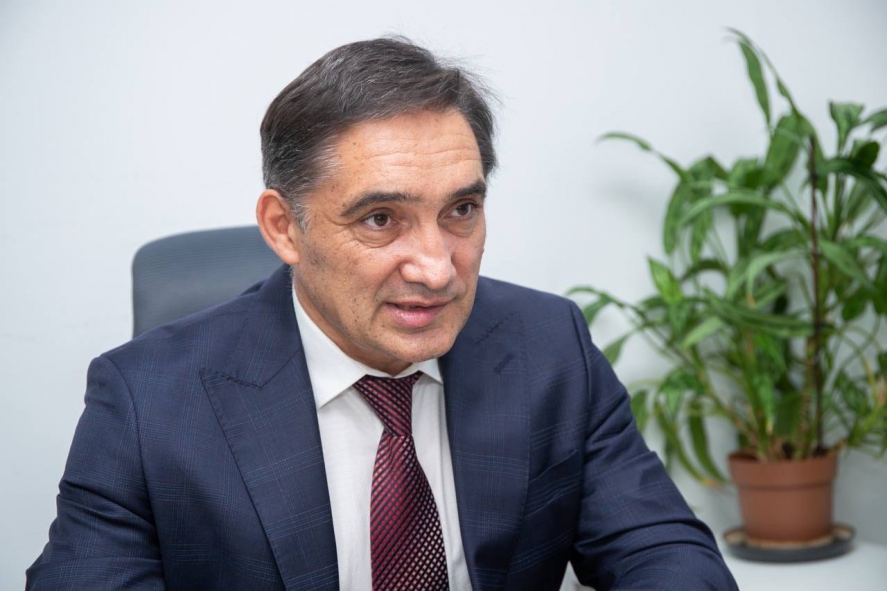
Interview with Alexandr Stoianoglo, candidate for the position of President of the Republic of Moldova
T: Mr. Stoianoglo, after the announcement that you would be running for the position of President of the Republic of Moldova, accusations that you are a nominee of oligarchs and the hand of Moscow were made, including, by the top leadership of the country. About a dozen and a half of special and various talk shows were devoted to you, where, again, serious accusations were voiced. Old criminal proceedings against you have been expedited. The Constitutional Court is also making a prompt ruling regarding your dismissal from the post of Prosecutor General. Mr. Stoianoglo, were you ready for all this? Why did you need all this? Maybe it is not too late to take a step back?
A.S.: I was ready for it and I had no illusions. I think this is just the beginning. I know them too well. And everyone understood everything about them a long time ago.
T: Can you be more specific? Give us your portrait of the current government in a few theses. And right away, briefly, what is the alternative to this power. It’s so easy to criticize the authorities. And it is very difficult for our authorities – both the President and the Government – to rule the country under the current conditions.
A.S.: Yes, but it will be the opinion of a non-party politician. Or not a politician at all. In my opinion, the people who now rule the country have in common several fundamental things.
The first thing – complete contempt for the rule of law, the presumption of innocence, civil rights, and the very constitutional order of the country. They promised justice reform, and what we got was chaos, confusion, and the complete destruction of the remnants of justice. They promised freedoms, but they rule the country in a regime of emergency, decrees, sanctions, extrajudicial killings and the dictatorship of the security services. Citizens are under the gun of humiliating suspicions, no one is sure of anything…
The second thing – rampant incompetence. You know, they don’t even realize that they don’t know how to apply the laws! They don’t realize that law is not the right of the strong, not the right of the boss to declare enemies of the people, but the observance of firm constitutional guarantees for all citizens. You should agree, when people do not know how to drive a car, they usually do not risk doing so. In our case, it is the opposite. The car is hurtling into the abyss. But it is not only the hapless driver in the car, but the whole country.
The third thing – it is their amazing, inexplicable trait: to divide the people, to divide them into good, advanced people and worthless, loser people. I believe that the people of Moldova should not to be divided in this way. We do not have extra people. Moldova needs everyone. The tasks we are facing require the unification of all citizens, even if they have completely different views: leftists, rightists, pro-Europeans and Eurosceptics, unionists and adepts of statehood. I believe that the role of the Head of State is precisely this mission: to find and support a common, constructive agenda for all, to give space for freedom of opinion, for the development of one’s abilities here in Moldova. Gentlemen, if you cannot find such a constructive agenda, then why did you come to power? Although, you are right, a certain barefacedness and complete lack of evidence in the accusations of the last few days are somewhat discouraging. I didn’t doubt for a second what kind of attack would be launched against me. But I did not suspect that none of the so-called pro-European media would want to know Stoianoglo’s point of view on all these wild accusations. They were obliged to contact me, to ask my position, in order to comply with their own professional and ethical standards. No, not once did anyone call me, not once did anyone ask me. If this is their European integration, then Lavrentiy Beria is probably the main European integrator.
T: Why were you nominated by Igor Dodon and the socialists? Why didn’t you become an independent, non-party candidate?
A.S.: I was not the person who suddenly got the idea of becoming President of Moldova. I do not suffer from megalomania. Moreover, I am very critical about my own candidacy. I understand all the known risks and all the measure of responsibility even with regard to simple participation in the election campaign.
This initiative does not belong to me. But I had to take this idea more seriously when my name started being heard in the information space, when statements of some politicians about me as a compromise figure started spreading.
And you are absolutely right; my like-minded people suggested that I be nominated by an initiative group – well-known representatives of civil society, many reputable people who have openly expressed their solidarity to me and human participation over the past few years. But, as they say, it was smooth on paper. The current Electoral Code only in theory allows us to follow this path. Overcoming each formal stage – registration of the initiative group, registration of the Fund for Assistance in Collecting Signatures in Favor of the Candidate, other procedures – are possible only in case of full personal loyalty to Maia Sandu and her party. There is no doubt that such a nomination would have stalled already at the first stage. They would have stopped me instantly. The authorities’ reaction of the last few days leaves no doubt.
On the other hand, during the last month I had a huge number of personal meetings with the leaders of political parties. Most of them have already run as presidential candidates. But at the same time, many of them assured me that this is not a final decision, negotiations are still possible. What is interesting is that almost all of them asserted two things. The first was that it would be very good if my nomination would come from the largest and most authoritative party in terms of rating – the Party of Socialists.
And secondly, that Igor Dodon would never agree to this, alas. But a sensation happened. Igor Dodon publicly announced that neither he nor representatives of his party will run for the post of head of state. Moreover, the Party of Socialists nominated my candidacy not just as its own candidate, but as a candidate that could be supported by the other parties as well.
It is not for me to judge, but Igor Dodon has committed a brave and surprising act, uncommon for Moldovan politics. Such selflessness is rare in our politics. It is important to strengthen this openness, to take advantage of it, to continue the dialog with politicians and representatives of civil society. And not only in the sense of supporting my candidacy, but also in working out a common strategy of actions in these elections.
T: Is this communication with political leaders ongoing?
A.S.: Yes, of course. I have had several very important meetings in recent days. In the coming days, weeks, this dialog will continue.
T: Are your opponents saying that Kremlin simply ordered Igor Dodon to give way? Or was he pressured by the same oligarchs – Plahotniuc, Shor, Platon?
A.S.: I have little knowledge of this, but it seems to me that in order to be a favorite of Moscow, one must meet at least once with some of Russia’s high-ranking officials, talk to them, and swear allegiance. It has to happen somehow. Nothing like that has ever occurred. Not in recent years, not on the eve of the elections.
But I believe that dialog with Russia should be restored. We need both energy resources and a market for our agri-industrial complex. Why the ambiguity and hypocrisy when we buy the same Russian gas, but through third hands? Or when we get electricity from Moldavskaya GRES? Who do we want to deceive at this moment?
As for the oligarchs, I was the person who opened a criminal case against Plahotniuc and nailed Shor with volumes of proven evidence on the theft of the billion. Who let him out? Why was he allowed to escape? The question is not for me. But Shor’s attitude towards me is well known. In the last week, his activists and candidates have been one step ahead of Sandu in the information campaign against me.
The story of Platon is the story of my handshaking with a Moldovan citizen during interrogation. This is what I did, with few exceptions, with most of the citizens I interrogated. And Veaceslav Platon found himself at large out of any connection with the actions or inactions of the Prosecutor General, who I was at that time. Moreover, it was a special commission created on the initiative of Maia Sandu that recognized the conviction of Veaceslav Platon as illegal. And everyone knows about it well. Everything else is slander and deliberate falsification. Apart from a handshake, they have nothing to show me. I’m sorry, that’s my upbringing. I greet people.
T: You were nominated by the Party of Socialists. I think it’s too early to talk about the possible support of other parties and the creation of a certain bloc to support Stoianoglo. But this very nomination obliges you to strictly follow the party doctrine of the Socialists?
A.S.: There is no such strict dependence. We had a rather open conversation with the Socialist leaders, members of the PSRM Executive Committee. And we agreed that our goal is to unite people of different views around the main tasks – guaranteed peace in Moldova, strengthening the neutrality of the country, overcoming the risks of the country’s disintegration, bankruptcy of the economy and exodus of the population. All this, of course, does not fall within the presidential powers, but the President is able to stand guard over the very possibility of making such a Moldova all together, jointly. And the socialists agreed with this. Our differences of opinion on some issues are compensated by our common attitude towards the future.
T: Good. Then let’s try a blitz on all these topics. So, tell about your attitude to the war in Ukraine. Whose is Crimea? Whose is Donbas?
A.S.: My attitude to the war in Ukraine, as well as the attitude of the absolute majority of Moldovan citizens, is sharply negative. War cannot be a solution to problems. The victims of war are always those who have nothing to do with it. These are the civilian population – children, the elderly…
Crimea and Donbas are part of Ukraine in accordance with international law. And until there are no other internationally recognized decisions, for me, as a lawyer, there is no ground for discussions; neither about the fact that Transnistria is an integral part of the Republic of Moldova.
I repeat, there seems to be no military solution to this problem. That is why it is necessary to pay great attention to all those peace initiatives that have recently emerged in the offices of some heads of state. The mere appearance of such initiatives already inspires optimism.
And here we should not be particularly categorical and demanding. Let me remind you that 32 years after the Transnistrian conflict broke out and was extinguished, the Agreement of July 21, 1992 remains almost the main document. In fact, it is just a ceasefire agreement. But it turns out to be quite a lot. How many lives have been saved! And the conflict itself is now being resolved exclusively by diplomatic, peaceful means.
T: Is the language Romanian or Moldovan?
A.S.: I am an ethnic Gagauz and it would not be quite correct for me to make categorical assessments here. Nevertheless, philologically no one disputes that it is one language. Everyone agrees with this. And it would be foolish to deny it. As for naming, this is not a philological question. There are quite a few cases when identical languages are named differently in different countries. In this case, the right to a final opinion always belongs to the majority of the people. The people, not the academicians, are always right in this case. If the majority of the population of our country considers its language Moldovan, if they were able to enshrine this in legislation, then so be it. If at some stage the majority considers that the language should be called Romanian, then this position should be respected and not insulted. It seems to me that the same principle applies to the name of the people – Moldovans or Romanians. I believe that this is an artificial issue that is thrown into society time after time in order to anger and divide it, to draw away people’s attention. My parents and I learned the language called Moldovan at school. My children learn Romanian at school. If you ask their opinions on this matter, which of them would be right? Probably both my parents and my children.
T: What is the place of the 1949 deportation of Moldovans in the history of our country and our collective memory?
A.S.: It is a tragedy. And it is a monstrous act of lawlessness even from the view point of the Soviet legislation of that time. In this case, I do not understand those who hide their heads in the sand and try to justify these pages of our history. But the victims of these events were all nationalities of Moldova. This should also be remembered.
Likewise, I do not understand those who try to silence the Holocaust in Moldova, the physical extermination of hundreds of thousands of Jews during the Second World War, those who see only one tragedy and do not want to hear anything about other victims. This is not the way to go. The truth, like bitter medicine, must be accepted by all. It is the key to our common recovery.
And we should also remember that our past did not consist only of deportations. The time of deportations was condemned even under Soviet rule. And the railroad and freight wagons were used here all the following decades to import machine tools, equipment, and machinery. Industry, universities, hospitals and schools, the buildings that now house the Parliament and the Presidential Administration are all part of the Soviet legacy. And we should talk about it honestly and openly and remember it with gratitude, as well.
T: Do you really believe in the need to strengthen neutrality? Or is it still the same, pardon the harshness, Soviet stereotypes of perceiving NATO as an enemy? Let’s remember that neutrality in World War II did not guarantee security for countries like Belgium, Holland, and Denmark. Neutrality does not save anyone….
A.S.: I am not a historian, but I recall that the membership of some countries in military alliances did not protect them from invasion either. Poland, Czechoslovakia, France… Isn’t that so? As far as stereotypes and clichés are concerned, are such neutral countries as Austria, Ireland, Cyprus, Malta, and Switzerland in your opinion also under hypnosis of Soviet stereotypes? Most of them are EU members, but this does not prevent them from pursuing their own security policy.
In the Republic of Moldova, indeed, the overwhelming majority of society is in favor of neutrality. Among them are those who are critical of Russia. There are also those who hope for Moldova’s integration into the Eurasian space. After the outbreak of the war in Ukraine, the number of supporters of neutrality has increased significantly. And now there is no more authoritative idea to unite our citizens than peace-making and non-participation in wars and military blocs. I may be wrong, but this consensus is primarily a consequence of the tragedy that Moldova experienced in 1992. From the Transnistrian conflict, our citizens on both banks of the Nistru/Dniester River learned a simple truth: it is better not to start a war, it is better to fight for peace by all available means. This is an amazing internal compromise. One should be proud of such civic maturity, not ashamed of such people. And I see nothing wrong with this unspoken social contract of nonviolence involving citizens of all different views and values, citizens who believe in our country’s ability to find common ground with all our neighbors – be it Romania, Ukraine or Russia. Everyone has already acknowledged the fact that: the administration of Maia Sandu is an administration of war rhetoric and hysteria. Take away the topic of war in Ukraine from the authorities and they have nothing to say to the people. Everyone is tired of this shrieking and this hysteria. In the meantime, Moldova can become a much safer place if it simply follows the will and wisdom of the majority of the people. If there is one less lit match in Europe, peace will come much faster than it seems.
T: You have described yourself as a supporter of European integration. What is your attitude to the referendum on this issue?
A.S.: This referendum has nothing to do with European integration. It is a referendum of Maia Sandu. Her style is to divide people, to pit one part of society against the others, to declare themselves good people, and to put the others out of the brackets. In the current conditions, the referendum is an instrument of forced discrimination of citizens on the basis of political principle. It is a way to split society into better and lower castes. These intentions are openly stated by the Security and Intelligence Service (SIS) leaders, who have already declared opponents of European integration as enemies of statehood. The leaders of the ruling party themselves publicly declare this. They say that those who are in favor of the EU are true citizens, while those who are against it are at best the population. This is a quote, not my speculation.
The level of controversy should be lowered. There are no practical consequences to the outcome of this referendum. We will not find ourselves on the second day in the European Union if the majority says “Yes” to European integration. And hardly anything critical will happen to Moldova’s European path if the majority answers this question negatively. And in general, there is no need to link the EU accession to Maia Sandu. PAS and European values are not the same thing, and even are quite polar concepts in spirit.
My position: we do not care how the majority of citizens vote on the referendum question. It is important for us what kind of President the citizens will choose: the guarantor of confrontation or the one who strives to become the guarantor of creation; someone who seeks and finds friends, not an excuse for conflict.
T: Are you in favor of continuing negotiations with the EU?
A.S.: It is very important that the EU speaks to Moldova not as if it is a territory of future Romania, but as to an independent state, creating for all sincere adepts of statehood, competent politicians and citizens a new unique chance to modernize the economy, social and cultural life. Therefore, the negotiations should continue, but with open eyes, understanding on what terms the EU will be ready to accept us in the end, informing our society about it, reporting to it, explaining to business, civil society and ethnic communities what kind of tasks Brussels sets before us, what kind of proposals we have made, defending our sovereign positions. And there are such sovereign and unchangeable positions. For example, we can enter the EU only as a neutral country. We should enter the EU only along with Transnistria and the settled Transnistrian issue. We can enter the EU without compromising the values and traditional heritage of our people and all its ethnic communities. And after all this, when the results of these negotiations are clear, of course, this issue should be put to a referendum. The people should give their final verdict.
The main advantage of EU integration is that so far it is the strongest instrument to support Moldovan independence. And we are obliged to use it to the full. But the ruling party even in these conditions continues the policy of purposeful state bankruptcy, political defeat of Moldova. The unique European chance is used as an excuse for “cold civil war” and “witch-hunt”. Shameless and unprecedented anti-European practice is being carried out in Moldova under European slogans. There is no law on foreign agents, but there are amendments to the law on treason, according to which the entire adult population of the country can go to jail. Look, they don’t negotiate with the EU, they don’t explain their interests. All they do is try to guess the wishes of the Brussels administration.
Consider the monstrous statements of the authorities on the necessity to join Europe without Transnistria! Instead of forming a package of constructive initiatives in respect of our citizens in Transnistria – there is a “law on separatism”. Instead of engaging the public on both banks of the Nistru/Dniester in thinking out a future neutral European Moldova – the language of hatred and confrontation. And – yes – I agree with those who say that the current government behaves like a colonial administration. Excuse me, but we will never join Europe on such servility!
The main thing is that the topic of European integration should not be turned into a dogma, and its opponents – into heretics. If we want to really modernize the country, make it contemporary, safe and fair, we must rise to a higher level of public discussions of these tasks without labels or political bickering. This is the style of truly European politics, unattainable for the party in power.
T: Well, thank you for the interview. Do you admit that you may have other problems after it?
A.S.: Let it be so. I say what I think. I would like to repeat, I am not a politician; I am not going to prevaricate. Though, recently I have read that “honesty is the best policy”. I will follow this principle to the best of my ability.

 Loading ...