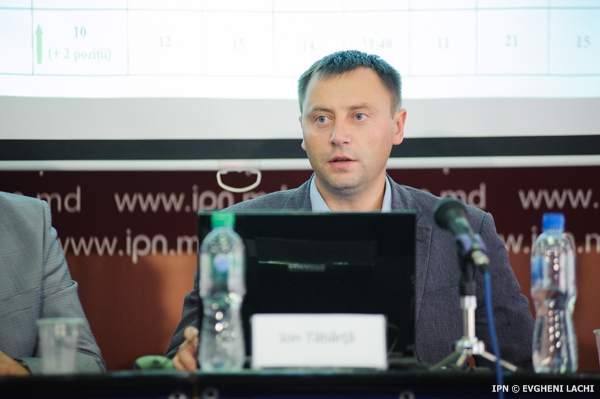
“On 24 February 2019, new parliamentary elections were held in the Republic of Moldova, which was long awaited and discussed. In particular, it was expected because the electoral exercise was conducted according to the new rules – the mixed electoral system. The “zero kilometer” of the Democratic Party is the free and fair election. If they do not meet these two conditions, then we cannot talk about a democratic society, explained the analyst of “IDIS Viitorul Ion Tăbârţă within the show ”the 15 minutes of economic realism”, conducted by IDIS” Viitorul “in partnership with Radio Free Europa.
According to TRIBUNA, Ion Tăbârţă mentioned that the electoral campaign in the Republic of Moldova took place with great organizational problems.
According to him, the first data show that the PSRM has accumulated 35 mandates, PDM – 30 mandates, the Bloc “NOW” – 26 mandates, the Sor Party -7 and three independent candidates. If the elections were organized according to the proportional system – PSRM would have won the same score, the winner of the mixed electoral system is PDM, which has accumulated with more four or five mandates, and the losers are the Bloc “NOW” and the “Sor” Party.
“A first post-election scenario is that we will have early elections because no party has accumulated the majority in the Parliament, but we could say 99% that the anticipated will not be. The political formations have spent a lot of money, so they will throw money for a new campaign and have no guarantee that they will accumulate the same score. This is especially the case of the PDM that holds the “bread and knife” of the current functioning of state institutions, “analyst Ion Tăbârţă believes.
The analyst mentioned that the PSRM, which has the most mandate, cannot come to the government alone, but only in a big coalition with the PDM. “However, whatever will be the formula, PDM will be in government. Naturally, the Democrats will be joined by the seven deputies from the “Sor” party, the two independent elected representatives in the constituencies on the left bank of the Dniester River, and the third w was elected in the Cahul constituency. PDM can go to government together with PSRM, forming a great coalition – pro-Moldova. Another scenario is the one used by PDM at the end of 2015 – the re-election of MPs from other parliamentary factions. This would mean the massive migration of 11-12 deputies for the constitution of a simple majority of government, most likely from PSRM, because it will be more difficult for deputies to take over from the “NOW” bloc, perhaps with some exceptions. Most likely, the block “NOW” will be in a tough opposition that will contribute to the liberation of the Republic of Moldova by oligarchs and preparation of the local, presidential and next parliamentary elections, “the analyst said.
In conclusion, Ion Tăbârţă stated that no matter what governmental coalition it will be, it will not lead to the immediate resumption of relations with the EU, but at the same time, the danger of a vectorial change of the Republic of Moldova from the west to the east has decreased.
Cristina Pendea
Trainee translator: Mihaela Grosu
 Loading ...