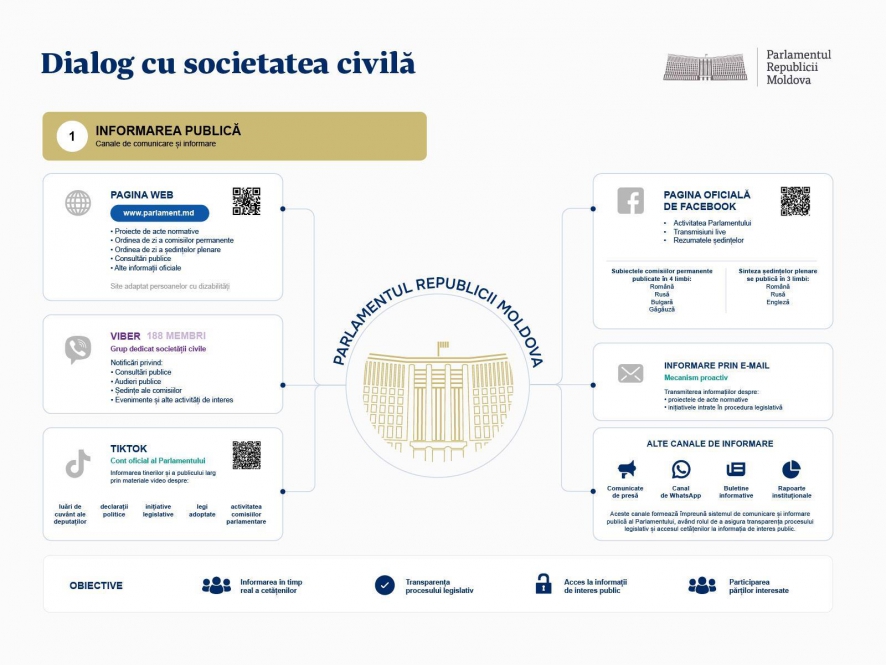
In the first half of 2026, Parliament continued to ensure civil society’s participation in the legislative process and to strengthen public consultation and expert input mechanisms, TRIBUNA reports.
During the period under review, 61 events were organized, including public consultations and hearings, working meetings, round tables, and other activities, with representatives of more than 50 civil society organizations taking part. At the same time, 21 draft laws were submitted for public consultation. As part of these consultations, civil society representatives submitted 68 recommendations, of which 51.4% were fully or partially accepted and incorporated into the legislative process. The data reflect the continuity of dialogue between Parliament and civil society and contribute to strengthening a participatory and transparent legislative process.
Another mechanism through which Parliament draws on civil society expertise is the expert councils established under the permanent parliamentary committees. During the first half of the year, the expert councils held 22 working meetings, examining issues such as agricultural policy, the protection of crime victims, telemedicine, social services, environmental protection, and tax policy. Following these discussions, 17 recommendations were formulated.
One example is the Expert Council attached to the Committee on European Integration, known as “Experts for the EU.” It consists of 45 experts in areas relevant to the European agenda, including international relations, European affairs, law, economics, environmental policy, political science, human rights, and gender policy. The Council also includes 17 experts from the diaspora who work in Romania, the United States, Germany, Austria, Denmark, the United Kingdom, Canada, Belgium, and Ireland. Their involvement makes it possible to draw on European and international experience and practices relevant to the European Union accession process.
The recommendations formulated by the expert councils were incorporated into the process of drafting opinions and improving certain legislative initiatives. Thus, the expert council mechanism contributes to strengthening cooperation between Parliament, academia, and civil society and to ensuring that decision-making is grounded in specialized expertise.

 Loading ...