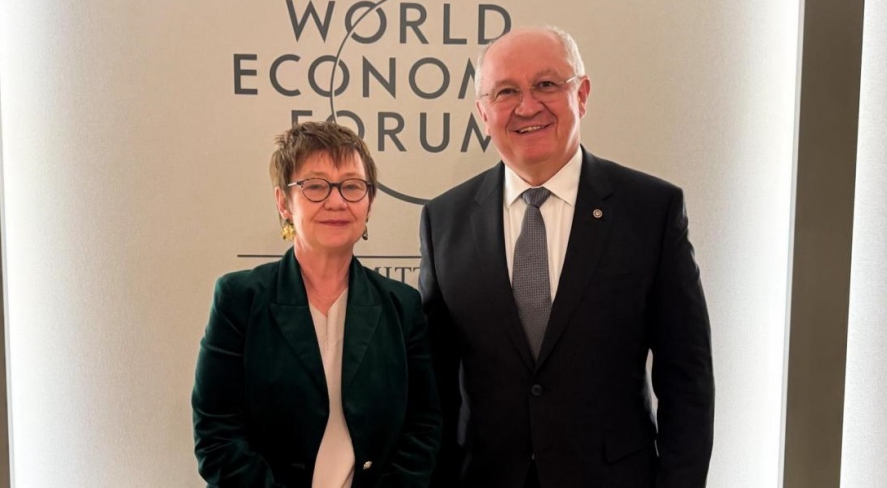
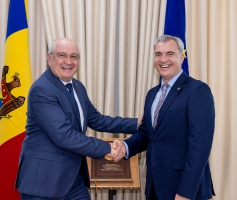
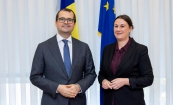
Prime Minister Alexandru Munteanu met with EBRD President Odile Renaud-Basso to review ongoing projects supported by the European Bank for Reconstruction and Development and to outline Moldova’s infrastructure priorities for the year. Munteanu highlighted the essential role of EBRD support in advancing national reforms, strengthening Moldova’s European agenda, and attracting foreign investment.
Discussions focused on priority projects in energy, rail, and road infrastructure aimed at improving internal connectivity and strengthening links with Romania and the European Union. Over the past four years, Moldova has made significant progress in enhancing its energy independence, including through the nearly completed Vulcănești–Chișinău power line, with testing scheduled for February–March 2026. Two additional strategic power lines — Strășeni–Gutinaș and Bălți–Suceava — are also planned.
Major infrastructure initiatives include a 25‑km electrified railway segment between Iași and Ungheni built to European gauge standards, and the construction of Moldova’s first motorway, the A1, which will extend Romania’s A8 and create a direct Romania–Chișinău–Odesa corridor.
Other priorities include completing the Fălciu railway bridge, reopening the Cahul–Galați line for freight and passenger transport, and continuing large-scale modernization programs such as “European Village” and “European Courtyard.”
Currently, 67 EBRD projects worth a combined €1.1 billion are active in Moldova, with around 24% of the portfolio dedicated to enterprise support. The EBRD remains the country’s largest institutional investor, contributing nearly €2.9 billion across 193 projects, 64% of which focus on infrastructure.

 Loading ...