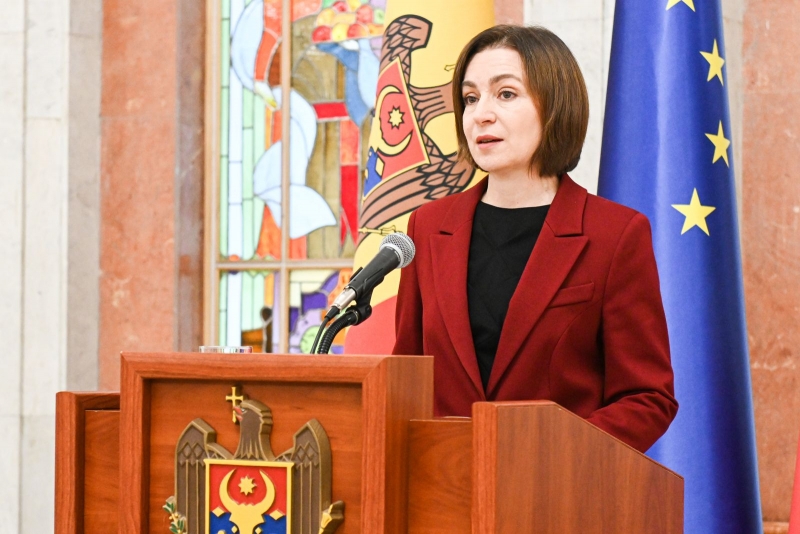
President of the Republic of Moldova Maia Sandu stated during a briefing that reforms in the justice sector are extremely important and will continue.
“Yesterday, Parliament adopted Law No. 333 aimed at increasing transparency in the administration of the judiciary and the Prosecutor’s Office, as well as strengthening the integrity of judges who examine corruption cases.
I have seen numerous reactions to this initiative and I want to present my own position, especially in the context of the latest developments in the justice system. In recent years, we have made significant efforts to clean up and reform justice and to ensure more effective conditions for combating corruption.
We can say that in certain areas of the justice system things have begun to function better and have improved, including thanks to the fact that some judges and prosecutors do their work honestly, in accordance with the law, and do not shy away from responsibility.
However, unfortunately, there are still areas of the system where actors in justice continue to collaborate with criminals and make every effort to preserve elements of the old, corrupt system,” the President said.
According to her, it is enough to look at the length of time cases take to be examined, especially high-profile ones.
“I will give just a few examples from publicly available information: a case involving an organized criminal group has been under court examination for 11 years, with only four years left until the statute of limitations expires, as happened in the Laundromat case. Another case involving an organized criminal group accused of drug trafficking has been in court for seven years. Another case of embezzlement of property has been examined for 11 years, and a similar case for nine years.
Cases related to banking fraud and money laundering: one case concerning fraud at Banca de Economii has been examined in court since 2013, while other banking fraud cases date from 2018, 2019, 2020, 2021, and 2022. In one case, only three witnesses were heard in three years; in another, five witnesses were heard in five years. You can draw your own conclusions. In my view, these examples are clear proof that some judges intentionally delay the examination of cases, and we can assume that they do so in order to obtain illegal benefits.
What happens with such cases? Who sanctions such behavior? I have not seen firm reactions from self-governing bodies. The Superior Council of Magistracy should have taken a much stronger stance in these cases,” Maia Sandu emphasized.
The President said that when the clean-up of the system began, she had hoped that the extraordinary evaluation of key justice institutions would be complemented by regular evaluations.
“We see that this is not happening sufficiently. Schemes of sabotage and corruption within the justice system have not disappeared.
There are increasingly worrying signals that some judges in first-instance courts are sabotaging and avoiding the examination of cases that are important for the country, relying on the fact that they will not be subject to vetting, that is, extraordinary external evaluation.
Due to the irresponsibility of certain actors in the justice system, there are major risks that some episodes of the banking fraud case will not reach final conclusions.
We cannot helplessly watch these abuses. We must move forward with firm measures to ensure an honest and effective justice system, and for the fight against corruption to deliver results. That is why I believe the legislative initiative adopted by Parliament yesterday is appropriate,” she stated.
She explained that the parliamentary initiative proposes including in the extraordinary evaluation process certain first-instance judges—those who since 2017 have examined or are examining corruption cases and related offenses.
“I believe we need to go even further, especially since the European Commission’s 2025 Enlargement Report recommends amending legislation to provide for mandatory external evaluation of all judges specialized in anti-corruption, including those in the specialized first-instance panel, by the relevant external evaluation commission.
In this regard, I ask Parliament, the Ministry of Justice, the Superior Council of Magistracy, and other responsible authorities to analyze the issue within a working group and urgently initiate measures regarding: – revising the vetting mechanism in order to expand the categories of judges subject to extraordinary evaluation; and/or
– accelerating the internal procedures of the relevant panel within the Superior Council of Magistracy for evaluating judges’ performance.
Justice reform is extremely important both for the functioning of the state and for our process of accession to the European Union. If the measures taken so far prove insufficient, we must move forward, correct, accelerate, and strengthen this reform. And this is what we will do,” the President said.
Maia Sandu also addressed the issue of convicted or accused persons evading justice before sentencing.
“Another problem I want to address—one that has been widely discussed in society in recent days—is that individuals awaiting sentencing leave the territory controlled by the constitutional authorities before the sentence is pronounced. The Transnistrian region is increasingly being used to evade serving sentences. The procedures for putting convicted persons on wanted lists are ineffective, as they involve timeframes that endanger the possibility of locating the person, thus losing the chance to bring them before justice.
In this context, I ask the Government to improve the existing framework and to undertake the necessary legislative measures to prevent convicted persons from evading the execution of sentences, including by simplifying the procedure for declaring a person wanted immediately upon sentencing and the issuance of an arrest measure for the execution of the sentence,” she added.
In conclusion, Maia Sandu urged society “to recognize and appreciate the efforts of honest people in the system—judges and prosecutors who do their work responsibly, despite pressure from corrupt groups.”
“But it is necessary for all judges and all prosecutors to behave correctly in all institutions and at all levels. Therefore, reforms will continue,” she concluded.


 Loading ...