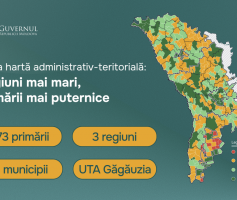
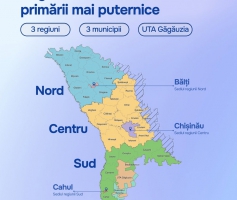
The Liberal Democratic Party of Moldova (PLDM) has expressed concern over the administrative reform promoted by the government, arguing that the proposed model of three regions and 273 mayors’ offices was presented without clarifying the powers, funding, local autonomy, and management of public assets of the future administrative structures, TRIBUNA reports.
The PLDM believes that the reform should be based on citizens’ needs, the economic capacity of communities, and effective decentralization, rather than simply reducing the number of mayors’ offices and districts.
“The new territorial configuration was presented before the powers, resources, and responsibilities of the future authorities had been established and publicly assessed. Parliament must be informed in advance about the costs of the reform and the sources of funding. Without financial decentralization, mayors’ offices risk becoming executors of government decisions without sufficient resources. Therefore, the territorial structure, powers, and funding mechanisms must be presented together,” the party stated.
The PLDM argues that moving from voluntary amalgamation to reorganization imposed by law raises concerns about local autonomy and participatory democracy. Article 109 of Moldova’s Constitution guarantees local autonomy and decentralization, while Article 5 of the European Charter of Local Self-Government provides for consultation with affected local communities when territorial boundaries are changed.
“Informational meetings cannot replace genuine consultations. The government must explain how it has examined the objections raised by communities and what criteria it has used to define the boundaries of the new mayors’ offices,” the party said.
The abolition of districts also requires clarification regarding the transfer of debts, contracts, investments, externally funded projects, legal disputes, and public assets. Without a comprehensive inventory and clear transitional rules, the reform could lead to litigation, jurisdictional conflicts, and interruptions in public services.
The PLDM is therefore calling for transparent rules governing legal, financial, and property succession to protect community assets and interests.
According to the party, the reform should serve economic development rather than merely redraw the administrative map. Strong regions need infrastructure, investment, dynamic urban centers, businesses, and jobs.
The PLDM argues that the government has not demonstrated that the three-region model is superior to alternative proposals or clarified whether the new regions would have decision-making autonomy and their own resources.
The party warns that the reform could further concentrate power and resources at the central level under the guise of decentralization. It believes the new territorial configuration should be based on verifiable economic, geographical, demographic, and institutional criteria rather than electoral interests.
The PLDM also raises concerns about financial incentives or conditions attached to amalgamation, changes to the rules governing the establishment of new administrative units, and the potential weakening of local consensus in the decision-making process.
PLDM’s Key Demands
In this context, the Liberal Democratic Party of Moldova is calling on the government to:
-
- Publish the legislative package and studies assessing the reform’s economic, budgetary, institutional, and constitutional impact.
-
- Present the territorial boundaries, powers, and funding arrangements together for the new administrative authorities.
-
- Conduct genuine consultations with local authorities and affected communities.
-
- Establish a legal framework for the transfer of district assets, finances, and contractual obligations.
-
- Independently assess the three-region model and compare it with alternative proposals.
-
- Link the reform to regional economic development, job creation, and the reduction of territorial disparities.
-
- Revise the legislative timetable until legal and financial safeguards have been clarified.
The PLDM says it supports the modernization of local public administration but insists that reform cannot be reduced to changing administrative boundaries.
“Changing the map does not mean decentralization, and a larger administration is not necessarily a stronger one,” the party stated.
The PLDM is calling on the government to engage in genuine institutional dialogue based on the Constitution, local autonomy, and sustainable economic development.

 Loading ...