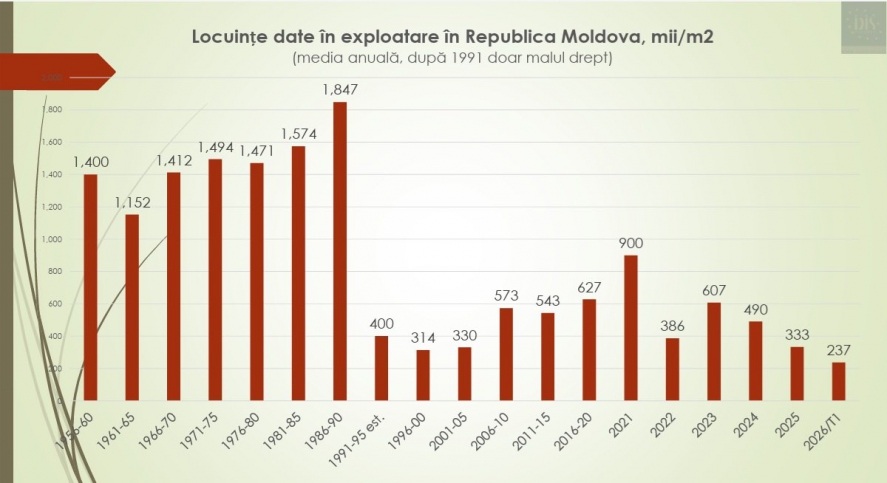
“Never in the last 70 years has so little housing been commissioned. We are facing a blockage in the real estate market, and the situation is particularly severe in Chișinău, which accounts for approximately 70% of all housing construction in the country,” said Veaceslav Ioniță, economic policy expert at IDIS “Viitorul,” during the weekly program “Economic Analyses with Veaceslav Ioniță.”
The expert noted that after a peak of 899,000 square meters of housing commissioned in 2021, the market entered a sharp downward trend. In 2025, only 333,000 square meters were put into operation, while during the first three months of 2026 just 17,000 square meters were completed. Annualized, the first quarter of 2026 points to only 237,000 square meters, the lowest level in the history of the Republic of Moldova.
Veaceslav Ioniță explained that the difficulties are caused by a decline in the number of construction permits, slower activity in the sector, and challenges faced by companies in completing and commissioning residential projects. In Chișinău, where 203,000 square meters of housing were commissioned in 2025, only 5,000 square meters were recorded during the first quarter of 2026. On an annualized basis, the capital has reached a historic low of 117,000 square meters.
“There are still purchase and sale transactions on the market, but the major problem is the small number of new homes being commissioned. The authorization, construction, and commissioning processes have become significantly more complicated, and the effects are evident in the dramatic decline in construction volumes,” he explained.
According to the analysis, while an average of about 40 square meters of housing per 100 residents was commissioned 70 years ago, the indicator dropped to 10 square meters in 2025 and to only 7 square meters in the first quarter of 2026, the lowest level ever recorded.
Veaceslav Ioniță also highlighted that Chișinău’s real estate market has collapsed over the past three years. While around 8,000 apartments were commissioned annually in the 1980s and approximately 6,700 in 2021, the annualized figure for the first quarter of 2026 fell to about 1,000 apartments. Over the last three years, roughly 4,500 apartments have been commissioned—fewer than in 2023 alone, when around 4,900 apartments were completed.
The expert also pointed to an unusual shift in the geographical distribution of construction. Although Chișinău has accounted for about 85% of the total value of residential construction and 70% of the built residential area over the past 15 years, the area of housing commissioned outside the capital has now surpassed that within the municipality, a situation rarely seen before.
Veaceslav Ioniță further emphasized the low level of investment in residential construction compared to other European countries. In 2025, residential construction represented only 1.4% of Moldova’s GDP, compared to 3% in Romania and an average of 5% across the European Union.
The expert stated that urgent measures are needed to unblock the real estate market, as “without interventions aimed at facilitating the authorization and commissioning of housing projects, the decline in residential construction will continue in the coming period, further increasing the shortage of new housing and the difficulties faced by the sector.”







 Loading ...