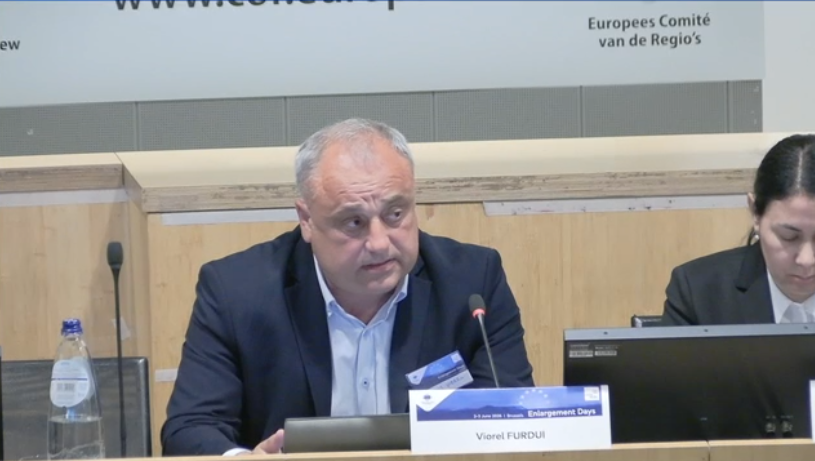
European integration of the Republic of Moldova and the reform of local public administration were discussed in Brussels during EU Enlargement Days, at the meeting of the Working Group for the Republic of Moldova of the European Committee of the Regions. At the event, the Congress of Local Authorities of Moldova (CALM) called on the European Committee of the Regions to closely monitor the reform process and to help mediate an authentic dialogue, given the worrying signals regarding the deterioration of local democracy. Moldova’s European path must remain anchored in genuine local democracy, subsidiarity, and respect for local communities, TRIBUNA reports.
CALM’s Executive Director, Viorel Furdui, explained that the Republic of Moldova is in a paradoxical situation. On the one hand, there is full consensus on the vital need to reform local public administration — no one disputes this necessity. On the other hand, there is no consensus at all regarding the reasons, the haste, the methods used, or the direction of the reform.
Over recent years, cooperation between CALM and the Government has led to important progress in local democracy: strengthening institutional dialogue, improving local public finances, increasing transparency, and reinforcing administrative oversight mechanisms. This collaboration has helped advance the recognition of the role of local authorities and the promotion of autonomy and subsidiarity.
Despite these achievements, CALM notes with concern a rapid deterioration in the state of local democracy in Moldova across all key areas: institutional dialogue, local public finances, the capping of local taxes, administrative control, and pressure on local elected officials.
In particular, as discussions on local public administration reform have intensified, communication between CALM and the State Chancellery — the institution responsible for the reform — has diminished, even though relations with other state institutions remain constructive.
Identified challenges
The reform of local public administration raises several major challenges. First, there is a conceptual dilemma between a strictly technocratic, efficiency‑driven approach and one centered on community, identity, and political representation. If the focus remains solely on economic efficiency, many villages risk being viewed merely as “costly units,” which could lead to their administrative disappearance and the loss of community identity.
Another issue is the confusion between causes and effects. Problems such as lack of infrastructure, depopulation, or insufficient jobs are not caused by the size of municipalities. If the reform ignores this, amalgamating villages may solve nothing, leaving communities without resources or real support.
There is also concern about the voluntary nature of the reform. Local authorities feel pressured, placed in absurd situations where they must choose to “voluntarily” dissolve themselves — either by their own decision or by the Government’s. And if they do not dissolve voluntarily, they risk losing access to funding or being forcibly amalgamated. This approach is already generating tension, division, and growing mistrust among mayors and within society.
Finally, the rigid threshold of 3,000 inhabitants required for amalgamation creates difficulties. In many cases, even after merging several communities, the threshold is not met, leading to administrative blockages, exclusion of some localities from the process, and a sense of discrimination.
Major risks highlighted by CALM
CALM warns of significant risks. First, there is the danger of increased tension and division within society and among local authorities. If the reform is perceived as imposed, communities may respond with protests, legal challenges, or refusal to implement new rules. This would weaken social cohesion at a time when Moldova needs unity more than ever.
Second, there is the risk of negative impact on Moldova’s European integration. A weakened local democracy could be interpreted by European partners as a setback, affecting the country’s credibility in accession negotiations. In an electoral context, with local and presidential elections approaching, instability at the local level could undermine trust and reduce support for European integration.
CALM’s proposed solution
CALM believes that the way forward is not the liquidation of communities, but a phased, evolutionary, and flexible solution inspired by successful European models (France, Germany, Czechia), which separate political representation from economic efficiency. The core principle is “legally independent, but functionally united”, or, adapted to Moldova’s context: “NO to abolishing town halls – YES to amalgamating services!”
According to CALM’s vision, the reform should continue with genuine regionalization in line with EU standards (3–5 NUTS 2 regions), focusing on truly voluntary amalgamation, especially around towns, and strengthening them through competencies and resources. At the same time, villages — under asymmetric decentralization — must retain their legal status, mayor, and council, ensuring direct citizen–state connection, with appropriate competencies and resources.
For efficiency, localities should be encouraged by law to cooperate in inter‑municipal structures for managing complex services (water, waste, transport) and for attracting major funding.
Conclusion
CALM considers it essential to restore institutionalized dialogue on the reform within the Joint Commission and to identify solutions that preserve local democracy throughout the reform process — a fundamental element of a democratic state governed by the rule of law.
“You cannot look at local public administration solely through an economic or mathematical lens. There are numerous administrative, cultural, traditional, social cohesion and identity‑related aspects — all crucial for understanding the essence of what a local community and local democracy truly mean.”




 Loading ...