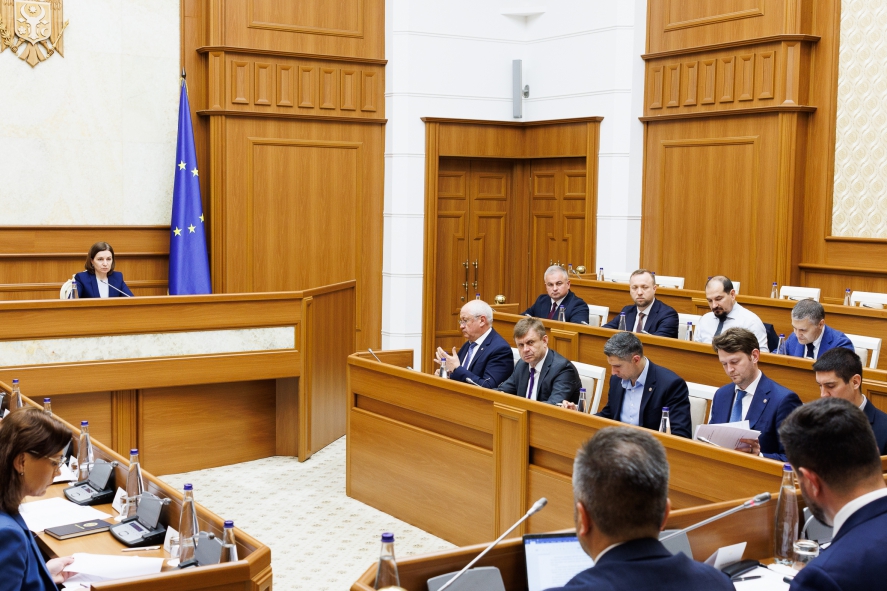
President Maia Sandu chaired a meeting of the National Security Council yesterday, during which members reviewed the Republic of Moldova’s current energy situation against the backdrop of international tensions, developments on external markets, and the measures needed to ensure the country’s energy security in the coming period, TRIBUNA reports.
According to the assessment presented at the meeting, there is currently no immediate risk to Moldova’s supply of natural gas, electricity, or fuel. State authorities continue to closely monitor global developments and are preparing measures in advance for any possible scenario, in order to protect the population and the economy in the event of new disruptions.
A key topic on the Council’s agenda was the progress of strategic energy infrastructure projects aimed at strengthening Moldova’s interconnection with Romania and, by extension, with the European energy network. Officials reviewed the status of the Vulcănești–Chișinău, Bălți–Suceava, and Strășeni–Gutinaș power line projects, noting that the contractual deadline for completing the Vulcănești–Chișinău line is the end of June.
Council members also discussed the development of energy storage capacities, the expansion of renewable energy use, and the acceleration of energy‑efficiency projects, all essential for strengthening Moldova’s energy independence. It was agreed that Energocom will continue diversifying supply sources and routes to ensure access to as many procurement options as possible and reduce external vulnerabilities.
The meeting also examined the physical and cyber security of critical energy infrastructure, given the heightened risks stemming from the regional context.
At the conclusion of the meeting, the National Security Council approved decisions concerning:
- continuous monitoring of energy‑related risks;
- preparation of a support program for vulnerable households for the cold season;
- acceleration of strategic energy projects;
- development of storage and energy‑efficiency capacities;
- reduction of physical and cyber vulnerabilities of energy infrastructure;
- rapid and transparent public communication to prevent panic and speculation.
The Council also emphasized the importance of reducing energy consumption in public institutions, households, and the private sector, noting that energy efficiency is a key contribution to strengthening the country’s overall energy security.




 Loading ...