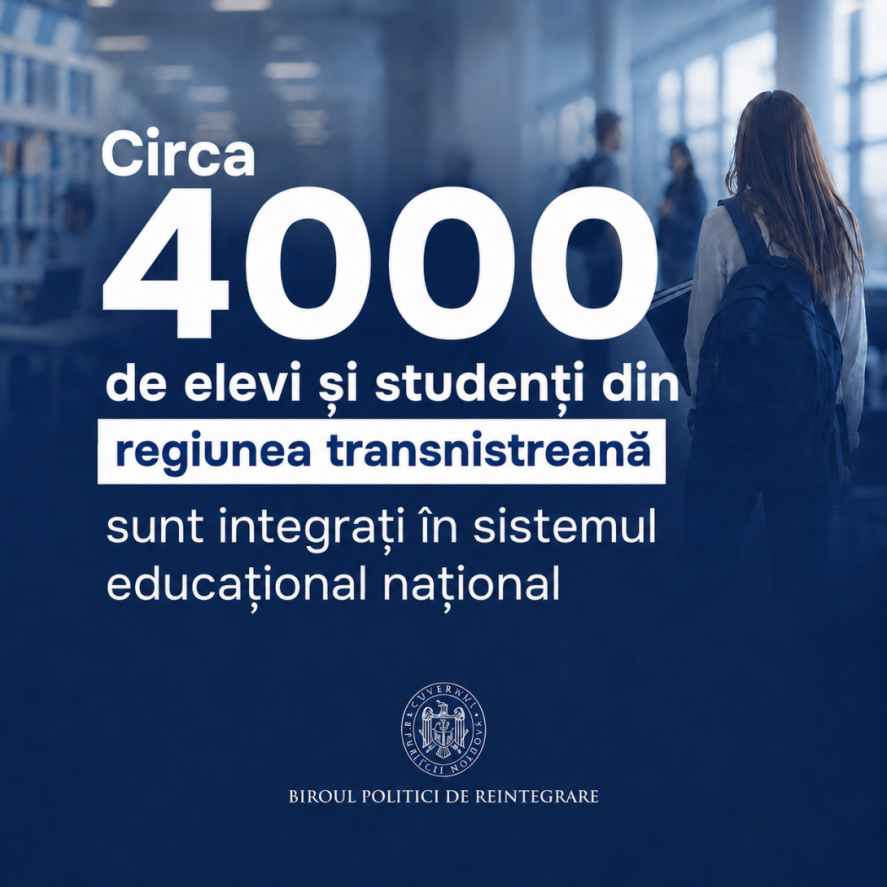
Approximately 4,000 children and young people from the Transnistrian region and the municipality of Bender are enrolled in the national education system, receiving education in general schools, vocational and technical institutions, and higher education establishments. The figure also includes around 2,000 students attending Romanian-language schools in the region that are subordinated to the Ministry of Education and Research, TRIBUNA reports.
According to the Reintegration Policy Bureau (BPR), during the 2025–2026 academic year, 971 students residing in the Transnistrian region and Bender studied in general education institutions located on the right bank of the Dniester River. Most of them were enrolled in schools in the districts of Dubăsari, Anenii Noi, and Rezina and received funding under the same conditions as all other students in the public education system, without differentiation based on residence or region of origin.
At the same time, 346 young people from the Transnistrian region are enrolled in state-funded places at vocational and technical education institutions. The average annual cost of training a student amounts to 26,000 lei in vocational schools and 32,500 lei in colleges and centres of excellence.
Another 674 young people from the region are pursuing studies at state-funded places in public higher education institutions, including through the compensatory year programme. The estimated expenses for their education, scholarships, and dormitory accommodation exceed 37.4 million lei. These measures contribute to expanding educational opportunities and integrating young people into Moldova’s unified educational space.
To facilitate the continuation of studies and the recognition of qualifications abroad, graduates of educational institutions from the Transnistrian region can benefit from a mechanism for the issuance and apostillation of neutral-model diplomas. By June 30, 2026, 681 such diplomas had been apostilled, including 26 during the first half of 2026.
This mechanism does not imply recognition of diplomas issued by unaccredited entities in the region. Instead, it provides holders with a neutral-model educational document that can receive the apostille of the Republic of Moldova, enabling access to international educational opportunities.
 Loading ...