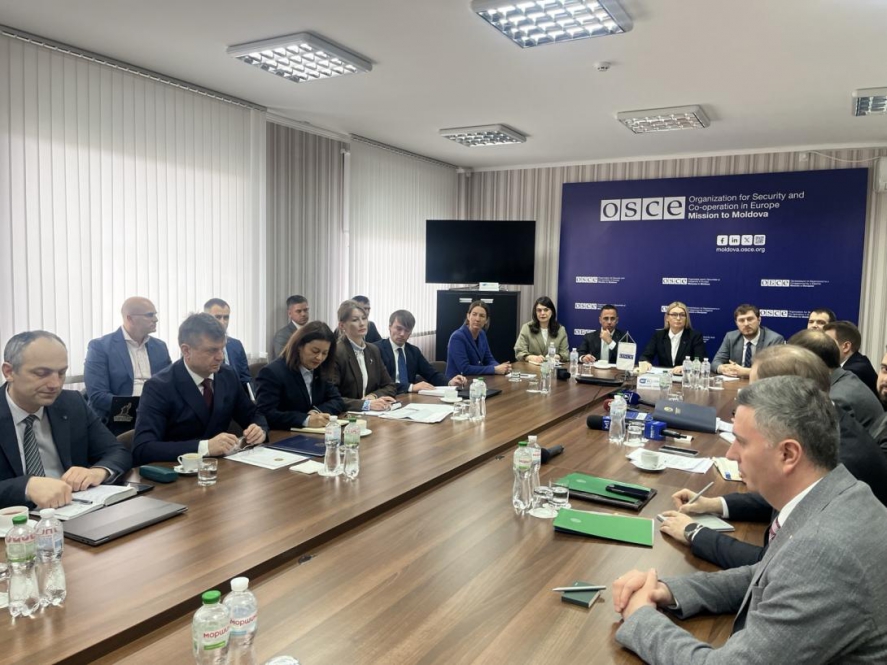
On 26 February 2026, a new working meeting took place at the OSCE Mission office in Tiraspol between the political representatives in the Transnistrian settlement negotiations — Valeriu Chiveri for Chișinău and Vitalii Ignatiev for Tiraspol — after a pause of more than 15 months (the previous meeting was held on 19 November 2024), TRIBUNA reports.
In his remarks, Deputy Prime Minister Chiveri reiterated the firm commitment of the authorities of the Republic of Moldova to achieve a sustainable and peaceful settlement of the Transnistrian conflict, in full respect of the country’s sovereignty and territorial integrity within its internationally recognized borders.
The chief negotiator from Chișinău emphasized that the central objective of the settlement is the reintegration of the eastern districts into the unified legal, economic, social, and educational space of the Republic of Moldova — and not the development of alleged bilateral relations between the two banks. He urged the Tiraspol representative to abandon illusory approaches and to accept Chișinău’s reintegration offer, which has no viable alternative.
The intention to establish a convergence fund — financed through national and international contributions — was highlighted, with the aim of supporting social and infrastructure projects on both banks of the Nistru.
Chișinău expressed appreciation for Tiraspol’s constructive involvement in ensuring the supply of essential goods to residents of the Cocieri plateau during the suspension of the Molovata ferry. At the same time, Chișinău reiterated the need for a definitive solution to the issue of free movement in the left bank and in the municipality of Bender for all categories of citizens, including journalists, and for the removal of illegal control posts.
Human rights were again raised as an acute issue in the Transnistrian region. Chișinău called for the release of Moldovan citizens held in illegal detention and for the annulment of grounds used to persecute them for alleged extremist activities, referencing relevant cases pending before the European Court of Human Rights concerning violations committed in the region.
The long‑standing problems faced by farmers in Dubăsari district and by Romanian‑language schools in the region were reiterated, with a call for Tiraspol to honor previously assumed commitments. Chișinău also stressed the need to advance discussions on providing dedicated premises for the “Evrika” Theoretical Lyceum in Rîbnița and the “Ștefan cel Mare și Sfânt” Theoretical Lyceum in Grigoriopol.
The Deputy Prime Minister for Reintegration proposed that, starting 1 September of this year, all Moldovan educational institutions in the region introduce Romanian‑language instruction into the educational process, and that a pilot project be launched — beginning in Bender and later extended to other localities — to ensure residents’ access to the 112 Emergency Service.
Chișinău rejected as unfounded Tiraspol’s claims that the criminalization of separatism in Moldovan law constitutes an obstacle to the negotiation process. Regarding various cases of detentions at the state border or refusals of entry for foreign citizens, Chișinău clarified that these are individual situations handled by law enforcement bodies in accordance with the legal framework.
On Tiraspol’s initiatives to establish mechanisms of interaction between the two banks in areas such as crime prevention, early warning of seismic risks, and environmental protection, Chișinău specified that viable solutions and appropriate measures can be ensured only through access to the region for the competent national authorities.
Regarding the import of certain categories of medicines into the region, Chișinău noted that uncertainties can be resolved by complying with the legislation aligned with EU requirements and by harmonizing with the relevant nomenclatures used on the right bank.
The sides also discussed the process of issuing neutral‑design license plates for vehicles from the region. Chișinău underlined that this mechanism will remain functional for the categories of vehicles and parameters defined by current legislation, and that it cannot be applied to ambulances transporting patients, which must comply with specific medical protocols and regulations.
Chișinău also addressed Tiraspol’s attempts to politicize the content of recently published history textbooks on the right bank, recalling that local teaching materials continue to contain interpretations and narratives that portray developments in the Republic of Moldova in a negative light.
The political representatives agreed to maintain regular interaction, contribute to identifying viable solutions to current issues, and encourage the sectoral working groups to meet periodically and address technical matters on the agenda.
The date, location, and agenda of the next working meeting will be agreed through the communication channel between the offices of the political representatives.
 Loading ...