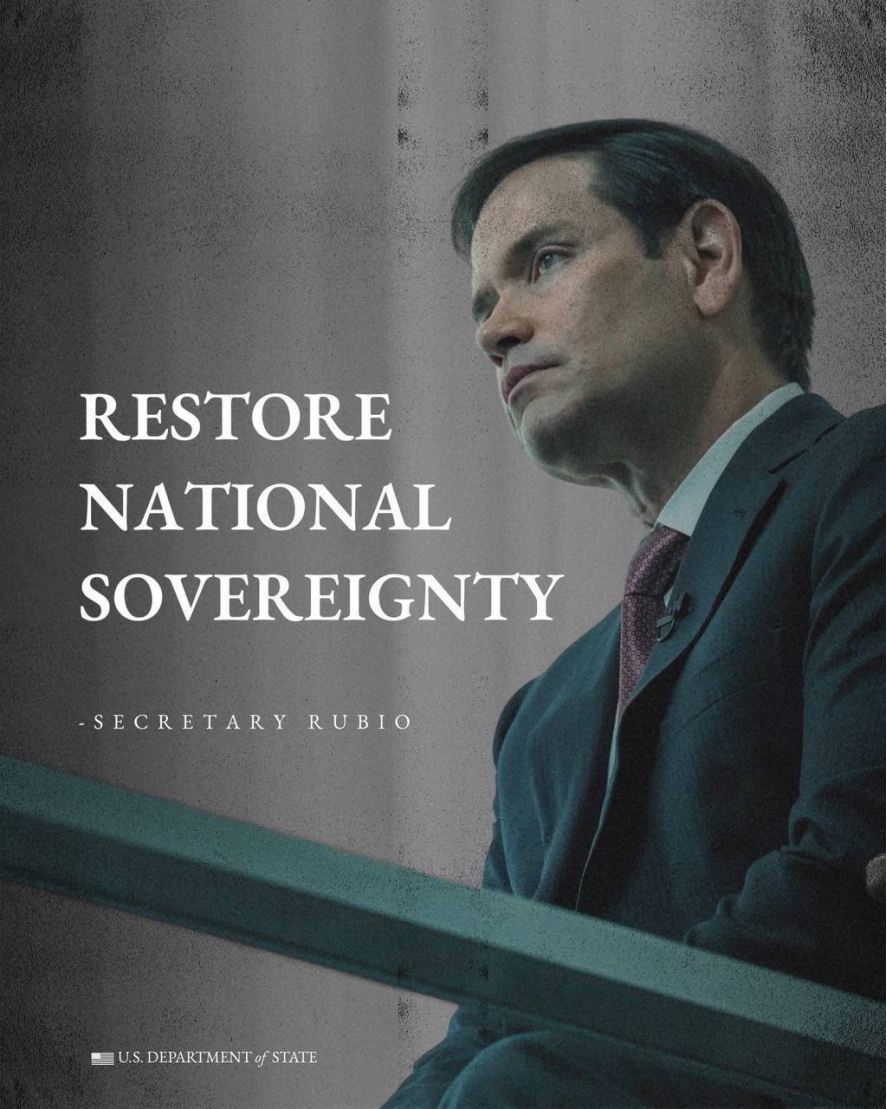
In Munich, in February 2026, the air felt thin and sharp, like the moment when something long‑familiar passes into oblivion. It was then that Marco Rubio’s unforgiving words echoed: “In America, we are not interested in being polite, well‑mannered spectators to the controlled decline of the West.” He spoke about the collapse of illusions with the same calm detachment one uses when recalling a past already consumed: “We believed that every country would inevitably follow the same trajectory. Now we see that this was a naïve idea, one that ignored human nature and the lessons of more than five thousand years of recorded history. And the costs have been considerable.”
No reproach, no pathos — only an unvarnished truth. He spoke of free trade turned into deindustrialization, of sovereignty ceded to impersonal institutions, of energy policies that impoverished nations. He listed them without emphasis, like a doctor delivering the diagnosis of an incurable disease, no longer disguising its name. Then, with an almost confidential inflection: “We are not seeking a rupture, but the revitalization of an old friendship and the renewal of the greatest civilization in human history.” In these words there were no threats, no promises — only fatigue and resolve.
For small states like the Republic of Moldova, the message landed like a sudden awakening. Only two options lie ahead. The first — a “cardboard façade,” a dusty menu forgotten under a table in Bulboaca: reforms displayed with pomp, triumphant reports, but behind the décor the same vulnerability — dependence on external decisions. The second — a direct, difficult, unglamorous path: strengthening institutions, rebuilding the economy, and asserting a policy anchored in national interest. Not for external applause, but for the dignity and well‑being of one’s own citizens. Did Maia Sandu understand Marco Rubio’s warning about the risks of delegating sovereignty to supranational structures that have become anachronistic?
Rubio did not name names. Yet his statement — “Armies fight for the people, armies fight for the nation” — sounded like a reminder: security does not lie in appearances, in décor, in illusory constructions, but in substance, in the real capacity to defend what is one’s own, without masking fragility. The Munich Conference of 2026 did not mark an ending, but a moment of clarification. The old order was not reformed — it became history. From now on, every state — large or small — faces a choice: to live according to patterns imposed from outside or to assume responsibility for writing its own history. Time for reflection is limited. And the choice is remarkably simple.
Vlad Filat, former Prime Minister of the Republic of Moldova, leader of the Liberal Democratic Party of Moldova


 Loading ...