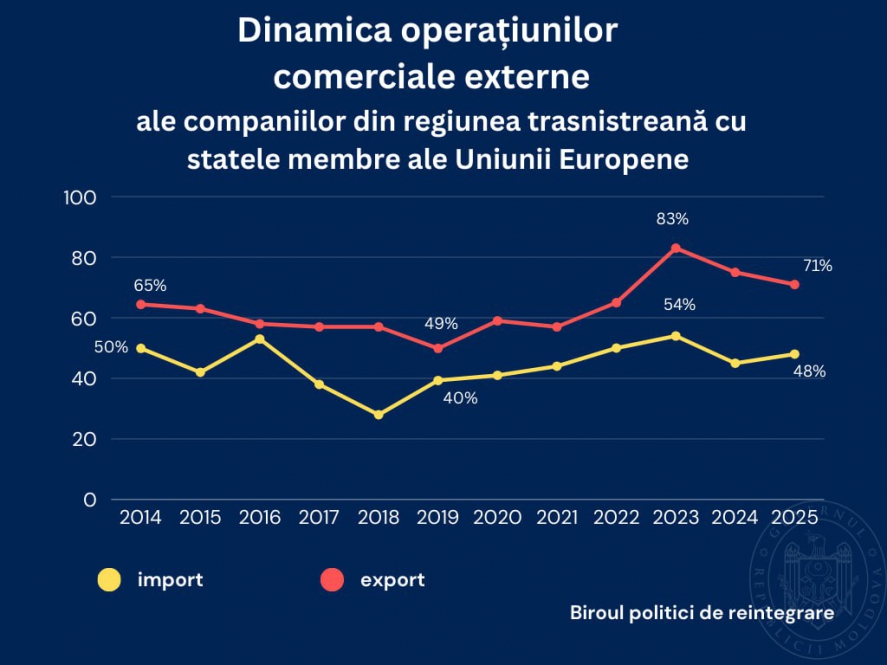
Exports from the Transnistrian region of the Republic of Moldova to the EU market accounted for 71% of all commercial activity last year. In 2025, economic agents from the Transnistrian region of the Republic of Moldova continued to conduct foreign trade predominantly with the member states of the European Union (EU), TRIBUNA reports, citing the Bureau for Reintegration Policies.
According to data provided by the Customs Service, imports from the EU made up 48% of the region’s total imports, while exports to the EU market represented 71% of all commercial activity. The main export destinations within the European Union were Romania, Poland, and Italy.
Over the past year, national authorities issued 3,894 certificates of origin for goods produced by economic agents in the Transnistrian region, of which 2,099 confirmed preferential origin for trade with EU member states. These figures reflect the strengthening of trade relations with European markets and the deepening of economic alignment with the rules of the single market.
It is important to underline that, over the past four years, the conduct of external trade through customs control points monitored by the Customs Service of the Republic of Moldova, along with the use of nationally issued permits, has had a significant impact on the region’s economic reintegration. Adjustments to logistics chains have facilitated a marked reorientation of Transnistrian trade toward the European Union, while also strengthening economic ties between the two banks of the Nistru River and ensuring the uniform application of commercial standards and procedures across the entire territory of the Republic of Moldova.
Recent developments confirm the region’s sustained orientation toward the EU market, reinforcing economic interaction between the two banks of the Nistru and contributing to the broader process of Moldova’s economic reintegration into the European space.






 Loading ...