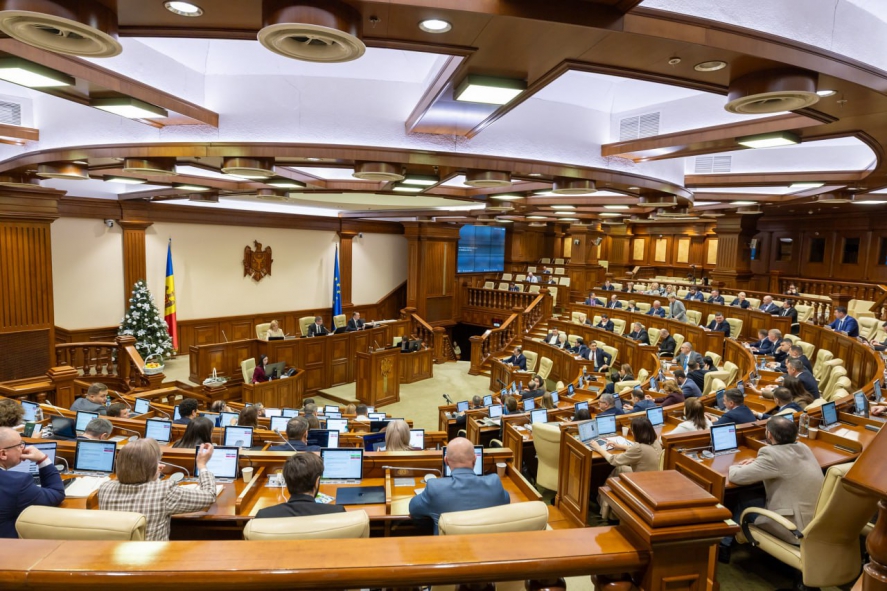
Parliament has adopted at second reading the draft law on the state budget for 2026. The document aims to strengthen economic resilience, develop infrastructure, boost the competitiveness of the private sector, and promote strategic investments in priority sectors of the economy.
The minimum wage in the public sector will also increase from 5,500 to 6,300 lei. Employees in budgetary institutions whose monthly salary, calculated for a full-time position, is below 6,300 lei will receive compensatory payments.
In 2026, revenues are expected to grow by 5.1% compared to the current year, exceeding 79.67 billion lei. The largest share of projected revenues — 91.4% — will come from taxes and duties. According to the Ministry of Finance, revenue growth is driven by moderate economic growth, favorable external developments, and progress in structural reforms.
At the same time, expenditures will increase by 7% compared to 2025 and will exceed 100.57 billion lei. The authors note that 93% of the planned expenditures will be covered from the general resources of the state budget, while over 5.7 billion lei will be allocated to projects financed from external sources.
According to the Ministry of Finance, the 2026 state budget places strong emphasis on responsible investments. Capital investment spending will increase by 35.6% compared to 2025 and will exceed 3 billion lei — the highest level in recent years. These funds are intended for the implementation of 85 infrastructure projects, including roads, nurseries, school catering, and the renovation of kindergartens. Additionally, 5.6 billion lei will be allocated from the EU Growth Plan for investment projects, infrastructure, and reforms.
More than 47% of capital investment expenditures will be directed to the economic sector, amounting to 1.44 billion lei. Of this amount, 81.8% will be used for externally financed road rehabilitation projects. Another 245 million lei will be allocated to water supply and sewage projects.
The document also stipulates that allocations for general public services will account for 16% of total state budget expenditures, or 16.1 billion lei. Of this amount, 74% will be directed toward development programs and other sectoral activities, including the implementation of information technologies, support for the diaspora, and financial support for local public authorities.
Allocations for economic services will amount to 14.85 billion lei, representing an increase of 25.8% compared to 2025. Specifically, 1.06 billion lei will be allocated to support small and medium-sized enterprises; 561.8 million lei to electricity generation and storage; 465.2 million lei to the National Fund for Agriculture and Rural Development; and 284 million lei to the National Fund for Regional and Local Development, among others.
A total of 9.8% of state budget expenditures, or 9.89 billion lei, will be allocated to healthcare. The funds are earmarked for developing an integrated regional healthcare network, implementing electronic health records, introducing a medicine monitoring and tracking system, and expanding access to innovative medicines.
Education will receive 21.94 billion lei, including 238 million lei for free meals for lower secondary school students, 35 million lei for increasing student scholarships, and 41 million lei for renovating kindergartens. Social protection will be allocated 22.47 billion lei.
For the second reading, the draft law was supplemented with amendments proposed by Members of Parliament. A total of 81 amendments providing for additional expenditures were registered. At the proposal of MP Radu Marian, an additional 20 million lei were allocated to the “Bridge Export” promotion program. MP Liliana Nicolaescu-Onofrei proposed allocating 3.5 million lei for the renovation of one floor of the dormitory of the Academy of Music, Theatre and Fine Arts. MP Maxim Potîrniche proposed allocating 12 million lei for the feasibility study of the National Stadium “Arena Națională.”
An amendment proposed by MP Vladimir Odnostalco was also approved, providing an additional 15 million lei for transport compensation for persons with disabilities. Another amendment by MP Olga Ursu allocating 5 million lei for the renovation of the Triumphal Arch in the capital was adopted. Amendments submitted by MPs Valentina Meșină and Eugeniu Sinchevici regarding funding for youth centers across the country were also supported, as well as an amendment proposed by Vlad Batrîncea allocating 3 million lei for equipping forestry enterprises with drone systems for the sustainable management of the country’s forest fund.
According to estimates, the 2026 state budget will record a deficit of 20.9 billion lei. The main sources of financing will include both domestic and external resources.
 Loading ...