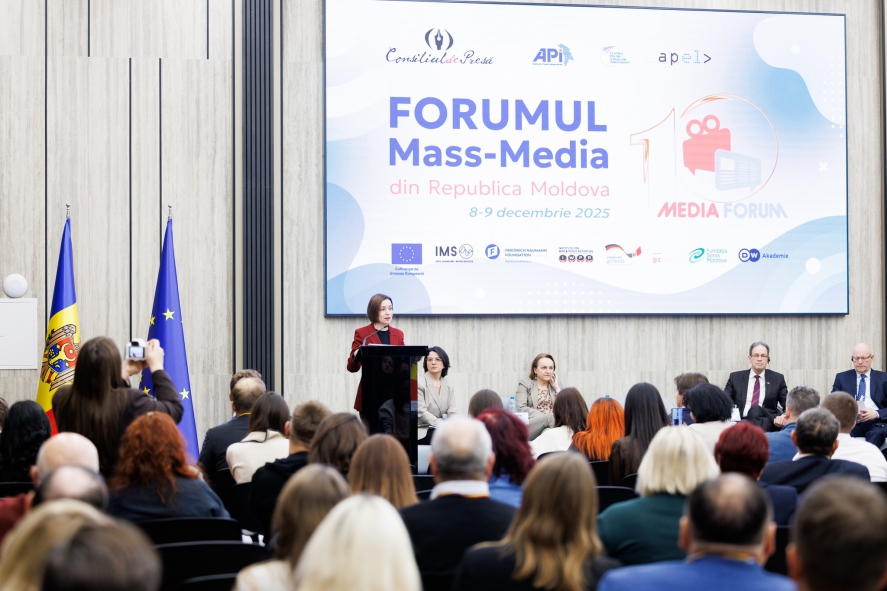
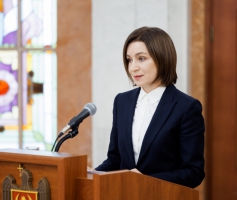
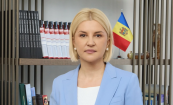
At the opening of the Mass Media Forum 2025, President Maia Sandu delivered a speech highlighting the crucial role of the press in Moldova’s democratic resilience. She noted that in recent years, the Moldovan media has demonstrated remarkable democratic maturity, serving as a pillar of resilience during times of immense pressure, directly contributing to the protection of democracy. Investigative journalism, she emphasized, has become a true civic force, exposing both domestically and internationally the gravity of existential threats faced by the country, TRIBUNA reports.
Sandu warned about the growing sophistication of disinformation: “Manipulation, technologies that allow almost perfect falsifications, coordinated attacks on public trust, propaganda massively financed by hostile actors and spread through fake accounts — all these form a sophisticated arsenal that creates an extremely volatile information environment. In the coming years, the volume and aggressiveness of disinformation risk surpassing everything we have seen so far. Impersonation through artificial intelligence or the fabrication of pseudo-realities are no longer theoretical risks, but tools already used on a large scale in many states — and they will continue to be used against us, with even greater intensity. If we do not acknowledge this, prepare, and unite our forces, democracy risks being defeated by falsehoods and manipulation.”
The President stressed the need for “clear rules for the online space, just as we need standards for transparency and accountability. New forms of manipulation must be sanctioned.”
She reiterated that European integration — Moldova’s most important national project — cannot be explained solely by state institutions: “It is essential that the press deeply understands European mechanisms, analyzes documents, and translates each stage of this journey into language accessible to the people. I encourage editorial offices to develop expertise in European affairs and ensure journalistic presence in Brussels. When individual resources do not allow this, editorial teams could create joint initiatives or collaborate through co-employment or correspondent rotation.”
Sandu also appealed to the Ministry of Education and Research, the academic community, and the entire media sector: “Let us treat the training of journalists as a shared responsibility.”
Finally, she emphasized the importance of equipping citizens with tools for informational self-defense: “Media education is no longer a luxury, but a necessity. We must see how we can introduce elements of digital and media literacy in schools, as an investment in the long-term health of our democracy.”
 Loading ...