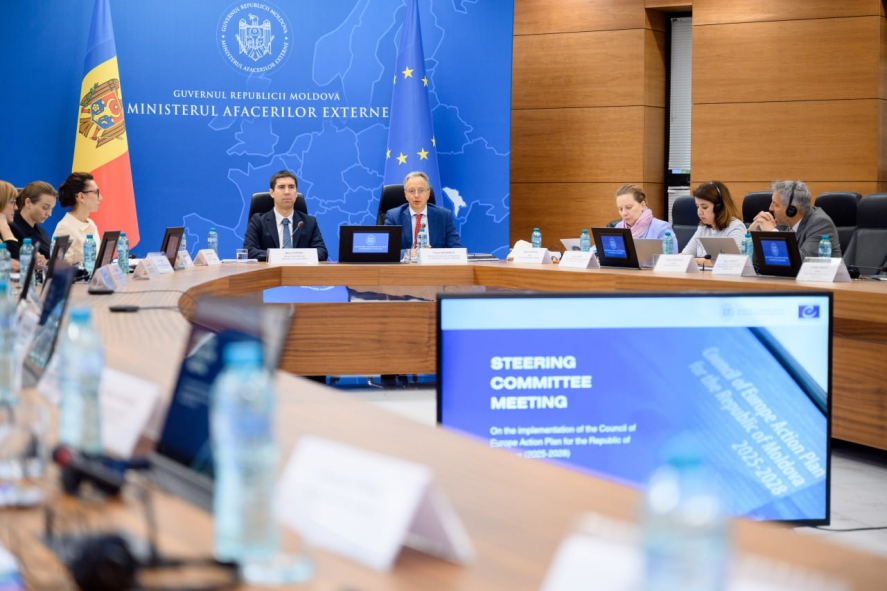
The Ministry of Foreign Affairs of the Republic of Moldova hosted a meeting of the Steering Committee overseeing the implementation of the Council of Europe Action Plan for the Republic of Moldova 2025–2028. Discussions focused on progress in implementing projects, their impact on reform processes, and cooperation priorities for the coming period, TRIBUNA reports.
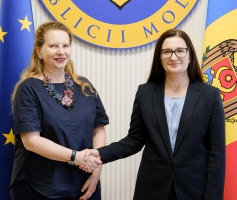
The event was opened by Deputy Prime Minister and Minister of Foreign Affairs Mihai Popșoi and Claus Neukirch, Director of the Council of Europe’s Directorate of Programme Coordination. The meeting was co-chaired by Corina Călugăru, State Secretary at the Ministry of Foreign Affairs, and Claus Neukirch. Representatives of beneficiary national institutions, the Council of Europe, and civil society also attended.
In his remarks, Minister Mihai Popșoi highlighted the Council of Europe’s essential contribution to strengthening democratic institutions, promoting human rights, and supporting reforms in the context of the Republic of Moldova’s European integration process.
“Cooperation with the Council of Europe provides essential support for strengthening democratic institutions and advancing the reforms needed for European integration. It is important to make effective use of the resources mobilized through the Action Plan and ensure that implemented projects deliver concrete and sustainable results for institutions and citizens. Our goal is to build increasingly strong institutions capable of responding to challenges and ensuring the continuity of reforms,” Minister Mihai Popșoi stated.
The head of Moldovan diplomacy also emphasized the importance of strengthening institutional and societal capacities to withstand foreign interference, disinformation, and hybrid threats. In this context, he highlighted the role of education and the development of critical thinking in building long-term democratic resilience.
Popșoi also reiterated the Republic of Moldova’s objective of advancing towards the post-monitoring stage within the Parliamentary Assembly of the Council of Europe (PACE).
For his part, Claus Neukirch, Director of the Council of Europe’s Directorate of Programme Coordination, praised the Moldovan authorities’ commitment and the effective cooperation in implementing joint projects.
“Strengthening democratic security requires not only strong institutions but also a resilient society capable of withstanding hybrid threats, disinformation, and foreign interference. The Council of Europe will continue to support the Republic of Moldova in promoting democratic values, strengthening the rule of law, and protecting human rights,” Claus Neukirch emphasized.
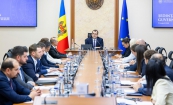
During the meeting, representatives of beneficiary institutions presented the main results achieved through project implementation, the impact on sectoral reforms, and the challenges and priorities for the next phase.
Discussions highlighted the need for effective coordination between national institutions and international partners to ensure that the assistance provided addresses the Republic of Moldova’s specific needs.
In the concluding session, State Secretary Corina Călugăru stressed the importance of building on the results achieved and adapting cooperation to emerging challenges.
Opportunities to expand joint projects were highlighted in several areas, including artificial intelligence and human rights protection, combating disinformation and Foreign Information Manipulation and Interference (FIMI), and protecting children’s rights and well-being in the digital environment.
The State Secretary reaffirmed the Ministry of Foreign Affairs’ commitment to ensuring effective coordination of the Action Plan’s implementation, in close cooperation with national institutions and the Council of Europe, to turn the assistance provided into sustainable results and tangible benefits for citizens.
The Council of Europe Action Plan for the Republic of Moldova 2025–2028, with a total estimated budget of €43.6 million, serves as the main strategic framework for cooperation between the Republic of Moldova and the Council of Europe.
The document aims to support reforms in human rights, democracy, and the rule of law, helping align national institutions and legislation with European standards and advance the country’s European integration process.


 Loading ...