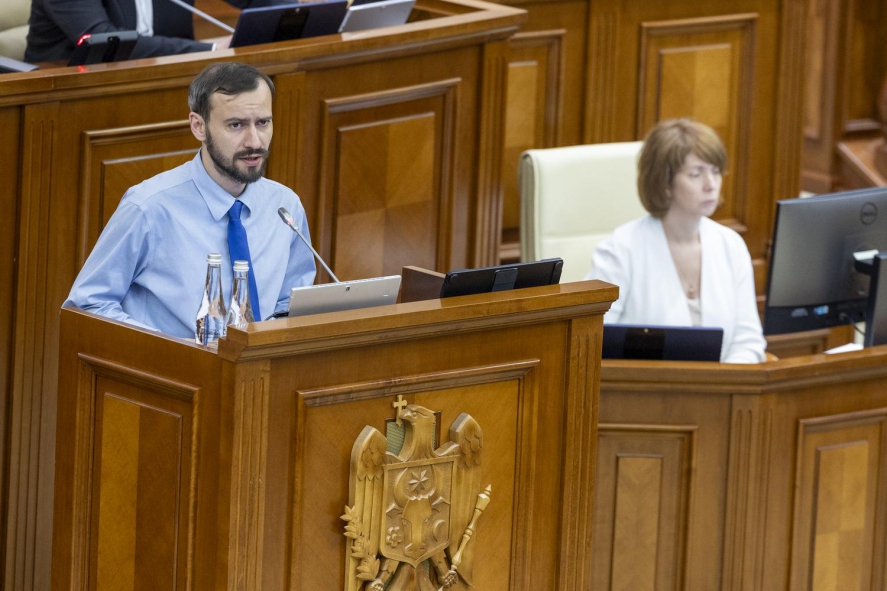
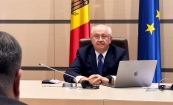
MP Dinu Plîngău, chairman of the Parliamentary Inquiry Commission on state-owned enterprises, which was established following the scandal at “MoldATSA,” said that when he took over the leadership of the Commission, he imagined that its main task would be to expose cases of unjustified hiring and excessive salaries, and that it would be an easy task, along with proposing legislative amendments to prevent such abuses from continuing. However, the reality in this sector shocked him enormously, in the worst possible sense of the word, TRIBUNA reports.
“Let’s talk about salaries! In most cases, they are not high compared with the situation on the labor market. The exception is a few companies that have been under public scrutiny for years due to multiple scandals, but also because of the importance of these companies: MoldATSA, the Airport, Energocom, Moldtelecom, Metalferos, etc. Even the remuneration of members of boards of directors is equivalent to the minimum wage in the economy.
The difference and the problem lie in abuses involving additional remuneration, bonuses, and the number of positions held by a single person. Thus, with a monthly salary of around 60,000 lei, even three annual bonuses equivalent to one monthly salary each would generate an additional income of 180,000 lei, on top of other bonuses.
To avoid populism, you cannot keep a professional manager at a large company in a position for 20,000 lei, and good managers who can deliver performance need to be attracted with a decent income, while making it a condition that they do not engage in wrongdoing, as has happened in many cases.
Returning to remuneration in state-owned companies, the Commission has already discussed and will propose legislative amendments to prevent waste and abuse. Regarding transparency, I will propose that we make public a database containing the list of administrators and board members, as well as their incomes, and, at the legislative level, require administrators to submit annual asset declarations,” he wrote on Facebook.
The politician said that, beyond waste related to salaries or remuneration, he discovered a situation that shocked him: “Hundreds of enterprises that are not managed by anyone. Do you know what that means? The waste related to some remuneration at these enterprises is a drop in the ocean compared with the billions that can/could have been recovered through properties that have been left ownerless.
It is a perfect situation for theft. Of course, most of these enterprises exist only on paper, but there are several that own properties right in the center of Chisinau, including unregistered land plots and buildings. The Aroma or Pedagogul cases — where the legal founder is the Public Property Agency (APP), the documents list the Ministry of Education, the property is managed by a university, and in practice there are unregistered buildings and land, with it still unclear what has disappeared — are extremely relevant and painful examples.
The corruption and enormous interest surrounding some of these properties make it almost impossible today to recover property rights over them, with some cases having been in litigation for decades. Poor communication, incompetence, and the indifference of uninterested officials make the situation even worse.
We have generally found out what happened with these companies in the past: they were created through orders, without proper records, with documents subsequently lost. We know what happened in 2017 with that reform, and it is clear that legislative time bombs were deliberately planted to create this kind of chaos.
What is not clear to me is what the APP has done in recent years, after it was legally designated as the founder of all these companies. In practice, it took control only of the large enterprises with a clear situation. The rest of the enterprises were abandoned.
This reminded me of the situation at the Anti-Corruption Prosecutor’s Office and the search for premises, while there are state-owned enterprises with buildings and land in Chisinau that have been left to decay or are being exploited for petty interests.”
Another major problem is procurement and the contracts of these companies. The MP said there is much to discuss, but one thing is certain: there are too many procurements conducted without tenders, or tenders for some companies are repeatedly won by the same person. In this regard, several inspections have uncovered illegal practices, but everything comes to a halt at the Prosecutor’s Office and the courts.
“We extended the Commission’s activity not because we have nothing to talk about — we have far too much — but because the main purpose is not merely to talk about problems, but to seek solutions. Therefore:
- We will prepare the necessary documents together with all relevant authorities to forcibly deregister enterprises that exist only on paper and remain there because some of them owe the state as little as 70 lei.
- We are working to conduct an inventory of enterprises that have or could have had property and to fully restore the APP’s rights over them.
- We will propose amendments to the legislation to establish a more transparent regulatory framework for state-owned companies, reform the APP, and make it mandatory for company management to submit asset declarations. I know cases where a director arrived wearing torn shoes and left as a wealthy man (the Metalferos case).
- We will request reports from law enforcement institutions regarding the dozens of complaints, notifications, and denunciations concerning the activities of state-owned enterprises.
- We will hold hearings, for as long as time allows, on specific cases involving state-owned companies. Tomorrow, at 11:00 a.m., public hearings will be held regarding the situation at Vinăria Ialoveni.
P.S. I want to clarify one point. The members of the inquiry commission are NOT remunerated. They receive 0 lei for their work on the special commission,” Dinu Plîngău added.

 Loading ...