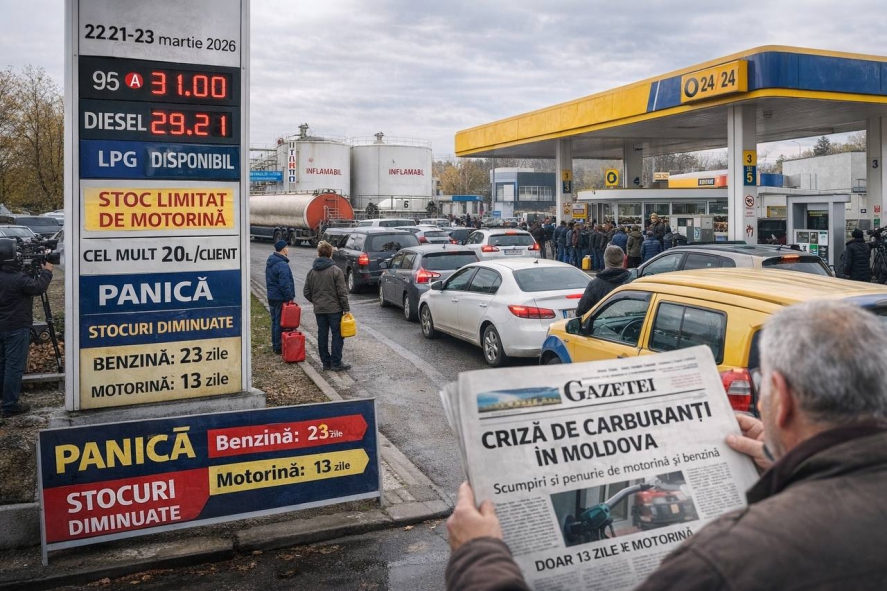
The League of Cities and Communes (LOC) considers that “the rapid increase in fuel prices and the tightening of diesel and gasoline stocks represent not only an economic problem, but also one of national security, of the functioning of local public administration and of the continuity of essential services. For 21–23 March 2026, ANRE set maximum prices of 28.47 lei/litre for 95 gasoline and 29.21 lei/litre for diesel, following new daily increases,” TRIBUNA reports.
At the same time, the organization notes that official Government documents show that on 2 March 2026, stocks in national depots and fuel stations covered approximately 23 days of gasoline consumption and only 13 days of diesel consumption, while in the Port of Giurgiulești there were additional stocks equivalent to another 16 days of gasoline and 5 days of diesel. However, part of these volumes was intended for regional transactions, which increases the vulnerability of the domestic market.
For this reason, LOC believes that the Government must move from ad‑hoc reactions to a national plan to stabilize the fuel market, built on three pillars: immediate intervention, protection of the local economy, and structural reforms.
“We call on the Government to establish a daily public transparency mechanism regarding real fuel stocks.
It is not enough for the population to be told that ‘the situation is stable and prices are rising’. Daily aggregated data must be published on available reserves, import flows, volumes in Giurgiulești, and estimated coverage in days of consumption.
Lack of information fuels panic buying.”
ANRE has already explained that daily diesel demand rose on some days to around 4,000 tonnes, compared to a usual level of 1,500–1,600 tonnes, and these additional purchases contributed to the rapid depletion of some stations.
LOC also states that critical sectors must be prioritized: local and intercity public transport, ambulances, firefighters, police, municipal services, sanitation, water supply, school transport, and seasonal agricultural work. “In a period of crisis, the state cannot treat strategic consumption and speculative consumption the same way.”
Temporary limits on speculative purchases are necessary, LOC argues, but without affecting normal economic activity. The Government has already introduced a 20‑litre limit for diesel purchases in consumer containers, “a useful but insufficient step”. The measure should be complemented by monitoring unusually large sales and by rapid sanctions for speculative or abusive stockpiling.
LOC calls on the Government to activate a joint operational command: Ministry of Energy, ANRE, Customs Service, Competition Council, Ministry of Agriculture, Material Reserves Agency, and representatives of local public authorities. The state of alert in the energy sector has already been declared for 60 days, so the administrative framework for strengthened coordination exists.
At the same time, LOC requests the urgent adoption of the following regulatory measures:
- Temporary full/partial reduction of excise duty on diesel for agriculture, public transport, and local public services. Support for farmers has already been announced, but the scheme must be extended and clarified for all essential services serving citizens.
- Creation of a compensation fund for local authorities, so that municipalities can cover fuel cost differences for local transport, road maintenance, waste collection, water and sewage networks, school transport, and emergency interventions. Without support, the burden will fall directly on local budgets, blocking investments or services.
- A targeted reimbursement mechanism for public transport operators and municipal enterprises. Without this measure, tariff increases will follow.
- Temporary suspension or reduction of certain taxes and related logistical costs, where the Government has competence, to reduce the shock along the supply chain.
- Accelerated diversification of import sources through active commercial and logistical agreements with alternative suppliers from Romania, Turkey, Bulgaria, and other compatible markets, so that Moldova strengthens its energy security through the creation and strategic use of fuel reserves and through regional supply partnerships.
- Maximizing the use of the Port of Giurgiulești for the domestic market, with priority for supplying the Republic of Moldova during periods of tension. The Government has already reduced the stock threshold required for re‑exporting gasoline from the port, from 8,000 to 5,000 tonnes, showing that the state recognizes the strategic nature of port stocks.
- Accelerating customs and logistical procedures for fuel imports, including priority lanes for volumes intended for agriculture and public services.
- Emergency framework contracts for supplying public institutions and critical operators, so that the state and local authorities do not compete chaotically on the market, each acting separately.
LOC appeals to the Government and Parliament to urgently and without dilution adapt the legal framework for emergency stocks, establish a clear calendar for building mandatory minimum reserves of gasoline and diesel, and ensure that most physical stocks are kept on the territory of the Republic of Moldova.
“We request the creation of a digital platform for real‑time monitoring of stocks, flows, and storage capacities, and the adoption of a plan for future investments in additional storage capacity and related logistics infrastructure, to minimize the effects of similar energy crises in the future,” the organization concludes.



 Loading ...