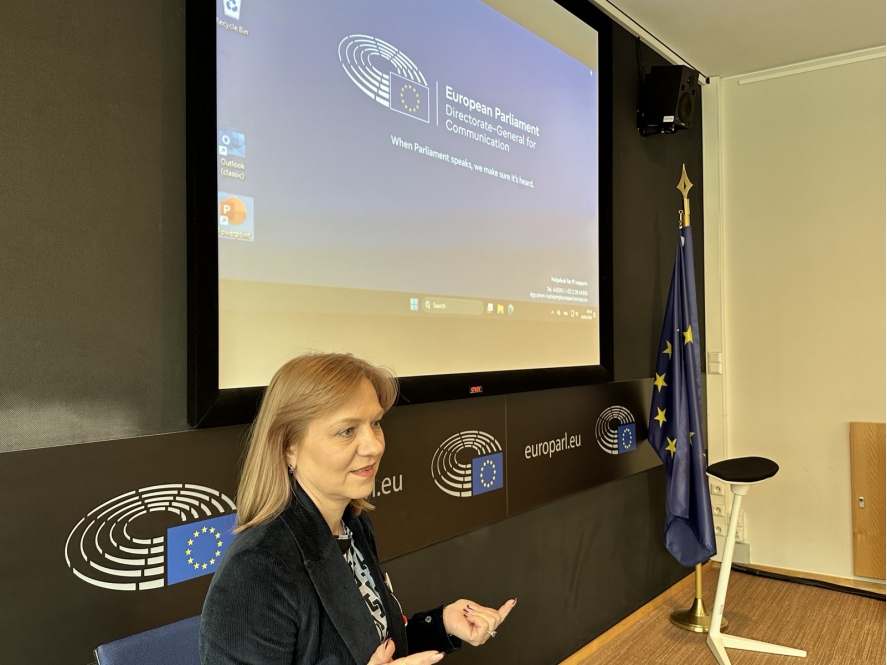
On 10 March 2026, the European Parliament adopted its first‑reading position on the proposed directive on harmonising certain aspects of insolvency law: Texts adopted – Harmonisation of certain aspects of insolvency law – Tuesday, 10 March 2026.
Irina Selevestru, PhD in Law and insolvency expert, states that this decision represents an essential step, as a provisional agreement with the Council had already been reached.
The next step will likely be the Council’s formal approval. If this happens without amendments, the legislative process will be completed at first reading, followed only by the usual formal stages (signature and publication in the Official Journal), the expert explains.
Irina Selevestru analysed the directive and explains what this development means strategically for the Republic of Moldova:
A major step in strengthening the European insolvency framework
The adoption of the European Parliament’s first‑reading position on the Directive on harmonising certain aspects of insolvency law marks an important step in consolidating the European insolvency framework and advancing the Capital Markets Union. The directive aims to reduce differences between national insolvency systems that affect the predictability of claim recovery and discourage cross‑border investment.
For the Republic of Moldova, this development is not merely a technical EU reform. It signals the strategic direction of insolvency law in Europe and provides important benchmarks for future legislative reforms.
Insolvency becomes an economic policy tool, not just a legal procedure
The new directive confirms a fundamental shift in the European approach: insolvency is no longer viewed solely as a liquidation procedure but as a mechanism for preserving economic value and protecting investments.
The introduction of pre‑pack procedures reflects this philosophy: saving the business and maintaining economic value take priority over traditional liquidation.
For Moldova, this suggests the need to evolve from a system focused predominantly on liquidation and asset sale toward one oriented toward business continuity and rapid restructuring.
Predictability becomes a key factor for investment
Major differences between national insolvency systems in Europe have been identified as obstacles to cross‑border investment and to the functioning of capital markets.
By establishing minimum common rules — particularly regarding:
- avoidance of suspect transactions,
- procedures for selling businesses,
- the role of creditors —
the directive seeks to increase predictability and transparency.
For Moldova, this is a strategic lesson: an efficient insolvency system is not only a legal matter but also a factor of economic competitiveness and investor attractiveness.
Fast procedures become the European standard
A central element of the directive is the emphasis on fast and efficient procedures, especially through mechanisms such as accelerated business sales (pre‑pack sales).
These tools are designed to prevent the loss of economic value that occurs when insolvency procedures drag on for years.
For the Republic of Moldova — where procedures can sometimes be lengthy and complex — this trend indicates the direction of necessary reforms:
- simplifying procedures,
- accelerating asset realisation,
- strengthening the role of insolvency practitioners.
Insolvency becomes part of capital‑market infrastructure
A key message of the directive is that insolvency law is no longer an isolated branch of commercial law. It is now considered an essential component of financial markets and the European investment system.
Investors always assess:
- the duration of procedures,
- recovery rates,
- the predictability of the system.
“Therefore, insolvency reforms become part of European economic and financial policy. For Moldova, this means that modernising insolvency legislation must be seen not only as a legal reform but as a structural reform for economic development and investment. The new European directive confirms a clear trend: modern insolvency systems must be fast, predictable, and oriented toward preserving economic value. For the Republic of Moldova, this evolution provides an important benchmark for future legislative reforms and for alignment with European standards. An efficient insolvency system is not just a legal tool but an essential component of economic stability and investor confidence,” concludes Irina Selevestru.
Source: Oficial.md







 Loading ...