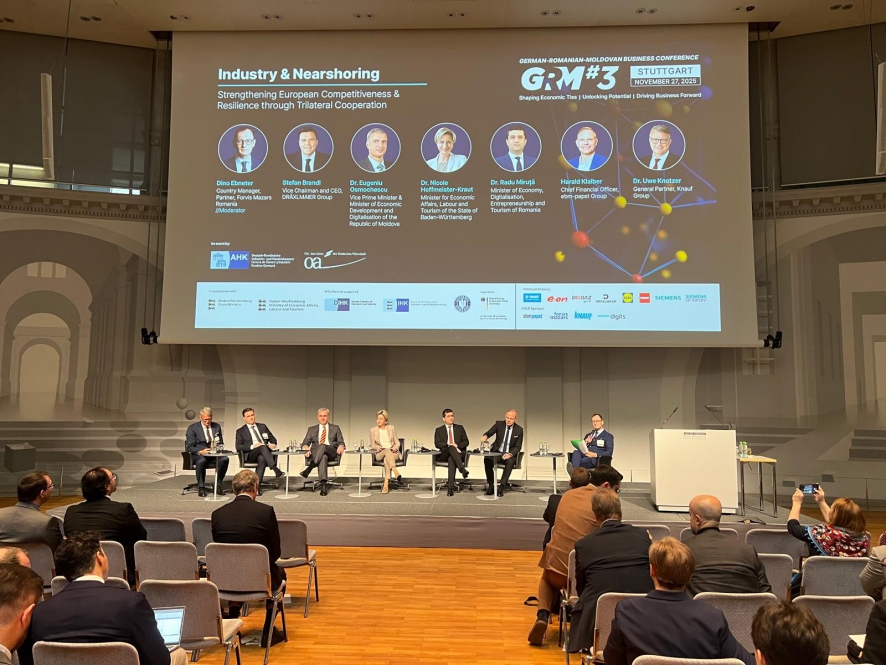
Deputy Prime Minister and Minister of Economic Development and Digitalization, Eugeniu Osmochescu, participated in the Germany–Romania–Republic of Moldova Economic Forum, where he emphasized the importance of strengthening relations between Moldova and Germany to boost European competitiveness and resilience.
He noted that this partnership comes at a decisive moment, as Moldova accelerates reforms and moves significantly closer to EU integration, modernizing infrastructure, the energy sector, public services, and digitalization processes.
In his remarks, Osmochescu highlighted substantial progress in digitalization: over 80% of entrepreneurs interact online with authorities, while the EVO platform has already issued more than 200,000 electronic documents. Moldova’s ICT ecosystem continues to grow rapidly, supported by 90% gigabit coverage, which fosters innovation and competitiveness. In this context, the Agrotek Park and Moldova HiTech Park will soon be launched — strategic initiatives designed to attract investment in future technologies and stimulate the transformation of the national economy.
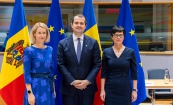
The forum also hosted the first meeting of the Moldova–Baden-Württemberg Intergovernmental Commission, co-chaired by Osmochescu and Florian Hassler, State Secretary for Political Coordination and European Affairs in the Baden-Württemberg government.
The parties reviewed progress in implementing the Memorandum of Understanding signed on October 2, 2024, and discussed prospects for economic cooperation in areas such as investment, bilateral trade, agriculture, food industry, energy, IT, and innovation. Osmochescu expressed gratitude for Germany’s support and reiterated Moldova’s openness to fully harness the potential of collaboration.
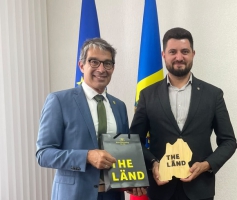
Additionally, Osmochescu held a bilateral meeting with Nicole Hoffmeister-Kraut, Minister of Economy, Labour, and Tourism of Baden-Württemberg. Discussions focused on the evolution of German investments in Moldova, the contribution of German companies to the automotive, agri-food, and IT industries, as well as positive results from cooperation within Moldova IT Park and projects supported by GIZ and KfW. Both sides expressed interest in expanding cooperation in digital transformation, cybersecurity, and modernization of energy infrastructure.
Germany remains a key economic partner for Moldova, currently ranking sixth among the country’s global trade partners. The dialogue in Stuttgart reaffirmed both sides’ commitment to intensifying trade and investment exchanges and deepening cooperation in areas of mutual interest.
 Loading ...