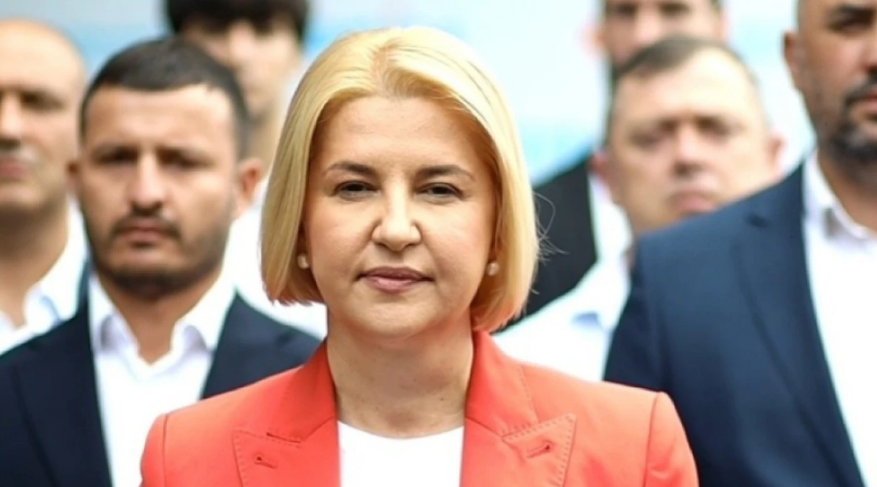
On Monday, October 20, the Court of Appeal will issue a decision regarding the restriction of the activity of the Republican Party “HEART OF MOLDOVA” for a period of 12 months. Irina Vlah, the party’s leader, stated during a briefing that in recent weeks, false information has been spread and attempts have been made to discredit the team, allegedly with the support of those in power. She emphasized the need to speak out about the events that led to this situation, as citizens deserve to know the pressure the party is under.
Vlah claimed that since the beginning of the electoral campaign, “HEART OF MOLDOVA” has been the target of constant provocations from the authorities: “Our active actions, sharp criticism of the government, peaceful and democratic protests — all of this clearly irritated the ruling party. Unable to silence us through pressure and threats, the authorities dropped their mask and resorted to open political persecution.”
She recounted that at the start of the campaign, police conducted over 60 searches targeting individuals associated with Șor. “Coincidentally,” she said, several searches were also carried out on members of “HEART OF MOLDOVA.” Later, media outlets published recordings of intercepted phone calls discussing transfers from a Russian bank. Vlah requested Police Chief Cernăuțanu to confirm that the individuals in the recordings had no connection to her party. At a court hearing, SIS representatives acknowledged that there was no link between the Șor-related searches, the Russian bank transfers, and the financing of “HEART OF MOLDOVA.” However, police did not respond to the request, intentionally leaving a false impression of association.
Based on these false publications, the Moldovan National Party filed a complaint with the Central Electoral Commission (CEC), requesting the party’s exclusion from the elections. Vlah argued that this was a coordinated scenario involving state institutions, where the government orchestrated the spread of fake news, and the CEC used these to initiate the party’s removal from the race. The CEC then submitted a request to the Ministry of Justice to restrict the party’s activity, which in turn petitioned the Court of Appeal — without evidence, according to Vlah — to suspend the party.
The court scheduled the hearing for October 20, after the elections, and imposed a provisional restriction on the party’s activity. This allowed the CEC to remove “HEART OF MOLDOVA” from the electoral race and exclude its candidates from the Patriotic Electoral Bloc of Socialists, Communists, “Heart and Future of Moldova.” Vlah stressed that the party was barred from political participation solely based on unverified suspicions and false reports — an unprecedented case in Moldova’s history.
She also highlighted that the restriction was based on a controversial law adopted just two months before the campaign, violating international standards that prohibit changing electoral rules on the eve of elections — a concern also raised by international observers.
Despite being removed from the race, Vlah said the regime continues efforts to restrict the party’s activity for 12 months. “President Sandu calls such cases a test for Moldovan justice. The system must prove it can withstand political influence. We hope the court will issue a fair decision — one based on facts, not fabrications. We refrain from political assessments and do not seek to pressure the court. Our goal is to inform society truthfully.”
She called on the public to closely follow the Court of Appeal proceedings, stating: “This case is crucial for the future of democracy in Moldova. We will announce our next steps and plans next week. But one thing remains unchanged: we stand with the people and will use all legal means to defend their right to a decent life in a free country.”


 Loading ...