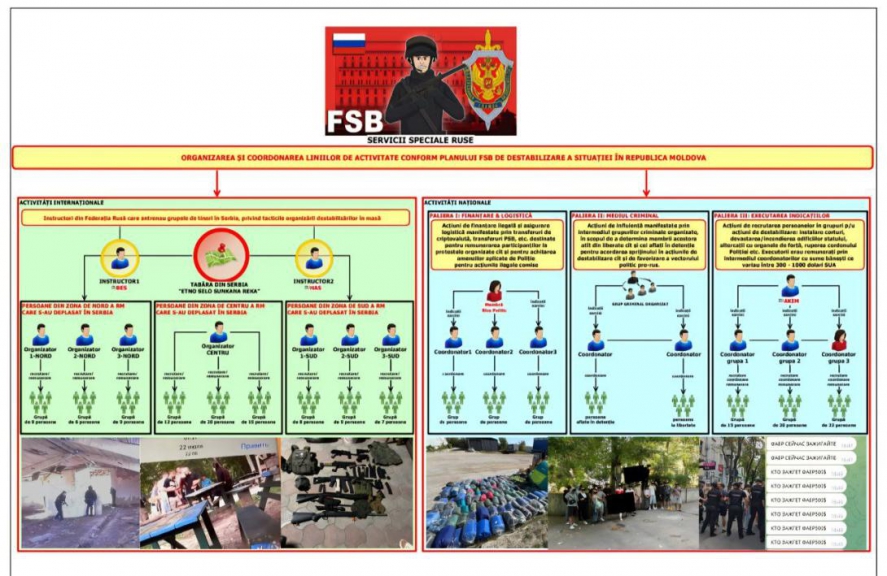
Officers from the National Investigation Inspectorate (INI), in collaboration with the Prosecutor’s Office for Combating Organized Crime and Special Cases (PCCOCS) and the Intelligence and Security Service (SIS), with support from the BPDS “Fulger” tactical unit, conducted a large-scale national operation as part of a criminal case concerning preparations for mass unrest and destabilizing actions, including the financing of such activities. The investigation revealed that some of the individuals involved are members of political formations and criminal organizations coordinated from the Russian Federation, according to TRIBUNA.
Moreover, in Serbia, Moldovan nationals were trained by representatives of Russian special services in tactics of confrontation and resistance against law enforcement. Some participants were misled about the nature of the trip, being told they would visit religious sites. Upon arrival, they agreed to undergo training and received financial compensation from individuals affiliated with Russian intelligence. None of them reported the activities upon returning to Moldova.
Law enforcement agencies also identified the involvement of an officer from the Main Directorate of the Ministry of Defense of the Russian Federation (known as GRU) in subversive operations on Moldovan territory. These actions were coordinated from abroad and aimed at destabilizing the country during the electoral period, using the ȘOR network and external resources.
Operating remotely, the GRU officer used Telegram groups linked to the ȘOR party to establish contact with activists and sympathizers, identifying “leaders” capable of mobilizing groups of 40–50 young individuals, preferably with athletic builds, to carry out swift and precise tasks. Detailed personal data (identity, address, occupation, phone number, family status) were collected to build a database of loyal “recruits” for rapid mobilization.
Communication was conducted via Telegram, maintaining anonymity or using intermediaries from Moldova, Ukraine, Belarus, or other paid actors.
Tactical groups under the GRU officer’s command were deployed across several EU countries, launching staged public actions designed to provoke social discontent or political protests aimed at destabilizing internal affairs.
The GRU officer’s social media network included leaders of the ȘOR party.
These groups were structured hierarchically: one “leader” (“brigadier”, $500/month), two “assistants” (“desyatniki”, $400/month), and 47 members ($300/month). Payments were made monthly by the coordinator for provocative actions, with photo and video reporting (two per week, $300/action).
Through rapid mobilization of tactical groups, the coordinator aimed to generate incidents that would discredit state institutions and undermine the perceived legitimacy of elections. Similar groups were organized in Asia, Africa, and EU countries, where staged protests were launched to incite social unrest and political destabilization.
The GRU-managed groups were designed to create chaos and erode trust in Moldova’s electoral process. Their objective was to intensify subversive activities during the electoral and post-electoral periods, combining diversionary tactics with public actions to influence public opinion by:
- Instilling fear and distrust in state institutions;
- Artificially shaping discontent around narratives of so-called “fraudulent elections,” aggressively promoted in advance by the Russian Federation through loyal actors;
- Distracting law enforcement agencies.
The ultimate goal of these actions is to undermine internal stability and the electoral process, thereby increasing Russian influence and weakening trust in Moldova’s democratic institutions.
Yesterday, law enforcement conducted 250 searches: 111 residential, 116 personal, and 23 vehicle searches.
Operation Results:
- 74 individuals detained for 72 hours;
- Seized cash in national and foreign currencies: over 150,000 MDL, 12,370 EUR, 6,600 USD, 15,000 RUB, and other amounts;
- Illegal weapons and ammunition: pneumatic guns, hunting rifles, cartridges of various calibers, including combat rounds;
- Documents and other relevant evidence;
- Passports, bank cards, handwritten notes;
- Technical equipment used for coordinating criminal activities: over 120 mobile phones, SIM cards, electronic storage devices, laptops, and hard drives;
- Jewelry without proof of origin, sleeping bags, tents, mattresses, megaphones, and other items used in mass actions.
The National Police, in cooperation with prosecutors, continues to document the case and is taking all necessary measures to ensure criminal accountability for those involved.

 Loading ...