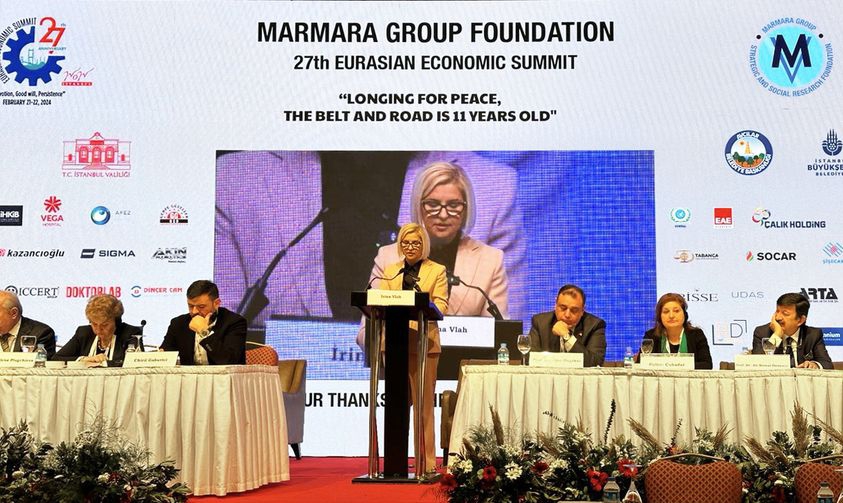
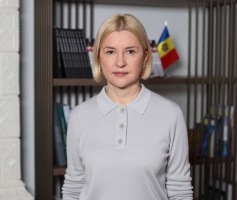
Irina Vlah, president of Platform Moldova, gave a speech at the 27th Eurasian Economic Summit in Istanbul, an international platform attended by over 300 prominent personalities from 40 countries. The theme of his speech, which was in English, was the devaluation of rights in times of crisis. The Republic of Moldova is facing new challenges.
I would like to express my gratitude for the opportunity to be on such a significant international platform and address my message to a well-respected audience. The world is facing a lot of challenges nowadays. Over the course of several years, we have witnessed the COVID-19 pandemic, the energy crisis, and the escalation of military conflicts in Ukraine, the Gaza Strip, and other regions. The consequences of these events rarely occurred one at a time. More often than not, they complemented and complicated each other, challenging governments with the need to solve problems of unprecedented complexity. And the way the authorities dealt with their solution showed not only the effectiveness of state institutions but also the political maturity of the leaders and their attitude toward democratic values and human rights.
It is no coincidence that I’ve mentioned human rights. The truth is that in times of crisis, human rights often fade into insignificance. It is fair to recognize that emergency crises require extraordinary measures. However, government actions can easily lead to abuses if the relevant authorities are vested with broad powers with minimal control. This is illustrated by the example of my country, the Republic of Moldova, where over the past three years several factors have emerged: external and internal crises that require extraordinary measures and the concentration of all branches of government in the hands of one political force. In February 2022, on the day the tragic events began in Ukraine, the Moldovan authorities introduced a state of emergency in the country, and the Emergency Situations Commission became the center of operational decisions.
The state of emergency was extended 11 times and was valid until the end of 2023. In the first months, the Commission fulfilled its positive role; in particular, it organized the reception of a huge flow of refugees. However, over time, the Commission has been assigned certain powers that go beyond its competence. This institution came into use as a political instrument, and the state of emergency was a pretext for abuse. Over the course of two years, the Commission repeatedly made decisions, replacing the legislative, executive, and judicial authorities. In particular, restrictions on holding public rallies were introduced. 12 TV channels and several dozen information sites were closed down. In the local government elections, several thousand opposition candidates were excluded from the race by the decision of the Commission the day before the voting date. I’d like to point out once again that all these prohibitions and restrictions were adopted without court decisions and bypassing legislative norms.
The example of the Republic of Moldova shows that human rights remain a vulnerable category in times of crisis. If during the pandemic, restrictions on rights were unintentional, then in the last two years there has been a tendency towards the authorities abusing their powers. The lack of transparency in decision-making and the violation of the principle of separation of powers have created a favorable environment for violations of freedom of speech, the rights of peaceful assembly, the right to access information, the right to judicial protection, voting rights, and other civil rights.
The authorities must not break the law. The vulnerability of human rights in times of crisis must be a focus of international attention. The approach to crisis management must be based on the supremacy of the law. This can be achieved through a control mechanism that can be created at the level of the OSCE and the UN.
Presidential elections are scheduled to take place in the Republic of Moldova this year. In this context, adherence to democratic principles becomes particularly relevant. Therefore, I ask the international community to pay close attention to the political processes in Moldova. I am fully convinced that such attention will be a determinative factor that will reduce the risk of human rights violations.
Protecting the rights of citizens is the meaning and purpose of the state’s existence. Their resilience in crisis situations depends on how states cope with this task. Abuses only provide the illusion of control over the situation. And vice versa, trust in citizens and respect for their rights makes the country stronger and allows it to overcome the most difficult challenges,” said Irina Vlah.
 Loading ...