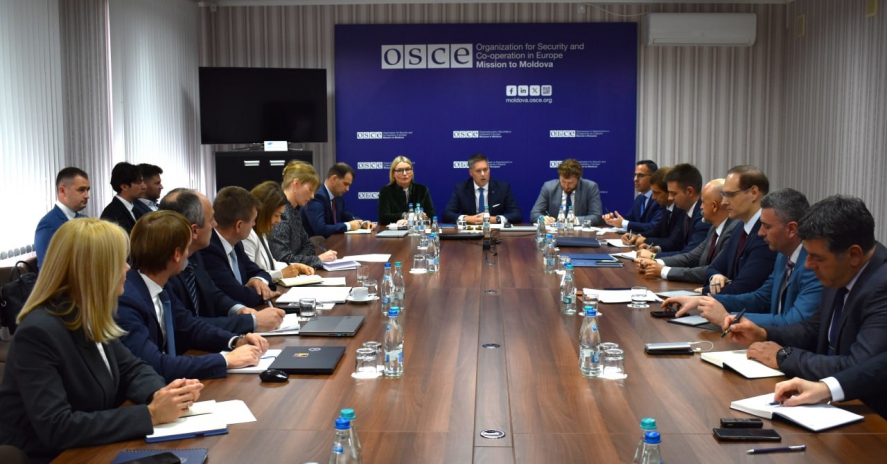
On September 24, 2026, a new working meeting was held in Tiraspol, Republic of Moldova, between the political representatives of Chisinau and Tiraspol in the negotiations on the Transnistrian settlement, Valeriu Chiveri and Vitalii Ignatiev, mediated by the Head of the OSCE Mission to Moldova, Christopher W. Smith, TRIBUNA reports.
The discussions primarily focused on the socio-economic aspects of reintegration and respect for fundamental human rights.
Deputy Prime Minister Valeriu Chiveri reaffirmed the authorities’ firm commitment to a peaceful and lasting settlement, respecting the sovereignty and territorial integrity of the Republic of Moldova within its internationally recognized borders. It was emphasized that the objective of the dialogue is the reintegration of the country and the restoration of unified national spaces (legal, economic, social, educational, etc.), and that the solutions under discussion must contribute to this objective and deliver tangible benefits to citizens.
A central topic was the Convergence Fund, conceived as an instrument to reduce socio-economic disparities between the Transnistrian region and the rest of the country. The areas of support and stages of the implementation mechanism were presented, with an emphasis on social protection, healthcare, education, and infrastructure. The Fund’s resources will be directed toward people and communities through legal, transparent, and verifiable mechanisms ensuring direct access to state support. In this context, it was noted that in the first half of 2026 alone, the constitutional authorities allocated more than 218 million lei for social, medical, and educational support for residents of the region.
With a view to bringing public services closer to citizens, Chisinau proposed opening a social services center and a family doctors’ office in the municipality of Bender. The initiative would facilitate access for residents of Bender, Tiraspol, and neighboring localities to social benefits, consultations, and primary healthcare, reducing their travel and related expenses. The project is conceived as a first step toward expanding national public services in the region, and the removal of any obstacles to the work of the relevant institutions and to beneficiaries’ access to these services was requested.
On the economic front, the rationale and phased nature of applying VAT and excise duties to certain categories of goods imported by economic operators from the region were explained. It was emphasized that the gradual unification of the fiscal and customs space is intended to ensure fair conditions for businesses throughout the country and to integrate economic activity into a fair, predictable framework compliant with the legislation of the Republic of Moldova.
Particular attention was paid to the right to education. Chisinau insisted on the full and unconditional return of the premises of the “Evrica” Theoretical Lyceum in Rîbnița and the “Ștefan cel Mare și Sfânt” Theoretical Lyceum in Grigoriopol, with respect for property rights and ensuring unhindered access. Regarding the “Evrica” Lyceum, the need to return the entire building complex and the adjacent land was reiterated. For the lyceum in Grigoriopol, the authorities reconfirmed their willingness to finance the necessary rehabilitation works once the building is returned and access barriers are removed. Children’s right to study in their own towns and in appropriate conditions cannot be politically conditioned or postponed indefinitely.
The proposal to return to education in the Romanian language in Moldovan educational institutions in the region that use the Cyrillic script was also reiterated.
Freedom of movement was reaffirmed as a fundamental right that must be guaranteed on a permanent basis. Chisinau called for the removal of restrictions on travel between localities and across the bridges over the Dniester.
Regarding the documentation of vehicles with neutral-format license plates, Chisinau expressed its readiness to examine options for continuing the mechanism, within the framework of national legislation. At the same time, it called for the removal of obstacles imposed by Tiraspol on owners of vehicles bearing national license plates, including dual-registration practices and parallel payments that generate additional costs for citizens.
Deputy Prime Minister Valeriu Chiveri confirmed his openness to continuing regular and constructive dialogue focused on achieving tangible results for the benefit of the population. He also reiterated the proposal to hold future meetings in Chisinau as well, in accordance with the principle of rotating meeting locations.
Restoring citizens’ rights, ensuring access to state services, and removing barriers between the two banks of the Dniester remain priorities of the Republic of Moldova’s reintegration policies.

 Loading ...