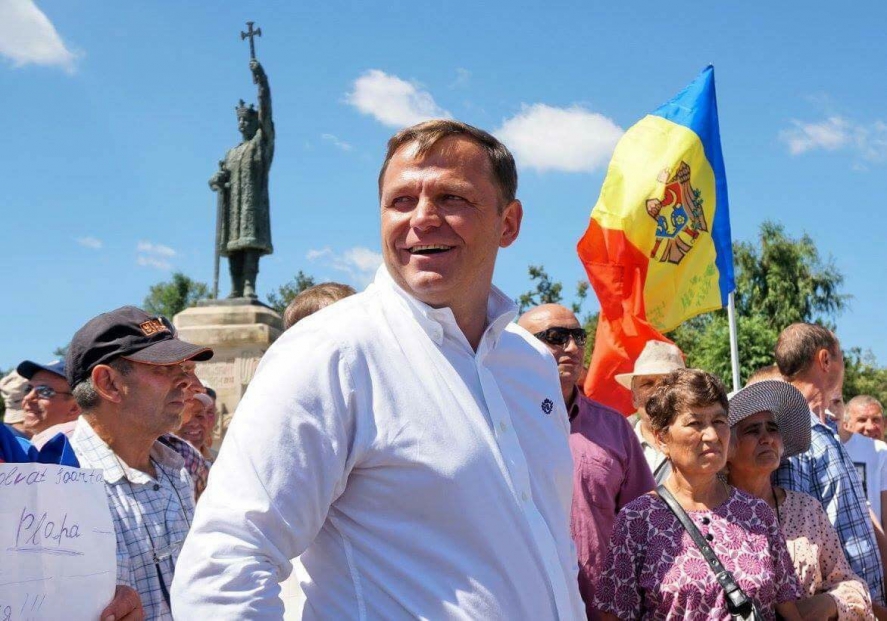
On the eve of Independence Day, TRIBUNA is publishing a series of articles under the title “35 Years of Independence.” Andrei Năstase, former Minister of Internal Affairs and lawyer, accepted our invitation and made the following statement:
The Republic of Moldova at 35
At 35, I see the Republic of Moldova as a state that has earned its right to exist, but which still needs to fully earn the trust of its own citizens.
We have been through a war, economic and political crises, poverty, corruption, an exodus, state capture, and enormous geopolitical pressures. There were moments when it seemed that we could even lose the very meaning of Independence. And yet, the Republic of Moldova endured.
This is perhaps the first conclusion after 35 years: we are stronger than we thought, but still far below what we could become.
Independence, however, is not a certificate that you receive once and keep in an archive. Each generation must give it substance.
A state is truly independent when its citizens are free, when judges do not receive instructions, when institutions do not belong to a political party or an oligarch, when the economy can sustain society, and when people are not forced to seek their dignity in another country.
In 1991, we proclaimed the independence of the state. After 35 years, our great responsibility is to build the independence of the citizen.
The Greatest Achievements Over These Years
The first major achievement is Independence itself and the fact that we have managed to preserve it.
For me, there is also a personal emotion here that I cannot separate from the history of my country. My older brother, Vasile Năstase, was the youngest member of parliament to sign the Declaration of Independence.
I have always viewed that signature not as a privilege for our family, but as an obligation. Because Independence is not inherited like property. It is inherited as a responsibility.
The second major achievement is the survival of Moldovan democracy.
There were years when the Republic of Moldova formally had democratic institutions, but in reality they had become captive to oligarchic interests. The judiciary, the prosecutor’s office, state institutions, and a significant part of the public sphere had been subordinated.
I had the honor of standing, together with many courageous people, on the front line of the struggle to free the state from that captivity.
Each of us paid a political price, and so did I, but I do not regret that sacrifice for the people and the country.
I do not claim that this was the victory of one person. That would be unfair to the thousands of people who took to the streets, resisted pressure, and refused to accept the confiscation of their country.
But I believe we can say one important thing today: at a critical moment, the citizens of the Republic of Moldova demonstrated that a state can be captured, but a society that refuses to give up its freedom cannot be permanently confiscated.
The third achievement is the preservation and consolidation of the European course. Today, the Republic of Moldova is closer than ever to the European family.
For me, however, Europe has never been merely about geopolitics. Europe means an order based on values: the law above power, institutions above personal interests, freedom, dignity, and respect for people.
The Greatest Challenges. The Issues That Divide Society
The greatest problem facing the Republic of Moldova is not geopolitical. It is demographic.
We can build roads. We can attract investment. We can reform the administration. We can make up for years lost economically.
But a country from which people leave slowly loses not only its population, but also its future.
That is why I believe the true measure of the Republic of Moldova’s success over the next decade will not be only GDP, the number of European projects, or the kilometers of roads built. It will be the number of people who choose to stay, those who decide to return, and the children who are born here.
The second major challenge is building institutions that no longer depend on who is in power.
I fought against a captured state, and precisely this experience makes me say unequivocally: a state is not truly liberated if we merely change who controls its institutions. It is liberated when institutions no longer have masters.
Justice cannot be “ours” or “theirs.” The prosecutor’s office cannot be good when it investigates our opponents and bad when it investigates our own people. The rule of law begins exactly where the double standard ends.
As for the divisions within society, I believe Moldovan politics has lived on fear for far too long.
East against West. Romanians against Moldovans. Those who left against those who stayed. The government against the opposition.
A mature country does not ask its citizens to think alike. It asks them to accept that, despite their differences, they share a common destiny.
Democracy does not mean that we all agree. It means that we do not become enemies simply because we disagree.
The Future of the Republic of Moldova. What Will It Look Like in 10 Years?
I see the Republic of Moldova in the European Union.
But I want to make this very clear: I do not want a Moldova that enters Europe by running away from its own problems. I want a Moldova that enters Europe after beginning to solve them.
European integration must modernize the Republic of Moldova, not become an excuse for failing to modernize it.
Europe cannot build our justice system for us. It cannot educate our children for us. It cannot bring our diaspora home for us. It cannot create respect for work, merit, and competence on our behalf.
It can offer us a historic opportunity, perhaps the greatest one since the proclamation of Independence. But what we do with this opportunity depends on us.
Ten years from now, I want a Moldova where success is no longer measured by the number of people who have managed to leave.
I want schools where teachers are respected, villages where children are once again present, an economy where work provides a dignified life, an administration where competence matters more than party membership, and a justice system before which the ordinary citizen and the powerful person are truly equal.
Moldova will truly be European when Europe is no longer, for our citizens, the place they have to leave for in order to live a normal life.
The Things I Am Proud Of and Would Tell a Foreigner If They Asked Me About Moldova
First and foremost, I would tell them about our people.
About their extraordinary ability to work, learn, adapt, and succeed. About Moldovans who left with very little and built lives, families, businesses, and careers all over the world.
Then I would tell them about our land. About the villages, vineyards, orchards, monasteries, and the quiet beauty of a country that does not need to be invented for tourists, but simply discovered.
I would tell them about the Romanian language and culture, about our history, and about the people who preserved the identity of this land even when doing so required courage.
I would tell them about our hospitality. Not the kind found in tourist brochures, but the simple kind in which someone who may not have very much is still ready to put everything they have on the table for a guest.
And I would tell them something I consider essential about Moldova: we are a people that has been tested by history far more than the size of our country would suggest, and which has found the strength to rise again every time.
We have many reasons to be dissatisfied with what we have not yet achieved. But we also have serious reasons to be proud of what we have refused to allow to be taken from us.
A Message to the Republic of Moldova and Its Citizens on the 35th Anniversary of Independence
At 35, the Republic of Moldova is no longer a young state.
Therefore, I believe the time has come to move from the political adolescence of excuses to the maturity of responsibility.
We can no longer explain every failure through the past, geopolitics, our neighbors, oligarchs, or previous governments. All of these factors have mattered, and some continue to matter. But after 35 years, we must have the courage to say that the future of this country depends, above all, on us.
As I have said before, Independence has a special meaning for me and my family. My brother put his signature on the founding document of the Republic of Moldova. Years later, I had the opportunity, together with thousands of citizens, to contribute to freeing institutions from oligarchic captivity and defending the country’s European path.
I do not say these things to claim credit. I say them because they taught me something.
Each generation has its own Independence to win.
The generation of 1991 had the courage to proclaim the state.
Our generation had to fight to prevent that state from being confiscated.
The generation that follows may have the hardest and most beautiful mission of all: to make the Republic of Moldova a country from which people no longer have to leave.
Independence was not given to us so that we could manage poverty, depopulation, and division. It was given to us so that we could build.
A state where the law is stronger than the politician. Where public office is a responsibility, not a privilege. Where merit is worth more than connections. Where teachers, doctors, farmers, entrepreneurs, and people who work honestly feel that this country belongs to them as well.
We do not need a Moldova permanently divided between winners and losers. We need a Moldova spacious enough for all its citizens.
And we need one more thing: trust.
Trust that we can build here. That we can succeed here. That we can stay here. That we can return here.
In 1991, we received an independent country. At 35, we must ask ourselves what kind of country we will hand over to our children.
Because, ultimately, this will be history’s judgment of our generation.
Not how many positions we held. Not how many elections we won. Not how many speeches we delivered.
But whether we left the Republic of Moldova freer, fairer, more united, and more dignified than we found it.
 Loading ...