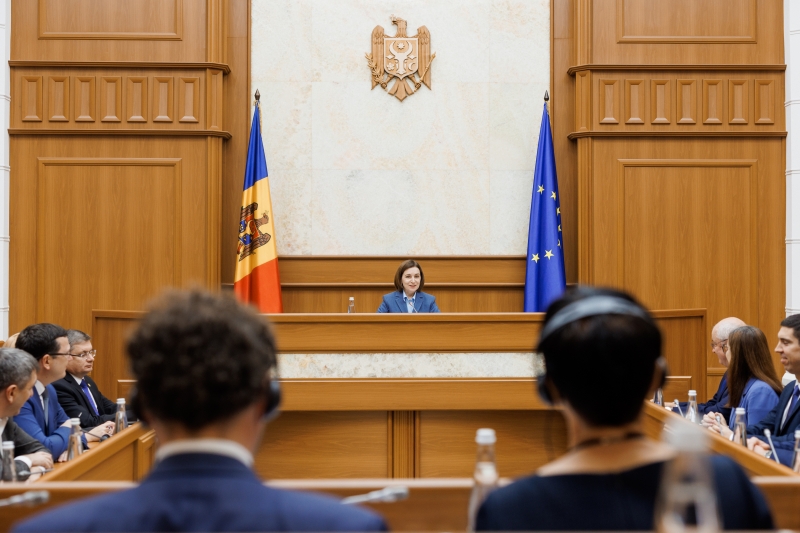
President of the Republic of Moldova Maia Sandu chaired today the meeting of the National Commission for European Integration (NCEI). During the session, the head of state emphasized the importance of maintaining the pace of reforms and ensuring strong institutional coordination to advance the EU accession process, TRIBUNA reports.
“We must focus and work even harder, with seriousness and responsibility. It’s not just about ticking boxes, but about making real changes where people expect them most: in justice, in the fight against corruption. Citizens want to see justice served. We have a window of opportunity, and our duty is to do everything not to miss it,” stated the President.
President Sandu also called on both parliamentary and non-parliamentary opposition to support the EU accession process: “We all need to talk to people, explain what European integration means, and unite our efforts to counter disinformation on this topic.”
European Commissioner for Enlargement Marta Kos also attended the meeting during her visit to Chișinău. She presented the key findings from the 2025 Enlargement Report, noting that Moldova has made the most significant progress among all candidate countries.
“There is not a single EU member state among the 27 that opposes Moldova’s accession. Over the past year, you’ve made progress across all chapters,” stated Commissioner Marta Kos.
Prime Minister Alexandru Munteanu outlined the government’s priorities in the EU accession process, while Deputy Prime Minister for European Integration Cristina Gherasimov briefed NCEI members on the update of the National Accession Plan to reflect the next steps in the negotiation process.
The National Commission for European Integration (NCEI) is the main coordinating body for Moldova’s EU accession process. Established by presidential decree, the commission is chaired by President Maia Sandu and brings together representatives of all key institutions involved in European integration — the Government, Parliament, Presidency, other public authorities, and civil society. The commission sets strategic priorities, monitors progress, and coordinates interinstitutional efforts to implement reforms and align national legislation with EU standards and norms.
 Loading ...