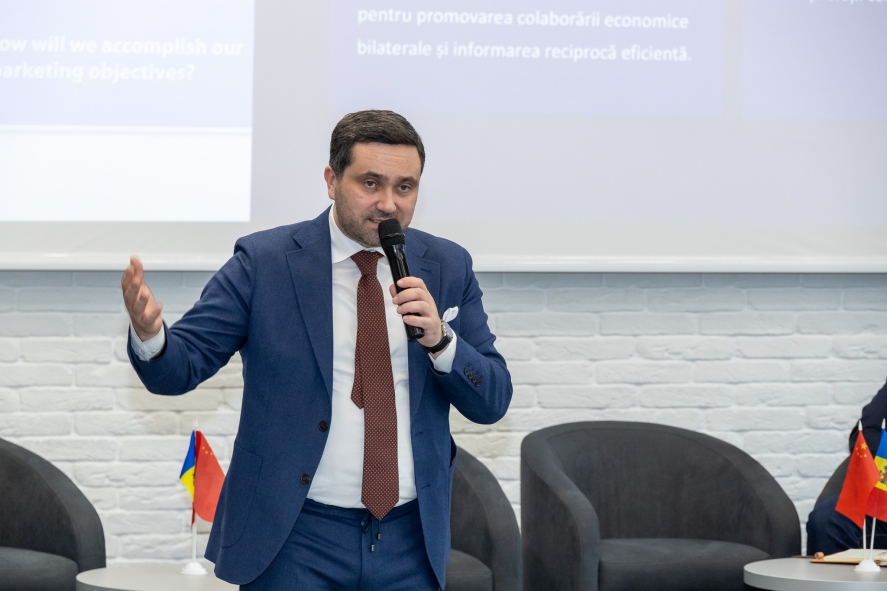
Moldova found itself in a difficult situation as a result of the Russian invasion of Ukraine. On the one hand, it has an aggressor “on the doorstep”, on the other hand, it wants to support Ukraine, but it has similar problems, as, for example, Poland and other neighboring states. But it also has the potential to be significantly involved in the post-war reconstruction of Ukraine. The world of economy talked about it with Boris Foca, a prominent Moldovan businessman and chairman of the Moldovan-Chinese Chamber of Commerce and Industry. His proposals are also very interesting for Czech entrepreneurs.
Moldova is currently under severe pressure caused by the conflict in Ukraine. “The influx of refugees from Ukraine is particularly noticeable, which places great demands on the social system of the Republic of Moldova,” says Boris Foca. More than a million of them passed through Moldova, of which 112,000 of them stayed in Moldova, most of them in the capital, Chisinau. This resulted in an increase in the city’s population by more than 10 percent. “This has a major impact on the real estate market. Because these people looking for rental housing have increased prices and also encouraged interest in apartments as an investment,” says Foca. “Some of the refugees in Moldova have set up their own businesses, mostly in the hotel and catering industry, in cryptocurrencies and in IT. They invest the most in these fields. They create job opportunities, recruit employees mostly from Ukraine. That’s the bright side of the issue. The darker one is that the local logistics infrastructure is not enough. Before the war, most goods for furnishing apartments were imported from Russia. We are now looking for a replacement supplier from the European Union. The transportation of petroleum products has also changed significantly. A large part of them are from Romania. And our agricultural and food industry is under great pressure. First of all, Ukrainian grain no longer has the necessary background of merchants in Moldova, who arranged its sale and re-export. So these goods are now severely hurting domestic producers. In this context, we must mention the difficulties at the border crossings. Kilometer-long convoys of cars are bought on them.”
These problems, Foca admits, helps Moldova to overcome international aid, including from the countries and institutions of the European Union. The aid concerns overcoming humanitarian, anti-corruption, energy and cross-border difficulties. “The Republic of Moldova does not have sufficient capacities to solve these problems on its own. Help from abroad is therefore very important for us,” emphasizes B. Foca.
“Certain decisions have been taken at the government level, such as limiting the import of products from Ukraine (we know that Poland, Romania and other European countries have also taken similar decisions). New state programs are being introduced to streamline border traffic, for example with several online applications. From the point of view of re-export, Moldova plays an important role for Ukraine. But here again, there are big problems and farmers constantly protest about it, and the state has to intervene with subsidies and preferential credit programs for farmers. We thus get into the dilemma that the authorities are trying to help Ukraine, but on the other hand they are hitting on domestic producers and then the government is required to come up with support programs, subsidies, easier access to credit for domestic producers. It is difficult, but at the moment the situation is under minimal control,” says Boris Foca.
As a result of the war in the neighboring country, a state of emergency was imposed in Moldova almost immediately after the outbreak of the war. The government thus delegated most of the competences to the Commission for exceptional situations. Critics often claim that the Commission has mishandled the energy crisis that began as a result of the war in Ukraine. It poorly managed the transit of goods through Moldova. For the first time in its history, the country was governed by a state of emergency for almost 2 years. And the decisions made during that period were not the best. All major indicators suffered, starting with inflation and ending with GDP growth. For example, Moldova is currently expected to have only 0.7% GDP growth over the past year, significantly less than Ukraine, which had 5% GDP growth during the war.
“Moldova can really become a connecting bridge in the reconstruction of Ukraine. We have 17 land border crossings, we have a favorable investment climate for large investors and many are already present in the Republic of Moldova, we have the opportunity to build warehouses on our territory, from where later companies can actively participate in the reconstruction. At the moment, not much is being done, but the potential is huge and it will need to be strengthened if Moldova wants to be involved in the process of rebuilding Ukraine,” B. Foca convinces. He emphasized that the Republic of Moldova supported the refugees by providing accommodation and basic goods, humanitarian aid (medicines, tents, generators) from the international community UNHCR and European governments. The Republic of Moldova supported Ukraine in exporting Ukrainian grain to Europe by establishing a railway corridor on its territory to the Romanian Black Sea port of Constantza.
According to B. Foca, the main opportunity for Czech businessmen to use Moldova in the reconstruction of Ukraine lies in logistical support for states that engage in this activity. He names heavy industry, the automotive industry and the pharmaceutical industry. “The Republic of Moldova can help the re-export of Ukrainian goods as well as the import of manufactured goods and technologies for Ukraine, which they will need in the recovery process. Secondly, we have free economic zones in Moldova, which will significantly help entrepreneurs interested in production, storage and re-export,” says Foca. “Our chamber develops extensive assistance programs. We want to represent potential investors from the Czech Republic in Moldova, to direct them, because it is not just a new market, but a market where different approaches work than what Czechs are used to at home. If you were to leave a Czech investor to absolutely solve all the mentioned reminders, I am not sure that he would be able to do it. Having a strong partner like the Chamber of Commerce and Industry is something else entirely.”
Boris Foca is a Moldovan businessman. He finished his university studies in 2006, and since 2018 he has been the chairman of the Moldovan-Chinese Chamber of Commerce and Industry. In 2021, he became the chairman of the political party Pro Moldova. It was founded a year earlier as a center-right political entity. PDM changed its name to the European Social Democratic Party (PSDE) in 2022, Foca changed the name of the party to the Modern Democratic Party (PDM) in early 2023. Next year, his party will run for parliamentary elections. He says about his party’s program: “People are waiting for a solution because the standard of living has decreased, in the last three years the Republic of Moldova has returned to the level of 1998-1999 from a social, economic, humanitarian point of view. It is clear that people want a fundamental change to return at least to the level of 2019. Such changes can only be provided by professional teams and we emphasize above all professional approaches.”
Moldova, officially the Republic of Moldova, covers an area of 33,483 km 2 and had a population of approximately 2.5 million in January 2023. The unrecognized separatist state of Transnistria lies across the Dniester River on the eastern border with Ukraine. The capital is Chisinau. The official language is Romanian, formerly called Moldovan. In 1859, it was freed from the Ottoman Empire and became part of Romania. In 1940, as part of the Molotov-Ribbentrop Pact, Romania was forced to cede the territory of Bessarabia to the Soviet Union and the Moldavian Soviet Socialist Republic was established. In 1991, the Moldavian SSR declared independence and became the Republic of Moldova, or Moldova. Today, Moldova is the second poorest country in Europe in terms of gross domestic product per capita, after Ukraine, and services make up a large part of its gross domestic product. It is a member of the United Nations, the Council of Europe, the World Trade Organization and a number of other international organizations.
Moldavsko trpí válkou na Ukrajině, ale chce pomoci při její obnově

 Loading ...