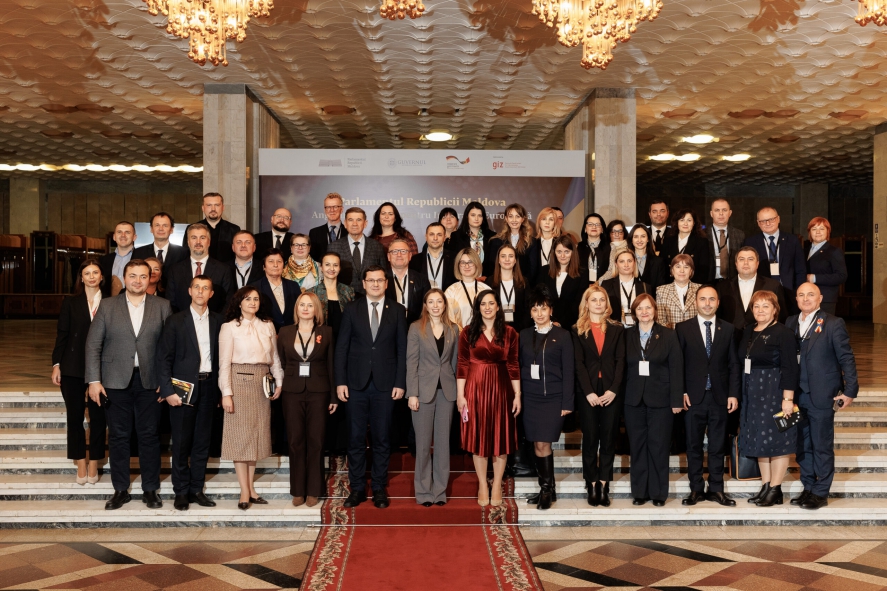
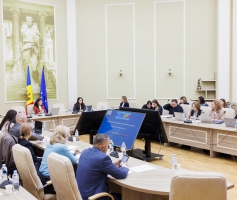
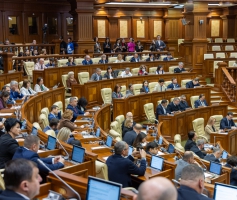
The Parliament of the Republic of Moldova, through the Committee for European Integration, in cooperation with the Office for European Integration, and with financial support from the Government of Germany via the German Agency for International Cooperation (GIZ), organized the conference “Parliament of the Republic of Moldova – Full Commitment to European Integration.” This institutional event is dedicated to accelerating the accession process and strengthening the role of Parliament in coordinating the national effort for European integration, TRIBUNA reports.
The meeting takes place in the context of the European Commission’s Enlargement Report of November 4, 2025, which confirms Moldova’s substantial progress and highlights the need to intensify legislative alignment, interinstitutional cooperation, and administrative capacity building.
The event was attended by Members of Parliament, representatives of the Government, the EU Delegation, the European Parliament Office in Chișinău, the German Embassy and GIZ, local authorities, academia, civil society organizations, and the media.
At the opening of the event, Marcel Spatari, Chair of the Parliamentary Committee for European Integration, stated: “The voice of society shows us today, more clearly than ever, that European integration is a common project – of state institutions, of the community, and of our international partners, who play an important role in this process. The Republic of Moldova is in a race against time, facing a historic imminence. We must choose between rapidly strengthening all state institutions and maintaining the accelerated pace of reforms, or risking losing the greatest European opportunity in the modern history of the country. European integration is our shared responsibility, of the entire society, and must be assumed with maturity, courage, discipline, and determination.”
Doina Gherman, Vice President of the Parliament of the Republic of Moldova, declared:
“We are here today because the citizens of the Republic of Moldova have repeatedly reconfirmed their firm support for the European path. With respect and gratitude for the citizens’ choice, on behalf of the Parliament of the Republic of Moldova, I assure you that every decision we take in this legislature will bring the country closer to European integration.”
In her capacity as Deputy Prime Minister for European Integration, Cristina Gherasimov reiterated:
“We are at a moment of historic importance. The decisions we make today, the way we cooperate, and the quality of the reforms adopted will determine not only the speed of integration but also the direction of Moldova’s development for future generations.”
At the end of the opening session, Hubert Knirsch, Ambassador of the Federal Republic of Germany to Moldova, emphasized:
“The Parliament of the Republic of Moldova will play a crucial role in the EU accession process, as it will have to carefully assess the impact of new legislation – including the workload it creates for both public administration and the private sector.”
The event sessions provided an in-depth analysis of the essential stages of the accession process. Discussions focused on the strategic role of the Committee for European Integration in effectively coordinating reforms and technical preparation for future negotiations. Through the exchange of experience with states that have already gone through this complex path, it was clearly highlighted that the success of negotiations depends on four fundamental pillars: intensive cooperation, solid expertise, total transparency, and effective communication with citizens.
The final session of the day underlined the vital importance of the Strategic Partnership with the European Parliament (EP). Discussions addressed the EP’s support mechanisms for candidate states, the essential role of interparliamentary cooperation, and the function of the EP Office in Chișinău as a collaboration hub. It was firmly concluded that the European Parliament is a strategic partner of the Republic of Moldova on its irreversible path towards the European Union.
By organizing this event, the Parliament of the Republic of Moldova reaffirms its full commitment to European integration and emphasizes the need to strengthen all institutions, both at central and local levels, as well as close cooperation with civil society organizations, academia, the business community, and international partners.
Moldova is at a decisive moment. Accelerating legislative alignment, ensuring transparency in decision-making, professionalizing public administration, and mobilizing society are essential elements for Moldova’s rapid and secure advancement towards the European Union.


 Loading ...