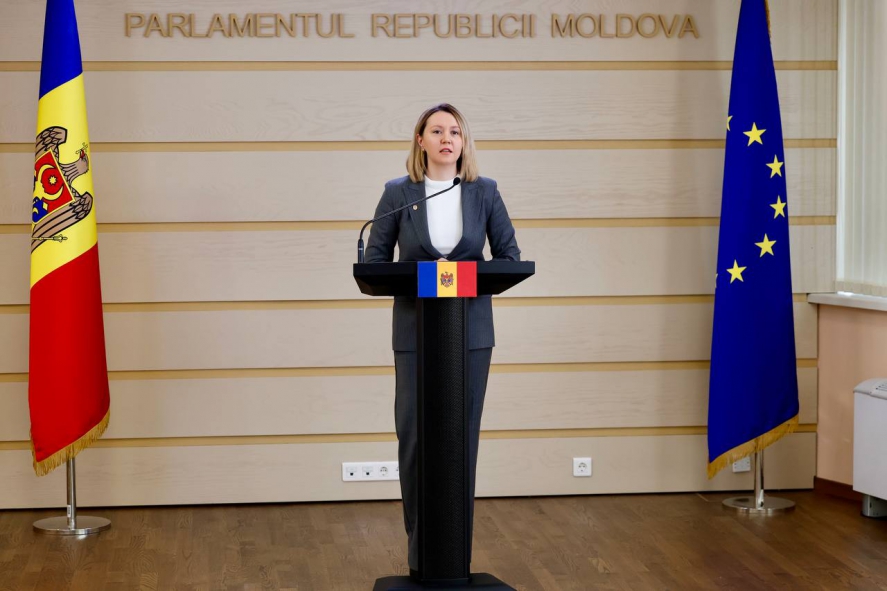
MP Olga Cebotari, Vice-Chair of the Parliamentary Committee on European Integration, analyzed the Republic of Moldova’s negotiating positions with the European Union during a briefing held today. According to her, the Government is undertaking major commitments, with deadlines and transition periods that will directly affect citizens and entrepreneurs, but these positions have not been discussed with Parliament.
The Republic of Moldova has opened four of the six negotiating clusters (24 of 33 chapters) and submitted four negotiating positions to the European Commission, against the backdrop of economic growth of just 0.6% and inflation of 10.77%.
“Negotiating does not mean accepting at any cost. The accelerated pace prioritizes quantity and undermines the quality of decisions,” Olga Cebotari stated.
The MP noted that, under **Cluster 1 – Fundamentals**, Moldova has not requested transition periods for key chapters. The closure of any other chapter depends on meeting six interim benchmarks related to the rule of law. Laws are adopted quickly on paper, but funding, infrastructure, and qualified personnel needed for their implementation are lacking, particularly at the local level.
Regarding **Cluster 2 – Internal Market**, Cebotari stated that the EU requires provisions allowing member states to temporarily restrict Moldovan workers’ access to their labor markets after accession. In the cases of Poland and Croatia, such restrictions lasted up to seven years.
“Our interest is to ensure access as quickly as possible and clear guarantees for citizens already working legally in the EU,” she emphasized.
Olga Cebotari added that the Government has, in turn, requested:
– 30 years of restrictions on the purchase of agricultural and forest land;
– Five years for state aid arrangements, including Moldova IT Park, SMEs, and industrial parks;
– Five years to increase the deposit guarantee threshold to €100,000;
– Five years for the reauthorization of medicines, to prevent products without alternatives from disappearing from the market.
“Transition periods are also being requested under **Cluster 3**: five years for VAT on agricultural inputs and excise duty on diesel fuel, and six years for Moldova IT Park.
**Cluster 6 – External Relations.** The EU requires Moldova to terminate its free trade agreements with third countries before accession, meaning withdrawal from the CIS free trade area and termination of the agreement with Turkey. The Government’s own negotiating position acknowledges that the CIS market remains strategic: apples accounted for 70.7% of exports in 2024, medicines for more than 50%, and wines for up to 29.3%.
Agri-food exports to Turkey exceeded USD 304 million in 2022. The Government is requesting compensatory assistance from the EU but acknowledges that producers will face ‘significant structural adjustments.’ At the same time, Moldova has committed to increasing its alignment with EU sanctions from 86.6% to 100%, including the toughest sanctions against Russia,” she added.
The politician pointed out that **point 23 of Annex No. 2 to Government Decision No. 180/2024** requires the Government to consult the Parliamentary Committee on European Integration before approving negotiating positions.
According to Cebotari, this provision was not respected, as none of the positions submitted to Brussels had been discussed with the committee. For this reason, she submitted a formal parliamentary inquiry to the Deputy Prime Minister for European Integration.
“Parliament must be involved while we can still influence deadlines and transition periods, not after the positions have already been sent to Brussels,” the MP stated.
Olga Cebotari proposes that draft negotiating positions with a major impact be submitted to the committee well in advance. The committee would then hold hearings with ministers and issue an opinion before the positions are finalized.
“National interests must come first and be respected,” concluded the Vice-Chair of the Parliamentary Committee on European Integration.




 Loading ...