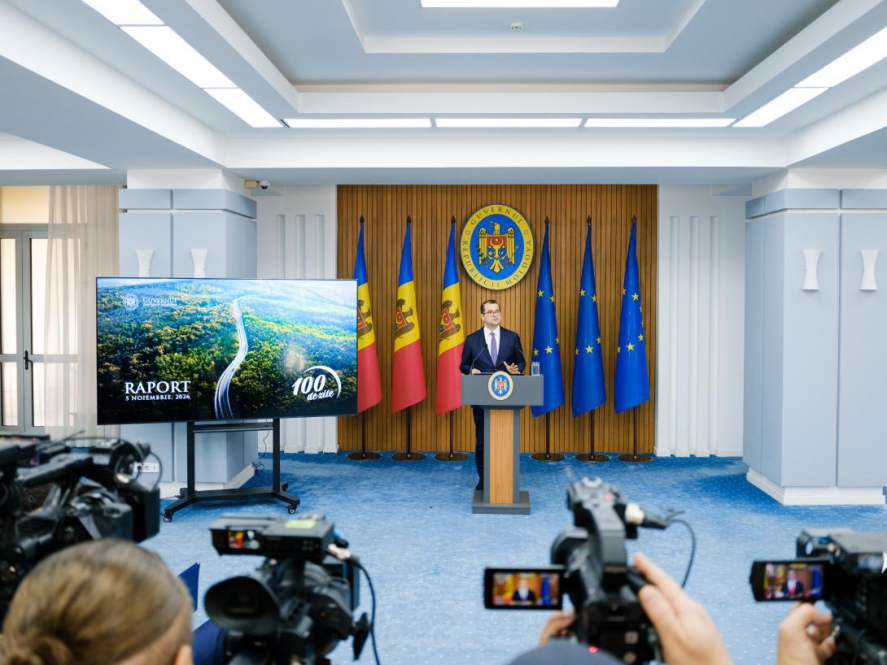
Prime Minister Vasile Tofan presented the results of the Government’s first 100 days in office today during a press conference. The head of the Executive highlighted the main measures aimed at developing the economy, attracting investment, modernizing infrastructure, improving the efficiency of public administration, and accelerating European integration, TRIBUNA reports.
“We have committed ourselves to necessary reforms, even if some of them are unpopular, whether we are talking about public administration, taxation, or the way public money is spent. We want to change how the state functions and turn decisions into tangible results for citizens. The assessment of our first 100 days is not about how many meetings we have held or how many decisions we have approved. It is, first and foremost, about direction, responsibility, changing the pace, and, above all, results,” Prime Minister Vasile Tofan stated.
In the economic sector, industrial output increased by almost 7%, exports of Moldovan products rose by nearly 13%, and the average salary grew by 9.5% in nominal terms. The Prime Minister acknowledged that these developments are not yet sufficiently reflected in citizens’ incomes and that the cost of living remains high.
To stimulate economic growth, the Government has launched a tax reform aimed at reducing taxes on labor and investment and has eliminated unnecessary permits, generating estimated savings of 37 million lei for businesses. During the first 100 days, more than 100 discussions were held with potential investors, while approximately 7,000 people found employment with the support of the National Employment Agency (ANOFM).
Improving government efficiency is another priority of the Executive. An assessment of central public administration and state-owned enterprises has been initiated to reduce bureaucratic costs and ensure the efficient use of public funds.
At the same time, the Government has advanced local public administration reform, including a proposal to reorganize the country’s 32 districts into three regions — North, Center, and South — to strengthen their development capacity and ability to attract European funds.
“We cannot ask the private sector to become more efficient if the state itself remains unchanged,” the Prime Minister emphasized.
In terms of infrastructure, 88 kilometers of national roads have been completed and officially accepted, while feasibility studies have been launched for 125 kilometers of the future Ungheni–Chișinău motorway.
Through the “European Village” and “Europe Is Close” programs, approximately 50 kilometers of local roads, 28 kilometers of sidewalks, and 285 kilometers of water supply networks have been rehabilitated. The budget for local infrastructure has also been increased by one billion lei.
In the energy sector, the planned natural gas volumes for the cold season have been fully secured. Meanwhile, electricity interconnection projects with Romania have progressed, including the Vulcănești–Chișinău power transmission line, which is in its final stage.
Investments in people have focused on expanding healthcare services, modernizing educational institutions, and strengthening social protection.
Contracts worth more than 340 million lei have been signed for the renovation and equipping of medical institutions. In education, an investment program worth 13.5 billion lei has been approved for the next five years.
The Prime Minister reiterated the Government’s commitment to continuing judicial reform, strengthening defense capabilities, and accelerating the European Union accession process.
Four of the six clusters of negotiation chapters have already been opened, and the Government maintains its objective of provisionally concluding EU accession negotiations by the beginning of 2028.
“The European Union is offering us a window of opportunity that Moldova has never had before: access to funding, access to the European market, and unprecedented political support. We have partners who want to see us succeed, but no one will carry out the reforms for us, and no one can build Moldova in our place.
European integration is not just the work of a team of negotiators in Brussels. It means better roads, stronger connections with Romania, access to water, healthcare services closer to home, and better conditions for business development,” Prime Minister Vasile Tofan stressed.
In conclusion, Vasile Tofan emphasized that the first 100 days mark the beginning of a transformation process that requires continuity, discipline, and decisive action.
“The direction is clear: a more competitive economy, a more efficient state, and a Moldova increasingly prepared for European integration.”

 Loading ...