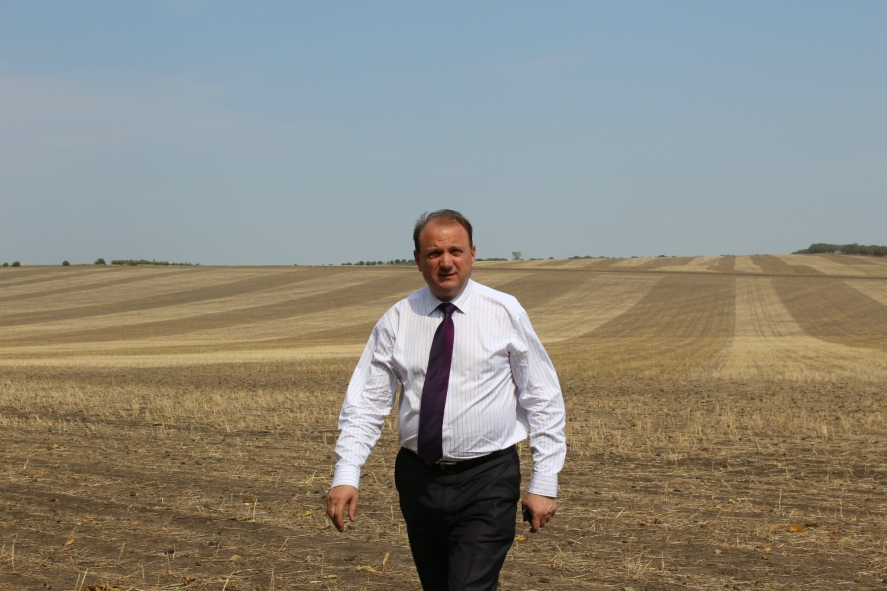
On the eve of Independence Day, TRIBUNA is publishing the series “35 Years of Independence.” Vasile Bumacov, President of the European Social Democratic Party, accepted our invitation and made the following statement:
The Republic of Moldova at 35
Thirty-five years is a moment in history, but an entire lifetime for a person. What do we have today? An internationally recognized state, sovereign only halfway, divided in two, both territorially and socially. Yet it is still a state that has withstood all challenges.
It is regrettable that the enthusiasm of ’91 has largely faded. Overwhelmed by realities, we no longer talk about the romanticism of independence as we once did. Now we talk about the fact that we have been left with half of what we once were, about high bills, miserable pensions, and children raised by relatives and grandparents because their parents have gone abroad.
Cold realism is taking shape and, let us call things by their name, so is disappointment. Thirty-five years have not been enough for everyone to come to terms with the new realities, and that is why we are doing worse and worse, year after year, government after government, continuing to believe in the same sterile promises.
It is easy to blame geopolitics, the energy crisis, armed and economic conflicts, and hybrid warfare. Of course, all these factors have an impact, but let us not fool ourselves: part of the failure is ours, belonging to each of us who voted out of narrow self-interest, or did not vote at all, or left and entrusted the country to those who remained.
I am optimistic, not because I have concrete reasons to be, but because resignation is the easiest path, while tacit acceptance is exactly what those currently in power want, because a resigned people no longer demands accountability from anyone.
The greatest achievements
Let us be honest: the struggle for independence was not about religion or ethnicity. It was about the Romanian language and the Latin alphabet. Today we must be proud that we won this battle, even if not to the extent it deserved.
In any case, today our children study in Romanian, more and more speakers of other languages are embracing Romanian, and those who kept frightening us with the “disaster” of independence have become quieter.
The second victory is that the world knows us. Moldova is no longer a blank spot on the map between Romania and Ukraine — it is a candidate country for membership in the European Union, with everything that entails: external pressure for reforms that no one here would have undertaken on their own initiative.
How many governments have reformed the justice system out of genuine conviction, without being pushed by a negotiating chapter or European conditionality? Almost none. This says something about us, but also about the real value of European standards.
We succeeded in signing the EU Association Agreement, in which I also participated by organizing the first Conference of Agriculture Ministers from the Eastern Partnership countries. Unfortunately, that was also the last one.
Thirdly, our products are slowly — far too slowly — beginning to enter Western markets: wine, fresh fruit, processed products, and even IT services, which have emerged from nowhere and grown into a genuinely competitive sector.
Everything is still far from the figures we would like to see, but it is a beginning. We simply must not fool ourselves into thinking that these achievements are enough — these are foundations, not finished houses, and a foundation left unfinished for too long begins to crack and eventually collapses.
The greatest challenges. What divides society
The problem of the Republic of Moldova has never been a lack of resources or capable people. On the contrary, we have always been proud of this wealth. It is unfortunate that most talented people have left and are achieving success elsewhere, under other flags and in other languages.
Today, the major problem is the incompetence of those placed in positions of responsibility by elected officials, as well as the incompetence of those who perpetuate themselves in power, because they generate exactly the kind of chaos that keeps them in power.
A poorly managed system does not correct itself; it creates its own beneficiaries, who then defend the status quo tooth and nail.
At the beginning of the country’s independence, traitors disguised as patriots were undermining us. Today they have been replaced by foolish people with initiative and their relatives, who have seized the state position by position, contract by contract, procurement by procurement.
They have allowed corruption to grow until it has become normality rather than an exception, the unwritten rule by which institutions and society operate. They have brought the economy to its knees and taught people to expect nothing good anymore, which is the most serious consequence of all, because this distrust is passed on to the next generations.
It has been proven that internships at Harvard are of no help if a person lacks the basic upbringing received at home and a solid education.
On top of all this, we have the war in Ukraine right on our border and Russia’s aggressive behavior, which never truly stopped, but merely changed its methods — embargoes, disinformation, energy pressure, and financing of loyal political forces.
We face crises caused by this war and by broader instability in the region, which has directly affected every family’s pocket.
Those who invested heavily in propaganda instead of the economy have created a colossal problem for us. They have turned most of the media into corrupt structures serving those in power, regardless of their political color. They have spent millions vetting the justice system until they made it subservient to the party.
Justice, which does not deliver justice but serves interests, case by case, selectively, depending on who is in power today or who is more generous.
These are the chains — without metaphor — that keep Moldova tied to the past, while other countries in the region are moving forward.
The future of the Republic of Moldova. What will it be like in 10 years?
I do not expect miracles. A society is like a train; you cannot easily stop it, and it is even harder to turn it around while it is moving, no matter how much you may want to.
This inertia will push people increasingly toward leaving, toward the West, toward anywhere that offers a better life than here. And part of the population, including some intellectuals — regrettably, I say this — will continue to support, as if hypnotized, a path that leads nowhere, simply because change is more frightening than slow poverty, which at least is familiar.
Poverty will become even more visible, even if official statistics say otherwise, with calculation methodologies changed whenever reality becomes inconvenient.
If those who have been deceived year after year with the story “tomorrow we will join the EU, just vote one more time the right way” do not wake up, we face an even more severe division of society — not only political and geopolitical, between East and West, but also social, between those who are better off and have access to public money, and those crushed by poverty, without any real guarantee of security.
But there is also the other scenario, the one I am betting on: a change of the so-called ruling clique in order to launch a genuine EU accession process and see it through to the end — a process that, through conditionality, forces us to implement precisely the reforms that no one undertakes willingly.
Not because someone in Brussels loves us more than we love ourselves, but because their strategic interest currently coincides with our real need for reform.
It is a narrow window. If we miss it now, I do not know when another one like it will open.
What I am proud of and what I would tell a foreigner about Moldova
After six years of disaster, we still have reasons to be proud.
We have a beautiful country, with landscapes you cannot find just anywhere, with real seasons, not merely periods on a calendar, and with soil so rich that few countries in the world still possess anything comparable.
We have strong traditions that have survived even through difficult times, poverty and mass emigration. And that is no small thing — it is proof of resilience that we rarely acknowledge in ourselves.
We have a Christian faith, even if it is still linked to a politically compromised structure, and this deserves to be said openly, not swept under the rug, because otherwise nothing will change.
We have some of the world’s finest wines, recognized where it matters, not just at home, produced by families who invested from nothing, with hard-to-obtain loans and a great deal of work.
And above all, we have hardworking, educated and talented people, as well as a young generation full of ideas that has taken its destiny into its own hands — this is the country’s true resource.
I would tell any foreigner: come and discover the Republic of Moldova before drawing conclusions based solely on statistics or news about political and economic crises.
Personally, I am proud of the reforms I carried out during my years as Minister of Agriculture, including the Wine Sector Reform, the Food Safety Reform and the Agricultural Payments Reform.
I am also proud of the technologies, machinery and projects that I developed and implemented in the country’s agriculture, as well as of the achievements of the thousands of engineers who were my students and who today contribute to the development of the economy of the Republic of Moldova.
Message to the citizens of the Republic of Moldova
Dear citizens of the Republic of Moldova, love your country through actions, not words, slogans and August 27 posts.
You have no other country, and no one will build this one for you.
Learn to distinguish traitors and liars, who are always the loudest patriots during election campaigns, from those who genuinely want what is best for this country, even if they say things that not everyone likes.
Unite, because division kills a people more surely than any economic crisis.
Prosperity comes from work, functioning institutions and citizen oversight, not from recycled electoral promises.
Demand accountability, not only at the ballot box once every four years, but every day — through a free press that you support and hold accountable when necessary; through a justice system that you demand to be clean; through a civil society funded transparently, rather than for party interests.
Be European not only by nature or by passport, but through culture, analytical thinking, innovation and work.
Do not fall prey to demagoguery, whether it comes from your own side or from those who govern us.
In another 35 years, someone will write a text like this about us. It depends on each of us whether they will have something to write about.
And as for me, as long as the Almighty grants me health and strength, I will continue contributing to the prosperity of my homeland, and as a political leader I will make every effort to implement an authentic social-democratic doctrine in our country, for the good of all.

 Loading ...