
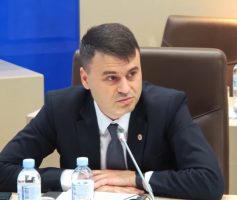
Alexandru Bujorean, co-chairman of the League of Cities and Communes (LOC), said in the context of the recent scandals and resignations that PAS is currently trying to portray what is happening as a few isolated mistakes by certain individuals. He said that a full audit of appointments to state-owned enterprises is necessary for all the years this party has been in government, TRIBUNA reports.
“Those who were nobody will become everything! Once upon a time, these words sounded like a promise of social justice: the state should give every decent and capable person a chance — regardless of their name, family connections, or party membership card. But under the current government, they have acquired a completely different and bitter meaning: someone who was close to PAS yesterday can become the director of a state-owned enterprise, an adviser, a spokesperson, or the beneficiary of a salary that the majority of citizens would not even dare to dream of today.
The scandal surrounding MoldATSA has torn away the beautiful packaging and exposed what those in power tried for a long time not to see. This is not simply a matter of an unsuccessful recommendation, but rather a question of the principles by which the state is administered. When a government comes to power promising to destroy cronyism but then starts promoting its own ‘vetted people,’ acquaintances, and politically connected individuals, it does not change the system. It merely changes the people who benefit from its privileges,” he said.
The politician noted that the National Anticorruption Center carried out searches at MoldATSA as part of a case involving abuse of power or abuse of office. The investigation is ongoing, so the final conclusions must be left to the courts. But the political conclusion is already clear. The internal control system did not work. The Public Property Agency did not work. The oversight mechanisms did not work. Nor did the party’s filter for selecting ‘good and honest people’ work. And only after public outrage did the wave of resignations begin. The head of the Public Property Agency, Roman Cojuhari, left his position, acknowledging insufficient oversight. Radu Marian stepped down as head of the parliamentary committee. PAS expelled several party members and called for the dismissal of Metalferos director Petru Bondari. And Igor Grosu apologized to citizens for the ‘institutional and human mistakes.’
“Admitting mistakes is better than completely denying them. But a question arises: Why did the government see the problem only when it could no longer be hidden? Why, before the scandal, were these people considered professionals, worthy of high-level positions and enormous remuneration, only to suddenly become a threat to the party’s reputation after information appeared in the press?
Today, PAS is trying to portray what is happening as a few random mistakes by certain individuals.
One person recommends someone, another is hired without a competition. A third is given an enormous salary. A fourth is supposed to oversee everything but notices nothing. A fifth takes political responsibility but remains a member of parliament. And then the party urgently launches a ‘cleanup’ and declares that its principles remain unchanged.
No, gentlemen. Principles are not tested after a scandal erupts. They are tested before an appointment is made, before a contract is signed, and before hundreds of thousands of lei are paid. Favoritism does not mean only directly appointing a relative. Favoritism means any system in which proximity to power, personal recommendations, or party loyalty can replace open competition, verification of qualifications, and equal opportunity. A full audit of appointments to state-owned enterprises is necessary for all the years this party has been in government.
The conditions of the competitions, recommendations, salaries, bonuses, performance indicators, and any potential conflicts of interest must be made public. We must identify not only those who benefited from privileges, but also those who granted them.
Because political responsibility does not end with returning bonuses and submitting a resignation,” the LOC leader added.
The mayor of Leova recalled that PAS came to power under slogans of justice, integrity, and meritocracy.
“But today, the expression ‘Those who were nobody will become everything’ no longer sounds like hope for the ordinary person. It sounds like the anthem of a closed circle of privileged people, in which proximity to the party sometimes proves more important than professional merit. And a state divided between ‘our people’ does not become European. It merely changes its old masters, who are more or less ‘pro-European’ than the current ones,” Alexandru Bujorean concluded.




 Loading ...