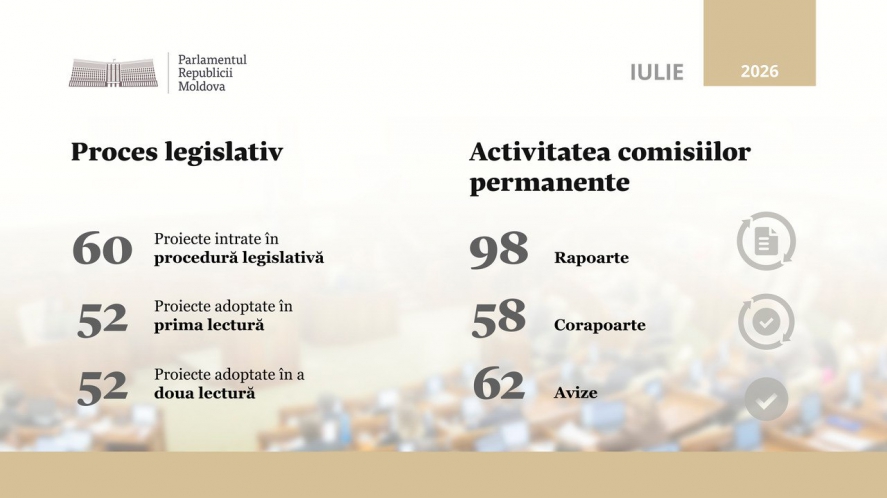
In July, Parliament held seven plenary sessions, during which 52 acts were adopted. In addition, 60 draft normative acts entered the legislative process, TRIBUNA reports.
Of the total number of adopted acts, 40 were laws and 12 were decisions. Among them, 16 acts concerned the harmonization of national legislation with that of the European Union, while 20 acts were included in the National Programme for the Accession of the Republic of Moldova to the European Union for 2025–2029.
A landmark moment in Parliament’s activity last month was the appointment of the new Government led by Prime Minister Vasile Tofan. At the same time, lawmakers adopted legislative initiatives aimed at increasing penalties for human trafficking, aligning labour legislation with EU standards, introducing tougher sanctions for the online promotion of drugs, their distribution, and involving minors in drug consumption, as well as establishing priority authorization procedures for strategically important energy projects.
Parliament also approved draft laws providing for the inclusion of periods covered by maternity and paternity benefits in the contributory period, as well as the establishment of a parliamentary inquiry commission to examine the activity of state-owned enterprises.
In the first reading, lawmakers examined and approved draft laws concerning:
- the possibility for citizens to initiate decisions of public interest through the civic initiative mechanism;
- the creation of Territorial Education Agencies, intended to replace district and municipal education management structures;
- amendments to the Electoral Code introducing new regulations on postal voting and the organization of elections in the Autonomous Territorial Unit of Gagauzia;
- recognition in the Republic of Moldova of medical and pharmaceutical qualifications obtained in the EU;
- the possibility for self-employed workers to receive maternity benefits and other social benefits;
- the calculation of maternity benefits for unmarried women based on the insured income of the child’s father.
During the reporting period, parliamentary standing committees held 62 meetings, during which they approved 98 reports, 58 co-reports, and 62 opinions.
The largest number of reports was approved by:
- the Committee on Economy, Budget and Finance — 28 reports;
- the Legal Committee for Appointments and Immunities — 24 reports;
- the Committee on Social Protection, Health and Family and the Committee on Foreign Policy — 10 reports each.
The highest number of opinions were approved by:
- the Committee on Public Administration and Regional Development — 13 opinions;
- the Committee on Human Rights and Interethnic Relations — 12 opinions.
At the same time, throughout July, the Permanent Bureau held seven meetings, while 11 public consultations on various legislative initiatives and public hearings on issues of public interest were held on the parliamentary platform.
 Loading ...