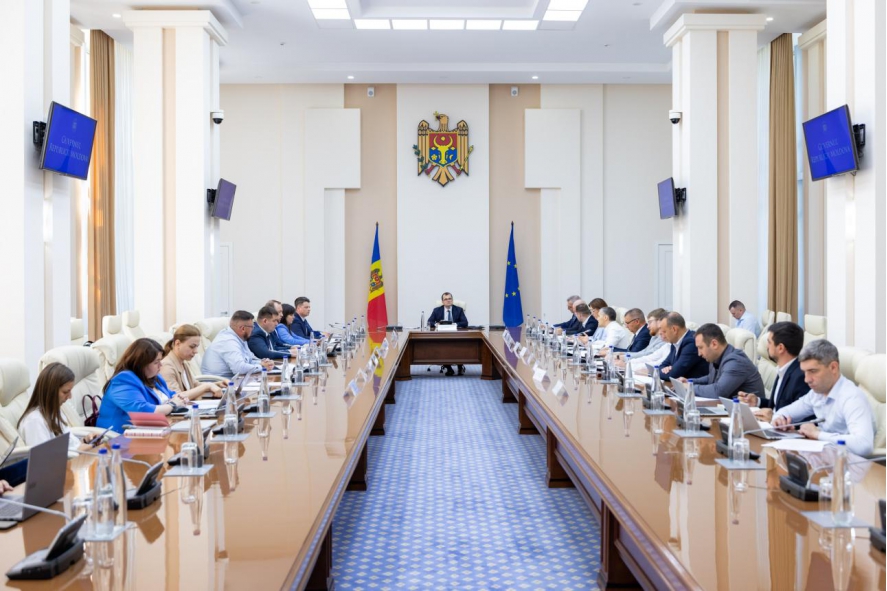
The National Crisis Management Commission (NCMC) met today to coordinate the authorities’ response to risks in the energy and water sectors following the introduction of a 30-day state of alert.
“We came to the Government to build and carry out reforms. But a responsible government must also respond to crises. We need to act before problems escalate and before they affect people,” Prime Minister Vasile Tofan said at a press conference following the NCMC meeting.
Addressing the situation on the fuel market, the Prime Minister said it is being affected by rising international prices, disruptions to crude oil deliveries through the Novorossiysk terminal, the conflict in the Middle East, transportation difficulties on the Danube, and measures adopted by some countries in the region regarding re-exports. Under these circumstances, the Government’s objective is to ensure uninterrupted diesel supplies without exposing citizens and farmers to unjustified price increases.
“We need to find a balance. We do not want artificially low prices and empty fuel stations, but we will not accept uncontrolled prices and profits made at the expense of a crisis,” the Prime Minister stressed.
In this context, the National Crisis Management Commission decided to temporarily adjust, for 30 days, the calculation formula used to determine the maximum diesel price. During the same period, the commercial margin will be increased by the equivalent of $25 per tonne, or approximately 37 bani per litre. The Prime Minister noted that importers had requested a larger increase, but the Government would not allow unjustified price hikes.
At the same time, measures were approved to facilitate imports, prioritize customs clearance for petroleum products, create dedicated border lanes for fuel tankers, and provide priority access to rail transportation. Exports and re-exports will be limited to ensure that the volumes needed for the domestic market remain in Moldova.
The temporary sale of diesel fuel in containers larger than 40 litres will also be restricted, with exceptions for farmers. Public institutions will reduce diesel consumption by 20% without affecting the operation of essential services.
Regarding the hydrological situation, Prime Minister Tofan warned about critically low water levels in the Dniester River and reservoirs, stressing that ensuring access to drinking water is the authorities’ priority.
“The priority is drinking water for people. We need to know in advance what alternatives we have and how quickly they can be activated so that any risk can be managed without interruptions to essential services,” Prime Minister Vasile Tofan said.
Authorities will continuously monitor water levels and quality, assess alternative supply sources, and update continuity plans for water operators to ensure that any disruptions can be managed promptly.
In conclusion, the Prime Minister said that authorities will monitor daily diesel fuel reserves, imports, the situation at filling stations, the Dniester River flow, and water supply conditions.
“We will act before problems turn into larger crises. That is what a responsible government means. Our goal is to protect people, ensure continuity of services, and maintain the normal functioning of the country,” Prime Minister Tofan stated.







 Loading ...