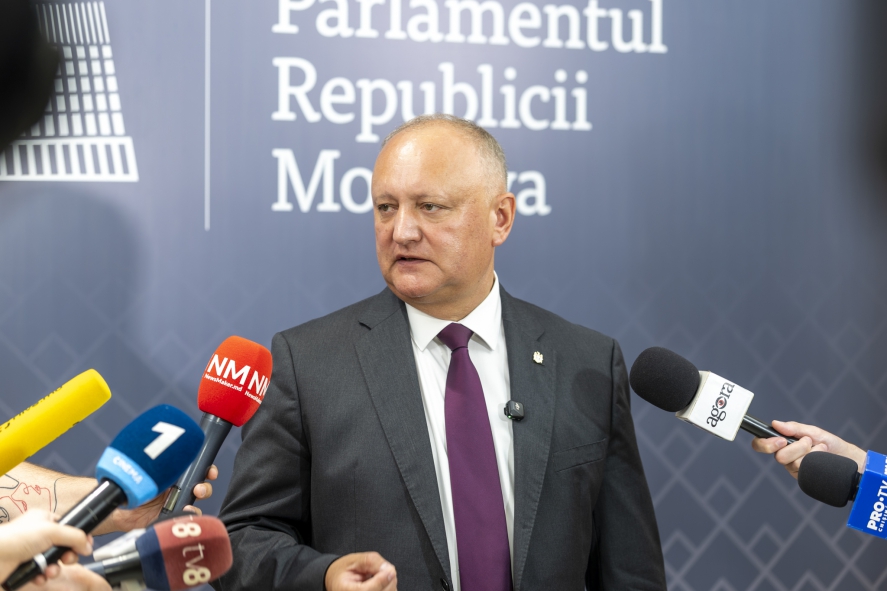
Igor Dodon, leader of the Party of Socialists of the Republic of Moldova, spoke in an interview with TRIBUNA about the current political situation following the resignation of the Government of Moldova.
– The resignation of the Prime Minister is being described as the main political event of recent days. Is this a routine government reshuffle or a sign of a deeper crisis of power?
– Today, Moldova is going through one of the most difficult periods of the past decades. And this is no longer only about economic problems, but also about a profound political crisis.
The main reason is the gradual dismantling of democratic institutions. Over the past years, dozens of media outlets have been shut down, while criminal prosecution is increasingly being used as a tool of pressure against the opposition. Any form of dissent is becoming unacceptable. As a result, the entire system of governance has become concentrated around a single decision-making center – President Maia Sandu. Yet she is not listening to the opposition, society, or, judging by recent developments, even part of her own team.
This is why we are witnessing the first signs that the current model of governance is beginning to malfunction seriously. The Prime Minister’s resignation is not an accident, but a natural consequence of internal contradictions within the ruling system. I would not rule out the possibility that this is far from the last resignation of this kind.
At the same time, the socio-economic situation continues to deteriorate. Prices and tariffs are rising, living standards are declining, public debt is reaching record levels, and the economy is becoming increasingly dependent on external loans instead of developing domestic production, exports, and investments.
– If the problem is indeed systemic, can a new Prime Minister change the situation?
– No. Replacing one name with another will not solve systemic problems.
Today, state institutions operate on the basis of political loyalty rather than professionalism. The country lacks a long-term development strategy, the budget remains dependent on new external borrowing, serious risks persist in the energy sector, and many decisions regarding tax policy and local governance are causing growing concern among businesses and citizens.
If this course continues, by the end of autumn we may face another political crisis, followed by a very difficult winter for the country.
– Nevertheless, the authorities claim that European integration is the main achievement of recent years. Why do you believe this course is not delivering the expected results?
– European integration has never been and should never become an end in itself. It only makes sense if it contributes to improving citizens’ well-being, developing the economy, creating jobs, and strengthening the state. If, however, a country is pushed toward decisions that lead to economic decline, growing social tensions, and limitations on national sovereignty, a legitimate question arises: whose interests does such a policy actually serve?
Today, the European Union itself is going through one of the most difficult stages of its development. Economic, energy, and migration crises, as well as the course pursued by Brussels bureaucracy toward militarization and transforming the EU into a military bloc, create serious risks for the future of the Union itself. Under these circumstances, Moldova should be guided прежде всего by its own national interests rather than blindly copying decisions made in Brussels.
Unfortunately, under the slogans of European integration, we are being offered a very different agenda. Instead of improving living standards, we see their decline. Instead of economic development, we see growing external debt and dependence on loans. Instead of consolidating society, people have been artificially divided into “pro-European” and “pro-Russian” camps, turning political competition into confrontation between fellow citizens.
Many European politicians acknowledge that the prospect of the Republic of Moldova becoming a full member of the European Union in the foreseeable future remains highly complicated. Therefore, it is unacceptable to build state policy on illusions and inflated expectations.
What concerns our citizens is not geopolitical rhetoric but concrete results: decent salaries and pensions, affordable utility tariffs, new jobs, economic growth, security, and confidence in the future. Any foreign policy strategy should be assessed according to these criteria.
– What solution do you propose?
– Moldova needs a political reset. We are convinced that the only way forward is through early parliamentary elections that would allow the formation of a new government enjoying the trust of society.
But most importantly, the country needs political forces capable of reaching agreements in the national interest. We must stop looking to external centers of power. The time has come to place the interests of the Republic of Moldova and its citizens at the forefront.
– How do you envision the political system after the crisis is overcome?
– The most logical solution would be to hold presidential, parliamentary, and local elections simultaneously in 2027. This would make it possible to conclude the prolonged political cycle and establish a new system of governance.
However, something else is even more important. After early parliamentary elections, politicians must understand that the country is tired of constant confrontation.
We need a strategy called “National Interest,” one that will unite political forces around economic development, strengthening the state, and improving citizens’ living standards.
– In your opinion, what principle should form the basis of the new state policy?
– The consolidation of political leaders around the idea of the National Interest.
A small country does not mean a weak country. We will be as strong as our ability to preserve internal unity, restore trust between people, and pursue a pragmatic foreign policy based exclusively on national interests.
If we learn to reach agreements, respect one another, and build pragmatic domestic and foreign policies based on national interests, Moldova will have a future. I am convinced that this is the only way to ensure political stability, economic development, and a decent life for our citizens. If needed, I can also adapt this into a news article format with headline, lead, and key quotes.
 Loading ...